[identity profile] offthelisthero.livejournal.com
"Good morning," Mohinder said, from the front of classroom. It was set up with the usual array of desks and chairs.

"Today's your last class. So, this is where I test that you've absorbed something from this time together. You should answer all the questions, and - if you have time, you may leave early. It's been an interesting experience teaching you," he finished.

"You can start now."

[OCD is up!]
[identity profile] offthelisthero.livejournal.com
"Adaptation," Mohinder began. "Starting from an enviroment similar to this the human body has certain expectations of the outside world - heat, light, pressure, gravity enough not crack your bones, air whose content won't scorch the lungs or leave it asphyxiating before it dehydrates."

"But that's only on this world - and others like it," he said passing out sets of notes. "And from such a relatively limited sample it would seem presumptous to think the same would happen elsewhere"

Mohinder turned to sketch out an equation on the board at the front of class, talking fractions of stars with planets, the likelihood of life developing, of intelligence etc, before throwing down the chalk. "Ultimately, this is all just guesswork and - out of Fandom's influence - we can't reason out if intelligent alien life exists without some kind of evidence."

"And if it did would we recognise it?" Mohinder settled back behind his desk. "How would life evolve on a very different planet? Or if you know it has - then how did it?"

[OCD has been discovered]
[identity profile] offthelisthero.livejournal.com
Handouts were already laid out on desks at the beginning of class.

"End to end, the human digestive system is several metres long," said Mohinder, carefully avoiding thinking about what he'd say next. "Where it can take anything up to 72 hours to process completely. From here," he touched the base of his jaw, "to here," and then midway down his torso, "in approximately seven seconds."

"Most of the digestion time takes place in the stomach; an expandable, warm, squashy enviroment full of bacteria and strong acids, before passing through the intestines to wring out as much of what is useful as possible," he said, summarising the last stages. "You are, in a very real sense, what you eat."

"You all have your collections of spare parts," he said, gesturing to the boxes by the desks. "You should have no problems being able to identify and put together your own systems."

[OCD is up. Have at!]
[identity profile] offthelisthero.livejournal.com
"Much of what makes you who you are, what makes you human," started Mohinder, pausing to pick out something from the box of fruits on his desk. "And this banana a banana is hard coded in your DNA."

"It's not always as simple as picking out a single gene. That that one gave me brown eyes, one made her left handed and another gave him an allergic reaction to pineapple. For eye colour, brown is generally dominant over blue; black, red and violet are rare but possible variations, with at least six genes known to affect the shade you see in the mirror."

"Deoxyribonucleic acid is made of sequences matched pairs of nucleotides," he said, handing out notes. "It uncoils from it's helix into RNA, coding amino acids which form proteins which make up each of your cells. If there's a mutation, something going wrong can result in serious, even lethal medical problems."

Mohinder started setting up what looked mostly like an over-complicated blender. "DNA extraction is fairly simple," he said, picking up a swab. "Whether from yourselves or from fruit or vegetable. You all have instructions, so you can try your own extraction process."

[OCD has landed!]
[identity profile] offthelisthero.livejournal.com
"One of the traits used to describe something - or one - as living is the ability to reproduce, to pass on its traits to the next generation. Of course, it's not quite so simple," continued Mohinder, passing out notes, and listing the conventional definitions. "And members of a species missing traits - reproduction or reaction - are still considered alive."

"Now in larger, multicellular beings - including humans unless or until cloning takes some leaps forward - reproduction is usually conducted sexually." More handouts followed.

"As for asexual reproduction - cell fission becomes inpracticable for anything larger than a bacteria. Budding off of the parent is most often limited to plants, as is reproduction by spores. Parthogenesis is perhaps the most common, with bees, scorpions and even the rare shark forming without the intervention of a male parent. But any of these limits the capacity of the species to change, to adapt to a new world. It can lead to a precarious existance, lost when its world changes."

[OCD is up!]
[identity profile] offthelisthero.livejournal.com
"We think therefore we are," Mohinder greeted the class. "Or I hope we do, at least here. The concept is an old one, that we cannot be deceived as to the fact of our existance."

"But," he continued, jumpimng down from his seat on the desk. "Who is doing that thinking? What directed the fire of neurons that expressed itself in your choice of breakfast this morning? Random chance, the paths of habit or the existance of mind?" He starteed handing out paperwork.

Picking up a model twin or quintuplet to those resting on the desks, Mohinder split it open and began to pointing out the regions when cognitive functions were thought to be based.

"Now, I'm not going to test your brain function with an IQ test. They're notoriously culturally biased when confined to a more standard population," Mohinder finished. "Instead, we're going in a more psychological direction, and trying to type your personalities."

[OCD is up!]
[identity profile] offthelisthero.livejournal.com
Mohinder was a little more than usually disheveled when he made it to the school. He'd dropped the box he was carrying at his feet, and had made a decent attempt at soundproofing the Danger Shop by the time class had assembled.

"The human body is not invulnerable," Mohinder started, passing round the handouts. "We break, we bleed, we fall apart and - if the damage isn't too much - we heal. Sometimes with mechanical assistance, broken bones pinned apart. Or simply through the unaided process of inflammation, cell proliferation and remodelling," he went on.

"Regeneration is largely limited in humans; the liver, some limited kidney function, and some occasional cases of fingertip regrowth. Some amphibians have the ability to regrow entire limbs." Mohinder paused. "But, save for that happening, you need to take care of the limbs you have left." He ducked down briefly, retrieve a length of bandage from the cardboard box. "You should find everything you need here. So - pick a partner, and practice."

[OCD is up!]
[identity profile] offthelisthero.livejournal.com
"By now," Mohinder started from his perch on the desk at the front of the classroom, "You should all have some idea of how complex a machine is the human body. As long as it's still healthy and functional that's fine. But it does mean there are almost countless ways for it to break down."

"Whatever resources are put into a healthcare system," he continued. "It cannot provide the best treatment to all of its patients. Newer drugs and treatments are more effective, but more expensive so fewer can be prescribed. The lucky few may live longer and happier at the expense of their less fortunate neighbours."

"So, if you have the extra money in your budget you could spend it on a drug that lowers someone's risk of a heart attack, or on surgical equipment that reduces the chances of death during brain surgery. More people will benefit from the drug, but the surgery will give those who undergo it more years." He started passing round handouts. "I want you all to talk these cases through, and try to come to decision."

OCD is up and at 'em
[identity profile] offthelisthero.livejournal.com
"All right," began Mohinder. "Starting with a internally functional human body only takes us so far. Survival and much else depends on responding to what we perceive. For that the human body is reliant on a combination of, let's say, seven senses in order to respond to external stimuli."

"Sight, hearing, taste, smell, touch, balance and proprioception," Mohinder said, passing out papers. "Of course, these aren't complete - in humans it leaves the perception of heat and pain and outside the species the ability to detect electric or magnetic fields or the echolocation of a bat."

"Sight," he said, opening up a model and naming the parts. "Is the interpreted perception of a reversed image collected by rods and cones here. Not all eyes are the equal. Long and short-sightedness are fairly common defects, colourblindness less so and colour based synesthesia, or perception of sounds or letters as inherently chromatic, are very rare."

"Now, if you'll cover each eye in turn, there are a few sight tests to try out," finished Mohinder pointing out the charts.

[OCD up, have at!]
[identity profile] offthelisthero.livejournal.com
"Muscle memory," said Mohinder, from the front of a Danger Shop created classroom emptier than usual of desk and chairs. He threw the tennis ball toward one wall, and - eyes still on the class - flicked the rebound through an open window. "Or where what practice doesn't make perfect, it does make automatic."

And the rest of class is behind the cut, the tennis ball - who knows? )

[Wait for it...OCD is a go!]
[identity profile] offthelisthero.livejournal.com
"Nitrogen, oxygen, argon, water vapour- and a handful of more exotic gases- are inhaled in every taken breath." Mohinder tapped the model in front of him. "But what lungs - ours and air-breathing animals from birds to snails - are really interested in that mix is oxygen, and transporting that into the blood stream."

Mohinder pointed out the squishy alveoli, talking through the gas exchange process. "If it were ever possible to completely unfold the lungs there would be about enough to cover a tennis court. They're almost living, breathing fractals."

Standing abruptly, Mohinder started giving out papers, saying, "And then sometimes they fail. Cancers, asthma, punctured by a sharp object or the surrounding ribs."

"There is the necessary equipment for basic lung function tests," he finished. "So, if you can all take a deep breath, you can start."

[OCD is a go!]
[identity profile] offthelisthero.livejournal.com
"Blood," said Mohinder in greeting to the assembled class.

"Approximately 10 pints or 7% of any one person and the workhorses of a complex system of circulation. Not just red, but a suspension of cell types in a plasma of mostly water with a scattering or proteins, hormones and ions as well as the three main types of blood cells," he said, handing out papers.

"Have any of you received a blood transfusion?" Mohinder asked the room, pausing briefly before continuing. "If you were as part of an operation your blood was probably typed earlier, while in emergencies people will be given the universal donor type. Blood has antigens which can attack each other - A, B, both or neither, O," and went on to describe them.

"As a result of this, and the possibility of blood borne disease transmission, blood is teated heavily, and only a restricted part of a population can donate," Mohinder said. "Try this questionnaire to see if you could donate blood. Would you? Is there a responsibility to donate if the person's blood type is rare? What about accepting payment?"

[OCD is up!]
[identity profile] offthelisthero.livejournal.com
Hands firmly jammed in his jacket pockets, Mohinder was standing by the windows - light had won out over the cold.

"Unprotected in freezing conditions the human body has only a limited period of time before it loses its capacity to regulate it's own temperature. Normally we function at a little above or below 37 degrees, with definite medical issues creeping in three or four degrees either way," said Mohinder, handing out thermometers. He held one under his tongue, waited until it beeped and held it up. "37.2 - Try it."

"This is your hypothalamus, regulator of several metabolic processes - hunger, thirst, emotional behaviour - " continued Mohinder pointing up at the diagram behind him. "As well as keeping you at a steady temperature in concert with sweating, shivering and dilation or contraction of the blood vessels," he went on.

"Cryobiology as a science is constantly improving, not only with focussed freezing as surgery. But also with the aim of freezing tissues so quickly that undamaged thawing can take place. Currently this is only the case for reproductive materials, cornea and skin cells." Mohinder picked up a thin slice of pineapple, flipped open the container in front of him and held it over the dry ice.

He held up the frozen fruit slice. "As you'll see in your samples."

[OCD is up. Have at]
[identity profile] offthelisthero.livejournal.com
Mohinder was pressing at buttons on the chair arm as class assembled in the Danger Shop. The lights were brighter and the walls more sterile than usual before he shrugged and hopped down from the tilted chair to the array of desks and chairs.

"Teeth," he said, passing out handouts, models and soft drinks. "Enamel over dentine over a pulp containing what anyone who's ever broken one can tell you are some very delicate nerve endings. You all should be onto your second," he held up the models, pointing out incisors, canines and molars, "and, in all probability, final sets of teeth, as human have not the unlimited supplies of a shark or - yet - the ability regrow broken ones."

"Bacteria and acidity can weaken or destroy the internal structure of a tooth, which is why fluoridation of water supplies has been adopted in a number of countries," Mohinder went on to elaborate. "But not without some contraversy over the benefits and risks or the precedent in mandating a medical treatment. Discuss whether you'd support such a measure."

[OCD is up!]
[identity profile] offthelisthero.livejournal.com
"All right," said Mohinder, snapping a book closed as he turned to greet the class. "I'm Dr Mohinder Suresh, most recently of a reletively current New York. In class we'll largely be sticking to Earth based lifeforms, and more often than not humans."

"Now, if this is your first class here, this will be new to you. In any case I'd like you to introduce yourself; name, origin, why you're taking this class and what you think is the most important drug - legal drug - so far developed." Mohinder paused. "Oh, and if you're likely to faint at the sight of blood."

After the introductions, Mohinder continued, passing out handouts. "Let's talk reflexes and reaction times. Typically someone can respond to outside stimulus no sooner than 150 milliseconds. It's how false starts are recorded in athletics, and like anything else can be affected by lack of sleep, alcohol or other distractions."

"On this board," he said gesturing at the gridded board hung on a wall at one side of the classroom, "a light will flash in a random pattern, designed to test your complex reaction times with a number of hits." Mohinder dropped the padded hammer by the board and sat back at his desk.

[OCD is waiting... three, two... a go!]
[identity profile] blonde-doctor.livejournal.com
The chairs in the room have been spaced far apart to discourage talking, and Elliot hands an exam to each student as they walk in.

"Welcome to your final exam in human anatomy," she begins, when they seem to be assembled. "I hope it will be as fun as a test can possibly be -- which is actually pretty fun. Anyhow, there are three parts. First page is cake, just label the body parts the arrows are pointing to. Second page is 20 multiple-choice questions. Third page is an essay question, and you get two choices there: Either 'Explain how the respiratory and circulatory systems react to physical exertion' or 'Name the five grossest things you learned in this class.' "

"This is my last class at Fandom. A few days after graduation, I am heading back to my old hospital, where I get to be co-chief resident. You all have been a fantastic class, and I hope you learned something. Anyhow, if you want to talk to me, I'll be around after class, or I'll have my final office hours tomorrow. Your grades will be posted before I leave, and if you're going to try bribing me, I like chocolate and pictures of men in uniform."
[identity profile] blonde-doctor.livejournal.com
"Hey," Elliot greeted her students from a casual perch atop her desk. "Easy class today because the final is next week." She pointed to a set of posters hung around the room. "You can use those or your textbooks for review, or I'm here for questions. If it's easier for you to work in groups, that works for me."

"Seriously, if there's anything you didn't quite catch during the semester, speak up now or consider your peace held."

She remained in her seat as the students began their study session.
[identity profile] blonde-doctor.livejournal.com
Elliot had handwavily told the students to come to the Danger Shop today. When they got there, they would find three very ... realistic ... human corpses covered with sheets and laid out on autopsy tables, surrounded by the scalpels and saws needed in a dissection.

"So today is the day you get to work in groups and cut up fake people," Elliot said, after the class was assembled. "You'll be using standard autopsy procedure -- and there's a handout describing it, and I can explain more if you need -- to find and evaluate the organs. If you want to try to do a real autopsy and guess at cause of death, that's good for extra credit. Oh, and if the idea of this makes you barf, let me know and we will come up with something else for you to do."

She went on to give a brief talk on the art and science of human dissection and autopsy before pointing the students to the tables.

"Remember, next week is our review session, and the week after that is the final."
[identity profile] blonde-doctor.livejournal.com
Elliot flipped her blond hair behind her shoulders as she waited for the assembled class, looking very, very determined.

"So today is the day we learn about the reproductive system," she said. "And despite what some of you may have heard or may remember from last term, I am NOT going to blush. Or cry. We're adults, or almost, and we can discuss all of this in an adult way." Yeah, she didn't even sound like she believed herself.

She gestured to two large posters of outlined bodies with brightly colored innards - "These are the human male and female ... private areas. This is the," -- she was pretty much talking to her shoes -- "vulva, labia, vajango -- vagina -- cervix, uterus and fallopian tubes on the female diagram." She pressed on, looking as if she wished for the sky to open. "And on the male we have the schw- penisscrotumandtestes."

Swallowing as if she thought the worst was over, she passed out a handout and stammered through a passable lecture on both reproductive systems, though she tried not to repeat the anatomical words because, frankly, getting through them ONCE was pressing her luck.

"And that's it from me. Any questions?" She looked as if she hoped the answer would be no. "Or you could go back to the computers and play a very fun [OOC: But noisy and probably NSFW] game designed to expand your knowledge about a sexual health issue. Up to you."
[identity profile] blonde-doctor.livejournal.com
Elliot looked significantly more chipper as she waited for class to begin today. "Hey, people. Sorry about last week -- it's just really distressing to lose your work like that. But this week, I did not lose my work. We are learning about the circulatory system, which is the system that moves blood and other fluid throughout your body, bringing oxygen in and carbon dioxide out." She continued her lecture, explaining the roles of the heart, veins, arteries and capillaries.

"There are three major parts of the circulatory system: pulmonary circulation, which moves blood from the heart to the lungs; coronary circulation; which keeps the heart healthy and functioning; and systemic circulation, which makes everything else work." She had a set of slides explaining each element in minute detail. "Your activity for today is to get into groups of three, and I want each of you to argue why one of those parts is the most important one in the body. Think of it as a brainstorming exercise, don't stress about right or wrong answers, and no threatening to cut each other to make a point. When you finish, you can do a mock heart transplant on one of the dummies in the back of the room."

"Let me know if you have questions."
[identity profile] blonde-doctor.livejournal.com
Elliot's eyes were red and her mood somber as she came into the classroom just at the bell. "Hi guys," she said. "We were supposed to learn about the endocrinology system today. Which is the most awesome system in the body - it controls all of your hormones, pituitary gland, adrenal gland, thyroid." She paused so the class would see how serious this was, wiping her nose on her sleeve. "But thanks to the flood last week, the text I was using to write your class is wrecked, and my very special handmade endocrinology board game is ruined -- half of it blew out to sea and the other half is covered in mildew."

She looked mournful. "There was vocabulary .. and hand-colored flashcards ... and of course I was an idiot and didn't realize what had happened until last night,when it was too late to even try to make the game again."

"So. No Endocrinology board game. Read the chapter in your books for homework, and for today -" her voice broke again "- today, just write a hundred words on your favorite organ or system of the body. We'll be back to regular classes next week."
[identity profile] blonde-doctor.livejournal.com
Elliot came into class scowling and with very drenched hair. She was carrying a muddy plastic bag with something moving inside of it, and if some of her students looked a little different, it took her most of her lecture to notice it. "So today, we are going to talk about -- first off, why will it not stop raining? And why is it that I can't manage to get a simple order for lab earthworms through the mail? I swear, these conditions ..." she trailed off. "Anyhow, I am supposed to introduce you to the nervous system, which is my personal second-favorite."

She threw up a slide. "The nervous system coordinates the activity of the muscles, watches the organs, constructs and halts input from the senses, and initiates actions. Major parts of the nervous system are the brain, the spinal cord, and the nerves throughout the body. Prominent participants in a nervous system include neurons and nerves, which play roles in such coordination. All kinds of parts of nervous system are made of nervous tissue. There are four kinds of nerves - motor, sensory, afferent nerves and interneurons. And you can divide the nervous system into the somatic nervous system, which is under conscious control, and the autonomic nervous system, which is not."

She ran a hand through her wet hair and continued her lecture before reaching into the wriggly bag. "Your experiment today might seem a little juvenile, but I swear it's fun. Basically you're going to figure out which end of the earthworm is smarter by testing its sensitivity to sound, touch, and smell. Pair up, grab a bottle of rubbing alcohol, and I'll be around with the worms."
[identity profile] blonde-doctor.livejournal.com
Elliot had tied her hair back and was wearing her glasses and lab coat, and generally tried to look as not-five-years-old as she possibly could.

"Hey people. Easy class today -- for me, because you get to do all the work because it's your midterm presentations. You have 15 minutes to finalize things in your groups, and then you'll be in front of the class. Aeryn, Chad, Peter, you're up first, then the muscular, digestive and finally skeletal teams."

"And if Chad and Henry could stop by to talk to me at the end of class, I'd really appreciate it. Thanks."

[OOC: I'll be slow but around. SP or handwave the presentations if you need to, but I would appreciate at least a comment saying you're handwaving and how well the group did by next Wednesday.]
[identity profile] blonde-doctor.livejournal.com
Elliot stood with her hands on her hips, watching the students come in. When most of them seemed to have assembled, she started to talk.

"Hey people. It's crazy, but we're almost halfway through the semester already -- your midterm break is in two weeks. And that means midterm projects." She paused, and seemed a little disappointed if the students didn't look wildly excited by this.

"Anyhow, I split you into four groups of three. Each group has been assigned a body system that we've already studied -- skeletal, lymphatic, digestive and muscular. Your task is to work together to find a creative way to present that body system. If you use the body tracings we've been working on every class in your presentation, you get extra credit."

"Projects are due next Thursday; I'll give you the class period today for groupwork. There are handouts from every class on that table over there if you need a refresher. Come talk to me if you have questions."

Groups and assigned systems )
[identity profile] blonde-doctor.livejournal.com
Elliot had a slide of the lymphatic system up on the screen behind her, and there was a strange-looking slab of meat rested on each lab table. She bounced on her toes before beginning.

"Okay guys, today we are learning about the lymphatic system. It's a little more complex than what we've covered so far, but I know you're up for it, so let's just jump in. The lymphatic system has three functions - it removes extra fluids from body tissues, absorbs fatty acids and transports fat to the circulatory system, and makes immune cells, like lymphocytes."

"The important parts of the lymphatic system are the cervical nodes, lymph vessels, thymus, axillary nodes, tonsils, spleen and inguinal nodes. You can remember them with the mnemonic, 'Children like to ask teachers sexual idioms.' " She went on with her lecture for a bit; when she was nearly done, her fingers went to the side of her throat. "If you have a tiny bit of a cold, or sore throat, or whatever, you can probably feel your cervical nodes, here. Don't press too hard, you could end up knocking yourself out." Her hands fluttered down to her sides.

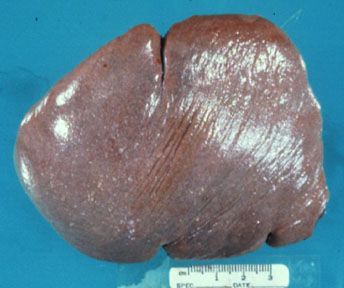
"I just wanted to focus on one part of the system with more detail than your textbook covers, and that is the magnificent spleen. It's a ductless, vertebrate organ, and even though it's part of the lymphatic system, it's also associated with the circulatory system, where it helps destroy old red blood cells and holds a reservoir of blood. And what's really cool is that for a long time, no one really knew why we had it? But now we're figuring out that its absence can make you get some infections. Oh, and also, one in ten of you has an extra teensy spleen or three. It's harmless, just a little quirk that forms where the nerves and blood vessels enter the main spleen. It's all almost as cool as the endocrine system."

She pointed to the slabs on the tables. "Now strap on gloves and goggles, get into groups, and get to cutting up these cow spleens. You're looking for the splenic artery, the splenic vein, and the renal, colic and stomach areas."

[OOC: Wait for OCD, and blame the spleen thing on [livejournal.com profile] bugofjustice.]
[identity profile] blonde-doctor.livejournal.com
The classroom has been remade into a very small gym, with 12 treadmills in a row pointed at another treadmill facing them. Workout mats and timers are in the back of the room, and the desks have "disappeared." (Elliot hoped the troll janitor, who she bribed to move them, wouldn't eat them.)

Once the class was gathered, Elliot hopped on the treadmill and began to talk, running at a slow pace. She only had to gasp for breath occasionally. "I thought that because we're learning about muscles today, I would make you guys get in a little workout while we learn," she said. "Bonus? Some of you are a little Peter, I mean pudgy."

"Anyhow, the muscular system is contractile tissue of the body and is derived from the mesodermal layer of embryonic germ cells. Its function is to produce force and cause motion, either locomotion or movement within internal organs. Much of muscle contraction occurs without conscious thought and is necessary for survival, like the contraction of the heart, or peristalsis (which pushes food through the digestive system). Voluntary muscle contraction is used to move the body, and can be finely controlled, like movements of the eye, or gross movements like the quadriceps muscle of the thigh. There are two broad types of voluntary muscle fibers, slow twitch and fast twitch. Slow twitch fibers contract for long periods of time but with little force while fast twitch fibers contract quickly and powerfully but fatigue very rapidly." She gestured to a poster on the wall behind her, stumbling slightly as she pointed. "This is what the major muscle groups look like."

She continued her lecture for about 15 minutes before wrapping, not notably winded. (Though she might have been leaning on the treadmill handles a tiiiiiny bit.)

"My TA-slash-future BFF is going to demonstrate ... something for you guys, and then I'd like you to hit the mats and test your core muscle strength. No cheating, no faking it. Okay? Let's go."
[identity profile] blonde-doctor.livejournal.com
Elliot had arranged the desks in the classroom to look like tables for two in a restaurant, complete with tablecloths and rosebud vases.

"Hey people, I am hoping you are all yourselves today because we are learning about the digestive system." She hit a button on her laptop, and a powerpoint presentation of the system popped up. "The key parts of the digestive system are the mouth, the tongue, the esophagus, the stomach, the small intestine, the large intestine, and the anus. They work together to get food from the plate to, um, the bathroom." She explained the workings of each part in more detail, passing out a handout as she did so, before hitting another button on her laptop to bring up a media player.

"For doctors, it's one of the most important systems because pretty much everything about your body chemistry turns up in the output of the digestive system. To show you what I mean, here's a little song from a recent episode of a strangely true-to-life medical sitcom."

She played the video, humming along, before turning to face the class again. "I am not going to make each of you give a stool sample, because that's kind of unhygienic and the administration would probably get creeped out by it. But you will be testing the other end of your digestive systems. Each of you has an array of baby food jars containing food samples in front of you; your job is to pair up, take turns blindfolding each other,and feed each other to see how sensitive your tastebuds are. You should each have something sweet, something salty, something sour and something bitter."

"And as always, add a sketch representing at least part of the digestive system to your body tracings before the end of class but after you un-blindfold yourselves."
[identity profile] blonde-doctor.livejournal.com
As the students filed in, Elliot fussed with an ivory-colored model skeleton. In an attempt at whimsy that might have failed, she had put a top hat on it and fastened a boutonnière to one rib.

"Hi, people, this is my second TA for the day, Mr. Bones, who is here to help me tell you about the human skeletal system -- which is kind of the framework that holds our entire bodies together. Mr. Bones -- who is, so you guys don't freak, just a model -- has about 206, well, bones, but I am not going to make you memorize every one of them just yet. But some of the more important bones in the front are the skull or cranium, the jaw or mandible, the sternum, the rib cage, the pelvic girdle, the humerus, ulna and radius in the arms, and the femur, tibula and fibula in the leg." She pointed to each part as she talked.

"If we spin him around, you can see the spine, the coccyx -- if you ever take yogilates, that's the "sit bone" -- and, because of the way he's hung, a better view of the bones in his hands and feet."

"Each of these bones is there for a reason." She went on to explain the intricacies of how the skeleton fit into a whole, possibly at slightly too much length, before pointing to the back of the room. "There are two model skeletons back there that have been taken apart -- it's your job to work as groups to wire them together by the end of class. And I wired another one up so you guys can make it do tricks, just please don't break it. For extra credit, there's a computer game you can try that's really more advanced than I expect you to be this week, but if you want to try it before next class, I will be all impressed with you."

"And don't forget to draw on the body tracings we made last week. You don't have to draw the whole entire skeleton, just part of it so you remember what we went over -- a skull or spine or coccyx or something."

"I think that's it for today; I'll be hanging out up here with Mr. Bones if you need me."
[identity profile] blonde-doctor.livejournal.com
Elliot looked like she was halfway between bouncing and running away in terror as she started her first class of the semester, and she kept wiping her hands on her slacks as if her palms were sweaty.

"Hi, people, welcome to human anatomy, which is the study of structures and systems of the human body,. If you didn't sign up for anatomy, you're in the wrong place. If you stick around without registering? You're volunteering to be dissected.

"I am Elliot Reid, which yes is a guys' name. Blame my dad. Call me Elliot or Dr. Reid. Doing the E.T. voice on Elliot will freak me out and earn you a detention. But basically, it's pretty easy not to get a detention in here - show up on time, don't miss more than three classes without letting me know, and don't be incredibly hugely obnoxious, and you're golden.

"I am passing around a couple of things. First, you have textbooks, which are yours to keep and love and put under your pillow. Second is my voice mail number. Call whenever. I'm also in my office Friday mornings, if you need me outside of class.You're also getting the class roster and syllabus. Syllabus is a guideline, not a rule -- it can change. Finally, my TA is John Dorian, so if you can't find me for something, talk to him."

Done with the preliminaries, she pointed to an area behind the rows of desks where seven-foot stretches of paper were taped to the floor, with buckets of markets between them. "To help make this class more visual, you're going to pair up and trace each other, and then we'll tape the drawings to the wall to fill in the body systems on as we learn them. But before you do that, I want to do some introductions. Say your name, your grade, and two interesting things about yourself. Starting with .... you." She closed her eyes and pointed randomly into the group.

Fandom High RPG


About the Game

---       Master Game Index
---       IC Community Tags
---       Thinking of Joining?
---       Application Information
---       Existing Character Directory

In-Character Comms

School and Grounds
---       Fandom High School
---       Staff Lounge
---       TA Lounge
---       Student Dorms

Around the Island
---       Fandom Town
---       Fandom Clinic

Communications
---       Radio News Recaps
---       Student Newspaper
---       IC Social Media Posts

Off-Island Travel
---       FH Trips

Once Upon a Time...
---       FH Wishverse AU


Out-of-Character Comms

---       Main OOC Comm
---       Plot Development
---       OOC-but-IC Fun


Disclaimer

Fandom High is a not-for-profit text-based game/group writing exercise, featuring fictional characters and settings from a variety of creators, used without permission but for entertainment purposes only.

Tags