[identity profile] takesaftermom.livejournal.com
As soon as her students settled into the classroom, Summer smiled and began. "I thought today would be a good day for a short film, touching on a few of the topics we touched upon throughout this class."

She hopped off the desk and hit a button to bring up the DVD menu.

"Feel free to take notes, if you'd like. If you have any questions, I'll be happy to answer them for you."

[Movie day brought to you by my being super busy at work. :( OCD is up.]
[identity profile] takesaftermom.livejournal.com
Summer had, once again, set up the Danger Shop to look like an underwater sea lab. This time, it closely resembled the one she and her brother had worked in a few years ago. If the students paid close attention, they'd notice sea turtles and other marine life swimming past the outer shell of the lab, which happened to be made up of glass. It was somewhat reminiscent of a fish bowl.

Summer happened to be sitting atop one of the tables near the front of the room. "Today, we are going to learn about marine reptiles. The earliest marine reptiles could be found during the Paleozoic era. They adapted to life in the sea during the Mesozoic era," she explained.

"Some marine reptiles that survived during that era and still thrive today are sea turtles, saltwater crocodiles and sea snakes. Some of those reptiles never returned to land and made a life in the sea. Others, like the sea turtle and crocodile, return to shore every so often to lay eggs and rest and bask in the sun."

She smiled as a pair of sea turtles swam past the windows. "They are quite majestic, aren't they? Sea turtles are almost always submerged and over time, they've developed an anaerobic system of breathing. They do still breathe air but if needed, they can stay submerged beneath the water for long periods of time."

Summer paused, watching them as they swam out of view. "Sadly, all species of sea turtles are listed as threatened or endangered. Conservation efforts have been made to protect this species and to prevent accidental death by fishing or by beach development, where the eggs might be tampered with."

"Sea turtles play key roles in two ecosystem types that are critical to them as well as to humans—oceans and beaches/dunes. In the oceans, for example, sea turtles, especially green sea turtles, are one of very few creatures (manatees are another) that eat the sea grass that grows on the sea floor. Sea grass must be kept short to remain healthy, and beds of healthy sea grass are essential breeding and development areas for many species of fish and other marine life. A decline or loss of sea grass beds would damage these populations, triggering a chain reaction and negatively impacting marine and human life.
Beaches and dunes form a fragile ecosystem that depends on vegetation to protect against erosion. Eggs, hatched or unhatched, and hatchlings that fail to make it into the ocean are nutrient sources for dune vegetation[citation needed]. Every year, sea turtles lay countless eggs on beaches. Along one twenty-mile stretch of beach in Florida alone, for example, more than 150,000 pounds of eggs are laid each year."

[OCD is a go.]
[identity profile] takesaftermom.livejournal.com
Summer had sent out a handwaved e-mail, letting her students know they were meeting in the Danger Shop today. Upon entering, they'd find the room set up like an underwater lab. A large table was in the front of the room, stools situated underneath it. Summer happened to be sitting on one of them; she'd pulled out a few more for her students to utilize.

Situated in the middle of the lab was a large pool of clear, deep water. If the students paid attention to it, they'd notice gray masses swimming in and out of it.

"Last class, we discussed what you wanted to learn about in these next few weeks," Summer began. "So, I decided to create a class around it. This underwater lab is home to a pod of dolphins," she explained, smiling lightly. She gestured to the large pool in the middle of the lab, "They come and go as they please. You can sit by the edge of the pool and get up close and personal with the dolpins today. If you have any questions, feel free to ask."

Summer, finishing her lecture, handed the students a handwaved handout containing numerous facts about the dolphins they were about to meet. "Feel free to look over that for a moment and then have some fun."

[... and I fail at putting up OCD. I apologize profusely. Got busy at work and totally forgot. Epic fail on my part.]
[identity profile] takesaftermom.livejournal.com
Today, the classroom was set up in a somewhat ordinary fashion. Summer had moved the desks in a semicircle formation and was sitting on top of one, waiting for her students to settle in.

"I thought we could use today's class as a discussion platform. I'd like to know what you want to learn about next, concerning the ocean and the life that calls it home," she added. "I thought it would be fun to plan a lesson around something you want to learn about, not just what's on the syllabus."

[OCD is up.]
[identity profile] takesaftermom.livejournal.com
Students would find an handwaved e-mail sent out earlier in the day from Summer and if they happened to miss that, there was a note attached to classroom stating:

Class is cancelled due to a family emergency.

[OOC: I had every intention of posting a class but the boyfriend just went to the hospital, so I'm a bit of a nervous wreck.]
[identity profile] takesaftermom.livejournal.com
Summer had sent out an handwaved e-mail to her students to meet in the Danger Shop for today's class. The room was set up to resemble the beaches of Rio de Janeiro, in honor of Fandom's latest spring break destination.

Summer stood on the sandy beach at the edge of the water, where a boat was docked. "I thought today was as good as any for a glass-bottom boat trip, don't you think?"

She didn't expect a response but it was okay. "Think of today as an observation day. Feel free to take notes on what you see when we're out on the ocean. And ask as many questions as you'd like. But most important, have fun."

[OCD is a go!]
[identity profile] takesaftermom.livejournal.com
When the students entered the Danger Shop, they'd find themselves in an underwater sea lab with large glass viewpoints extending out onto the sea floor. If they ventured toward the viewpoints, they'd see an array of fish swimming around them -- clown fish, angel fish, to name a few.

Summer smiled, a small clown fish catching her eye as it swam up to the glass and then vanished. "Continental shelves, the shallow areas of the ocean typically 200 m (650 ft) deep or less, with abundant light from the sun and nutrients from the continents, contain most of the ocean's fishes. This habitat promotes large populations of tiny invertebrate animals that are in turn eaten by fishes. Similarly, the upper 200 m (650 ft) of the ocean holds 78 percent of marine fish species. The warm, well-lit waters near coral reefs also promote a rich diversity of fish species," she explained.

"Fish can be separated into two groups -- jawless and jawed fish. The jawed fish may also be separated into two major groups: bony fish, which have skeletons made of rigid bone, and cartilaginous fish, which have skeletons made of elastic cartilage. There are nearly 1000 species of cartilaginous fish, including sharks, rays, and chimaeras, or ratfish."

Summer turned, eying a school of clown fish that were swimming around the coral reef outside the glass. "Feel free to explore the lab and check out the species of fish swimming outside. There's a submersible, if you want to head out into the habitat and get up close and personal with the fish. Just let me know."

[OCD is a go!]
[identity profile] takesaftermom.livejournal.com
Today, her students would find a DVD player set up in the front of the room.

Summer had some moddable snacks and drinks set out for them.

"I thought today, we could watch the meta for Finding Nemo. Next week, we'll get back on topic with types of fish and their habitats."

[OCD up.]
[identity profile] takesaftermom.livejournal.com
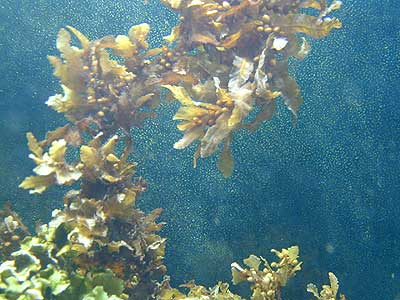
"Plant life is widespread and very diverse under the ocean," Summer began, once her students arrived and took a seat. "Seaweed is one type and they come in all shapes and sizes. They convert sunlight energy into chemical energy, which can be a very useful source of food. They also produce oxygen and a source of shelter for many organisms."

She paused to pull up a picture. "Seaweeds lack true roots, leaves and stems of plants and can reproduce sexually or asexually." That was something she'd found quite interesting the first time she learned that fact.

"Another type of marine plant is a flowering plant, that lives in the sea. Flowering plants are like the plants that live on land because they have specialized tissue and true leaves, roots and stems," she explained. "They are bottom dwelling organisms."

She switched the slide to bring up a picture of mangroves. " Seagrasses, mangroves and salt-marsh grasses are examples of marine flowering plants. Microscopic algae, another type of seaweed, provide important habitats for life, sometimes acting as hiding and foraging places for larval forms of larger fish and invertebrates, like mangroves."

"Seaweeds live in constant contact with potentially dangerous microbes, and they have apparently evolved a chemical defense to help resist disease. That is one reason why coastal people, particularly in East Asia, consumes seaweed. They also harvest and cultivate seaweed for the extraction of alginate, agar and carrageenan, gelatinous substances collectively known as hydrocolloids or phycocolloids. Hydrocolloids have attained commercial significance as food additives. The food industry exploits their gelling, water-retention, emulsifying and other physical properties. Agar is used in foods such as confectionery, meat and poultry products, desserts and beverages and moulded foods. Carrageenan is used in salad dressings and sauces, dietetic foods, and as a preservative in meat and fish products, dairy items and baked goods. Quite a number of uses for seaweed, huh?"

Summer smiled and pulled out a tray of seaweed from her bag. "If you're feeling adventurous, I thought I might pass some seaweed around for you to try. Purely optional, of course. Next week, we'll discuss different fish of the sea and their habitats and feeding habitats."

[OCD up.]
[identity profile] takesaftermom.livejournal.com
"I thought today we could watch a short documentary film on sea life, and see first hand how some marine life coexist together and cooperate to survive, while other species feed on weaker ones to continue living," Summer began.

"Feel free to take some notes on it. Next week, we'll discuss different types of plant life, how they survive in the depths of the ocean and what creatures use them as a food source to survive."

[OCD is a go!]
[identity profile] takesaftermom.livejournal.com
Summer had sent out a handwaved e-mail, letting her students know they were meeting in the Danger Shop today. Upon entering, they'd find the room set up like a laboratory, with tanks of various sizes set up throughout the room.

"Today's topic of discussion, if you couldn't tell from the tanks, is on coral reefs," Summer explained. "Reefs are known as the rainforests of the oceans because they are a component of a larger ecosystem, a collection of biological communities. Corals are actually tiny animals that are stationary; they stay fixed in one place," she added.

"All reef-dwelling corals have a symbiotic relationship with algae called zooxanthellae. The plant-like algae live inside the coral polyps and perform photosynthesis, producing food which is shared with the coral. In exchange the coral provides the algae with protection and access to light, which is necessary for photosynthesis," Summer continued, moving over to one of larger tanks. It was filled with brightly colored coral and various types and sizes of fish, swimming in and out of the coral.

"Coral reefs provide habitats for a large variety of organisms. These organisms rely on corals as a source of food and shelter. Besides the corals themselves and their symbiotic algae, other creatures that call coral reefs home include various sponges; molluscs such as sea slugs, nudibranchs, oysters, and clams; crustaceans like crabs and shrimp; many kinds of sea worms; echinoderms like star fish and sea urchins; other cnidarians such as jellyfish and sea anemones; various types of fungi; sea turtles; and many species of fish," she added, watching a group of clown fish chase each other through the coral.

Summer grinned and turned back to her students. "Feel free to study the tanks and if you have any questions, don't hesitate to ask."

[OCD coming up]
[identity profile] takesaftermom.livejournal.com
Summer had put out some moddable snacks and drinks for her students and stood at the front of the classroom, nursing a large cup of coffee. She waited until her students settled in before beginning.

"Good morning," Summer began, smiling brightly. "Welcome to Life of the Sea. I'm Summer Pitt, for those of you that might not know me. You can call me Summer or Miss Pitt, if you're more comfortable with that."

"This class will focus on various plants and animals that call the ocean home. Along the way, we'll touch on coral reefs, tidal pools and other plants and animals that need the ocean to survive. You'll even get the chance to get up close and personal with simulated and real, live oceanic plants and animals."

She was looking forward to putting those together for her students.

"Why don't we start off with some introductions? How about your name, grade and favorite sea creature/mammal if you have one."

[OCD coming up.]
[identity profile] takesaftermom.livejournal.com
Summer decided to set up something special in the Danger Shop for their last class of the summer.

"I thought we could do something a little different today since it's our last class," Summer stated, once everyone showed up. She was dressed in her diving gear, all set to go. The boat she was situated on was in the middle of the ocean, with nothing but water surrounding them for miles.

If the students paid attention to the water, they might see large dark shapes swimming in the water and every once in a while, said dark shapes would surface for a breath of air. "I thought it might be fun to dive with whales today."

It was something Summer had always wanted to do and maybe one day, she'd actually do it. In the meantime, she'd settle for the simulated version. "See them up close, their habits and just have a fun time with this dive. And as always, if you have any questions before we dive, feel free to ask them."

[OCD up.]
[identity profile] takesaftermom.livejournal.com
Instead of having a session in the Danger Shop, today's lesson was in the classroom. Summer had projector equipment set up near the front of the classroom and had the DVD all set to play. She waited for her students to settle down before she began.

"I thought I'd switch it up today and show you a video about the history of deep sea diving," Summer explained. "A bit of a background on the marine activity. If you have any questions during the film or once it's finished, feel to ask and I'll answer them as best I can."

With that, Summer lowered the lights in the room and started the movie.

[OCD coming up.]
[identity profile] takesaftermom.livejournal.com
Summer had the Danger Shop set up to resemble Australia today. It was a similar setting to that of last week's location, except there was no island to be found for miles. She was dressed in her diving gear, all ready to get in the water.

"I thought you guys might like today to explore the area, split off into a group or go out individually, if you'd like. Take note of what you see and we'll discuss it next week."

[Short post brought to you by LJ fail.]
[identity profile] takesaftermom.livejournal.com
Summer hadn't expected the cold weather to suddenly show up, so she was glad she'd booked the class in the Danger Shop again.

Thankfully, the students wouldn't have to deal with the cold in class. She'd set up the classroom to resemble a warm, tropical setting where the water was clear and the sun was bright. The depth of the water varied from five feet to fairly deep.

Once again, Summer was standing on a boat with diving equipment, ready to go.

"I thought we could spend some time in the water today. There are varying degrees of depth to the water, including shallow parts, so you could practice with your equipment and feel comfortable doing so." Summer was definitely getting into the water today.

"Feel to explore the area as much as you want. There are moddable coral reefs and marine life to look at. If you have any questions, whether it's about your equipment or what you see out there, I'll do my best to answer them."

[OCD is up.]
[identity profile] takesaftermom.livejournal.com
When the students entered the Danger Shop, they'd find themselves standing at the edge of dock, a boat tied up nearby. There was diving equipment laid out on one side of the boat. Summer stood at the entrance of the boat, smiling warmly.

"Welcome to Deep Sea Diving," she began. "I apologize for not having our first class last week. Something unexpected came up. But that's taken care of, so we can make up for it today. I'm Summer Pitt, for those that might not know me. You can call me Miss Pitt or Summer, whichever you prefer." She wasn't picky.

"I thought we could start with brief introductions, what experience you might have with diving, if any. And just for fun, I'd like to know if there's a particular place you'd like to go diving. For me, it'd be the Great Barrier Reef." She'd get there, one day.

"After that, we'll set you up with the right equipment and I'll teach you how to use it. Then, if you want to, you can test it out in the water and see how it feels. If you have any questions, feel free to bring them to me. Along the way, I'll give a brief history of diving -- how it started and how far it's come."

[OCD up.]
[identity profile] drgrissom.livejournal.com
Grissom is in a shockingly jovial mood. He's even rocking a costume and has candy (without bugs) for his students. Must have some good Halloween childhood memories buried somewhere.

Criminology

Here is the study guide for your midterm exam. [it will be an 'essay question', but feel free to study/stress]

To review, in class today I would like you to discuss one thing you have learned in this class so far, and how it either surprised you, or changed your mind in regards to a certain topic. If that is not the case in any aspect, why not?


Death and Dying

Discussion: Your homework was to Choose a death by suicide from Shakespeare's work, and share a short reaction to it. Please do so.

Your midterm exam will be on Wednesday! It will be an in-class essay, in a similar vein to the homework you are turning in. Using what you have learned in class, and moving on to our accidental death chapter, please analyze A Darwin Award Winner or Honourable Mention. You may bring in notes on one 3x5 index card.

Fandom High RPG


About the Game

---       Master Game Index
---       IC Community Tags
---       Thinking of Joining?
---       Application Information
---       Existing Character Directory

In-Character Comms

School and Grounds
---       Fandom High School
---       Staff Lounge
---       TA Lounge
---       Student Dorms

Around the Island
---       Fandom Town
---       Fandom Clinic

Communications
---       Radio News Recaps
---       Student Newspaper
---       IC Social Media Posts

Off-Island Travel
---       FH Trips

Once Upon a Time...
---       FH Wishverse AU


Out-of-Character Comms

---       Main OOC Comm
---       Plot Development
---       OOC-but-IC Fun


Disclaimer

Fandom High is a not-for-profit text-based game/group writing exercise, featuring fictional characters and settings from a variety of creators, used without permission but for entertainment purposes only.

Tags