
http://takesaftermom.livejournal.com/ (![[identity profile]](https://www.dreamwidth.org/img/silk/identity/openid.png) takesaftermom.livejournal.com) wrote in
takesaftermom.livejournal.com) wrote in ![[community profile]](https://www.dreamwidth.org/img/silk/identity/community.png) fandomhigh2012-02-02 09:39 am
fandomhigh2012-02-02 09:39 am
takesaftermom.livejournal.com) wrote in fandomhigh2012-02-02 09:39 am


Entry tags:
Life of the Sea, Thursday, Period 2
"Plant life is widespread and very diverse under the ocean," Summer began, once her students arrived and took a seat. "Seaweed is one type and they come in all shapes and sizes. They convert sunlight energy into chemical energy, which can be a very useful source of food. They also produce oxygen and a source of shelter for many organisms."
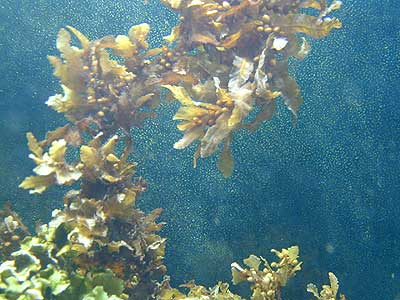
She paused to pull up a picture. "Seaweeds lack true roots, leaves and stems of plants and can reproduce sexually or asexually." That was something she'd found quite interesting the first time she learned that fact.
"Another type of marine plant is a flowering plant, that lives in the sea. Flowering plants are like the plants that live on land because they have specialized tissue and true leaves, roots and stems," she explained. "They are bottom dwelling organisms."
She switched the slide to bring up a picture of mangroves. " Seagrasses, mangroves and salt-marsh grasses are examples of marine flowering plants. Microscopic algae, another type of seaweed, provide important habitats for life, sometimes acting as hiding and foraging places for larval forms of larger fish and invertebrates, like mangroves."
"Seaweeds live in constant contact with potentially dangerous microbes, and they have apparently evolved a chemical defense to help resist disease. That is one reason why coastal people, particularly in East Asia, consumes seaweed. They also harvest and cultivate seaweed for the extraction of alginate, agar and carrageenan, gelatinous substances collectively known as hydrocolloids or phycocolloids. Hydrocolloids have attained commercial significance as food additives. The food industry exploits their gelling, water-retention, emulsifying and other physical properties. Agar is used in foods such as confectionery, meat and poultry products, desserts and beverages and moulded foods. Carrageenan is used in salad dressings and sauces, dietetic foods, and as a preservative in meat and fish products, dairy items and baked goods. Quite a number of uses for seaweed, huh?"
Summer smiled and pulled out a tray of seaweed from her bag. "If you're feeling adventurous, I thought I might pass some seaweed around for you to try. Purely optional, of course. Next week, we'll discuss different fish of the sea and their habitats and feeding habitats."
[OCD up.]
She paused to pull up a picture. "Seaweeds lack true roots, leaves and stems of plants and can reproduce sexually or asexually." That was something she'd found quite interesting the first time she learned that fact.
"Another type of marine plant is a flowering plant, that lives in the sea. Flowering plants are like the plants that live on land because they have specialized tissue and true leaves, roots and stems," she explained. "They are bottom dwelling organisms."
She switched the slide to bring up a picture of mangroves. " Seagrasses, mangroves and salt-marsh grasses are examples of marine flowering plants. Microscopic algae, another type of seaweed, provide important habitats for life, sometimes acting as hiding and foraging places for larval forms of larger fish and invertebrates, like mangroves."

"Seaweeds live in constant contact with potentially dangerous microbes, and they have apparently evolved a chemical defense to help resist disease. That is one reason why coastal people, particularly in East Asia, consumes seaweed. They also harvest and cultivate seaweed for the extraction of alginate, agar and carrageenan, gelatinous substances collectively known as hydrocolloids or phycocolloids. Hydrocolloids have attained commercial significance as food additives. The food industry exploits their gelling, water-retention, emulsifying and other physical properties. Agar is used in foods such as confectionery, meat and poultry products, desserts and beverages and moulded foods. Carrageenan is used in salad dressings and sauces, dietetic foods, and as a preservative in meat and fish products, dairy items and baked goods. Quite a number of uses for seaweed, huh?"
Summer smiled and pulled out a tray of seaweed from her bag. "If you're feeling adventurous, I thought I might pass some seaweed around for you to try. Purely optional, of course. Next week, we'll discuss different fish of the sea and their habitats and feeding habitats."
[OCD up.]
Sign In
Re: Sign In
Listen to the Lecture
Seaweed
Re: Seaweed
Wasn't he the lucky one.
Talk to Summer
OOC