onlyajones: (Default)
[personal profile] onlyajones
That morning instead of their normal professor, Jo was standing in front of the class awkwardly, “so Professor Cutter got called back home and couldn’t be here for his final class, he had a dinosaur related emergency back home” she began, not entirely sure how you could have a dinosaur related emergency, “he didn’t actually give us any instructions on what we’re supposed to do for class, but he said we can watch a movie” she said, rather embarrassed but at least a movie was something that she could manage to play.
itsananomaly: (another smile)
[personal profile] itsananomaly
“Last week we took a look at habitats,” Cutter began that week’s class, “this week we’re going to look at ecosystems,” he said as he handed out his usual stack of notes for the class, “An ecosystem includes all living things, plants and animals and organisms in a particular environment and how they interact with each other,” he explained, “this also includes their interactions with non living environments such as weather, earth, sun, soil climate and atmosphere,”

“There are eight main ecosystems,” he continued, “these are temperate forests that exist in the Eastern United States and most of Europe, these include hardwood trees that lose their leaves in Autumn, temperate forests are also home to animals including racoons, deers and salamanders. Tropical rain forests include Central and South American jungles and includes many species, characteristics of these include tall, tense trees where dense vegetation blocks out the sunlight on the forest floor and most plants are evergreen,” he explained, “Then we have desert ecosystems where annual rainfall ranges from zero to 10 inches and includes plants such as cacti, sagebrush and mesquite and animals tend to burrow to escape the dessert heat and search for food after dark.”

“Next we have grasslands which is where grasses and herbs tend to be found more readily than forests, the grass provides food but doesn’t offer much protection from animals from predators, then we have the Taiga which is found in northern circumpolar forested regions characterized by long winters and moderate to high annual precipitation,”

“The last ecosystems we have to cover are the Tundra, which is where trees grow little or not at all due to the extreme latitudes and has a short growing season that produces little, The Chaparral is a coastal biome found in California and consists of plants that are mostly oak, grapes, olives and figs and eucalyptus, the plants here are usually dormant in the dry summer but thrive in the wet winter and finally the last ecosystem left to cover is the ocean and the ocean has more saltwater than fresh water and starts with plants and plankton and works it way up smaller fish and crustaceans to whales and dolphins,”
itsananomaly: (Default)
[personal profile] itsananomaly
“This week we’re going to take a look at animal habitats,” Cutter began that week’s lecture, once he handed out this week’s notes , “we have covered the evolution of animals a few weeks back when we looked at the Cambrian explosion but I did want to note that habitats began to evolve as animals did, after life began to evolve in the sea ,they began to move into fresh water and then on land in the Ordovician period when plants became a source of food,”

“A habitat is the natural environment where an animal, plant or organism lives,” he continued, “and there are 16 different types of habitats - these are Artic, Aquatic, Coastal, Desert, Manmade Deserts, Forest, Grassland, Tundra, Mountain Ranges, Steppes, Wetlands, Microhabitats, Extreme Habitats, Deep Oceans, Volcanos and outer space,”

“Most resources will officially list between six and eight habitats,” he explained, “and the ones that we’re going to cover today in particular are Polar, Tundra, Evergreen Forests, Seasonal Forests, Grasslands, Deserts, Rainforests, and Oceans,”

“Polar habitats are found at the North and South Pole and they form at the highest latitudes on Earth while tundra is part of the polar habitat that is on land and not covered in ice, in the South Pole you can find colonies of penguins, leopard seals and whales and in the North Pole you can find polar bears and narwhals, ” he went on, “and continuing on with the polar themes, evergreen forests are just outside the North Pole and they cover a region from Canada, Northern Europe and Russia and what is notable about this habitat is that they have more trees than anywhere else, here you can find animals such as snowshoe hare and the Canada Lynx,”

“Next we have seasonal forests which are in areas that are found in places around the world that are not to extremely cold, dry or wet. Owls are the main predators here and will feed off a variety of prey ranging from fish and frogs to snakes. Grasslands grow under conditions that are warm enough to support life but are too dry for trees but not dry enough that a desert forms,” he went on, “it is in the grasslands where the largest groups of mammals are found like in the African Savanna, where the herds support the largest land predators such as lions, hyenas and crocodiles,”

“Deserts are habitats that form in the driest places on earth but they don’t always have to be hot, such as deserts like the Gobi Desert in Western China and Antartica and animals such as the fennec fox and the sidewinder snake are particularly well adapt to survive the harsh desert conditions,”

“Tropical Rainforests in particular, are well known for supporting plant life as they are warm, dry and wet and they form near the equator so that they can get as much sunlight as possible and here animals such as the flying lemur have learned to survive in a tropical rainforest where sometimes the trees can grow so thick that light doesn’t reach the ground and so they learn to adapt by flying or gliding through the treetops,”

“And finally the last habitat that we’re going to cover is oceans, which as I explained at the start of the lecture is where animals first evolved so it seems fitting to end with this habitat, while there are some species that can only survive in specific types of water there are those than can survive in nearly every ocean environment like the starfish,”

“For next week’s class I would like you to write a report on a habitat of your choosing and on an animal that lives in it,”
itsananomaly: (beach)
[personal profile] itsananomaly
That morning Cutter had arranged for both his classes to meet at serenity cove, he was feeling a lot better from the weekend and his bandages were now gone so he had more use of his hands, “this morning we’re going to be doing something a little different and go on a fossil hunt around the serenity cove and light house area, this area has proved to be rather successful in finding fossils, so I thought that we could have ourselves a bit of a hunt around this area and see just what we can find here,” he said with a smile.

“There are four types of fossils that you can look out for,” Cutter continued, “they are trace fossils - which are preserved with an animal’s behaviour or activity such as trilobite tracks,” no one was surprised at all by this point that Cutter had mentioned trilobites were they? “And then there are fossils with some organic material preserved such as a removal of all organic material except carbon, which remains as a film in the rock and mineralised fossils which is where a organic matter is replaced gradually by mineral such as Replacement of organic material in bone with minerals and finally impression fossils, which when the remains decay completely but leave an impression in the sediment and examples of these can include internal impressions such as trilobites and external ammonites or impressions of armoured fish or tree barks,”

“and today I’m being joined Connor Temple, he teaches Dinosaurs 101 with me, if you need help or having any questions you can ask either myself or Connor and we’ll be happy to assist,” Cutter smiled over at him, trying not to worry that Connor would be doing so much walking but Connor had assured him that he was fine with small brace and he would be able to manage to do the hunt, “happy hunting,” he said with a smile and let his classes go off to to explore.
itsananomaly: (Default)
[personal profile] itsananomaly
“Since we’ve covered the role that both evolution and extinction have played in the animal kingdom, the next part we’re going to be looking at is fossils, what we can learn from them and how they help us understand the links,” Cutter began that week’s lecture as he handed out his usual stack of notes.

“To help us understand the past and what the fossils tell us, we use the the fossil record,” he began, “the fossil record is the history of life according to fossils and include the remains or imprints of organisms and from earlier geological periods found in sedimentary rock,”

“The study of the fossil record has proved useful in three different purposes, the first one being to describe the evolution of a specific animal group, this includes the acquisition or loss of specific features in a species and that these adaptations can prove to be the better adaptation in a particular environment,”

“Fossil records can also make it easier to assistant when assigning an age to the strata where they occur and finally they can also be used to tell us more about the climate and the environment in which they originated and how the environment may have shifted over time,”

“Next week we will be doing some field work looking for fossils along serenity cove and the lighthouse, so we will be meeting there next week,”
itsananomaly: (Default)
[personal profile] itsananomaly
“Last week, we looked at the Cambrian Explosion and the impact that the explosion of diversity had on early evolution for the animal kingdom and now we’re going to look at the opposite end and look at what was responsible for the end of the Cambrian Explosion,” Cutter began that week’s lecture as he began to hand usual his stack of notes.

“At the end of the Cambrian Explosion, there was a mass extinction event that became the largest mass extinction that the Earth has ever known, this occurred at the end of the Permian Period and was responsible for wiping out 90 percent of life at the time,”

“The Permian Extinction was responsible for wiping out 95 percent of marine species and 70 percent of terrestrial species,” he continued, “and this is where the trilobites from last week come in since this is where they met their end,”

“To give an idea of just how long the trilobites did last, the Cambrian Explosion took place roughly 538 million years ago and the Permian Extinction Event happened roughly between 299 million to 252 million years ago, so Trilobites lived for nearly 300 million years,”

“While it was mostly marine invertebrates that were wiped out, the Permian Extinction also saw aquatic vertebrates, including the acanthodian, which are believed to be the earliest jawed fishes were wiped out,”

“In terms of the Terrestrial species that were wiped out these include the pelycosaurs and Moschops and there were also numerous insect families that were lost at this time,”

“It is believed that causes for the Permian Extinction were due to the nutrient cycle being disrupted by biological and physical causes and this includes changes in the temperate and changes to the carbon cycle,”

“For next week, I’d like you work on a report on one of the species that were lost in the Permian Extinction,”
itsananomaly: (Default)
[personal profile] itsananomaly
Cutter’s date with Connor to the museum and been very … inspiring to say the least and it had given him at least one topic to cover in his class. He had actually been working on his lesson notes all week because there was so much to cover in this particular topic that he was considering that maybe expanding it to two lectures wouldn’t be a bad idea.

Rex was sleeping in Connor’s jacket on Cutter’s desk, he hadn’t been able to pry Rex from the jacket since it was still a little cold for him but decided to let him keep sleeping.

“You might remember this little guy from class last semester?” Cutter said with a fond smile while he gave Rex a gentle chin scritch as he slept, “this is Rex, he’s from the Permian period and the reason I brought him in today for class is to highlight just how prevalent the Cambrian Explosion was,”

Cutter had been a bit distracted by Rex so had decided to hand out notes notes before class started so that they were already on the students desk when they arrived.

“I did briefly talk about the Cambrian Explosion last week but I feel that it is such an important topic when talking about Evolution that it deserves a topic on its own, well really I could do an entire course on the Cambrian alone but that’s a topic for another time,” Cutter explained, “now the reason I brought Rex in specifically for today is that he was around at the same time as some of the creatures that were a result of the Cambrian Explosion, namely Trilobites - Trilobites are especially important to understanding our concept of Evolution and they were arthropods, marine animals and we know this because of the type of rocks they were found in.

“Trilobites first appeared in the Cambrian Period and became prevalent during the Cambrian and Ordovician Seas, they went extinct at the end of the Permian Period,”

At this moment, Rex began to wake up, letting out a sleepy yawn and perked right up when he saw Cutter and started chirping rather excitedly. Cutter gave him more scritches as he continued the lecture.

“There was no life on Earth at this point in the early Cambrian period,” he went on, “so life was contained to the seas, particularly in the ocean shallows … no life inhabited the ocean depths as well so that is what makes this explosion of life particularly fascinating, that they were able to form here and diversify in these regions,”

Rex continued to chirp happily and then at that point he took off and happily began flying around the room, it was a good thing both the door and windows were locked.

“I would like you to do a report on the Trilobites for next week and in particular I would like you to focus on their development and the role they played in early aquatic ecosystems,”
itsananomaly: (Default)
[personal profile] itsananomaly
Cutter had briefly considered what would happen if he didn’t turn up to his class for the third week in a row, even though really one of those week’s they’d been on vacation so he felt that didn’t really count but in the end he had finally prepared a class and was ready Friday morning to give his lecture. At least preparing for class gave something to focus on and not feel so nervous about his date with Connor.

“This week we’re going to be begin covering animal evolution,” he began that week’s lecture and handed around the usual stack of notes that he’d made for the class, “animals first appeared in the Ediacarian Period, which was roughly 635 million to 541 million years ago and these were soft bodied forms that left traces of their bodies in shallow water sediments,”

“Most of the animals in the Ediacarian period were thin and their cells were capable of diffusing nutrients from the water,” he continued, “the first mass extinction event ended the Ediacarian and this in turn led to the Cambrian Period, which set off the great evolutionary radiation to lead towards creating the very first group animals or phyla,”

“Evolution also occurred very quickly in this time period, in the Cambrian Period we have our first known appearance of sponges. A few more examples of evolution include after the Permian Extinction where a group of sea anemones evolved a skeleton and then diversified into modern corals,”

“Anthropods have been the most diversity phyla since the Cambrian, Myriapods diversified into insects during the Devonian period,”

“The fossil record can be particularly useful to us when studying these evolutionary patterns, this is the history of life from fossils, the remains or imprints of organisms preserved in sedimentary rock, it is important for describing the progressive changes within an animal group and the evolution of that group,”

“For next week, I’d like you to prepare a report of an animal or insect of your choosing from one of these time periods and talk about how their evolution progressed,”
itsananomaly: (Default)
[personal profile] itsananomaly
“This week we’re going to start looking at extinction and evolution,” Cutter began that week’s lecture as he handed out his usual stack of notes


“Extinction is the process where it results in the disappearance of a population of species,” Cutter continued once he had handed out his notes, “there are a number of causes that can explain why a species went extinct, these range from asteroid strikes to loss of habitat and samples of extinct animals include the Dodo, Tasmanian Tiger and the Mammoth,”

“Meanwhile Evolution is the change in the characteristics of a species over several generations, relying on the process of natural explanation,” he explained, “there are different types of evolution, convergent evolution is when the same adaptations evolve independently under similar pressures and coevolution is where two species or groups of species have evolved alongside each other and they adapt to changes each other and finally adaptive radiation is where species split into different forms after there is a change in the environment makes new resources or creates new environmental challenges,”
itsananomaly: (Default)
[personal profile] itsananomaly
Despite his lack of sleep the last few days, Cutter had not been able to fall asleep last night so he had stayed up all night working on his lesson plan.

“This week we’re going to cover the remaining different kingdoms, we’ve covered animalia and plantae,” he began that week’s lecture as he handed out his usual stack of notes, “and we’re going to take a look at Kingdoms Monera, Protista, Fungi ,”

“Starting off with Kingdom Monera,” he continued, “typically with the Monera Kingdom, these are organisms that do not have a true nucleus, this means that their DNA is not enclosed in the nucleus and these also are some of the oldest microorganisms on Earth,”

“Meanwhile Kingdom Protista contains of protists that are eukaryotic organisms and these are grouped together because they typically don’t have anything in common with other kingdoms,” he explained, “they are typically microscopic and unicellular organisms,” he went on, “there are protists that can make their own food and are photosynthetic while others are heterotrophic and this means they seek out their own food,”

“The last Kingdom we have to cover is Kingdom Fungi,” Cutter concluded, “these are organisms that are heterotrophic and cannot make their own food and they play an important part in nutrient cycling in the ecosystem, fungi cells are do contain both a nucleus and organelles like plants and animals do however they do not contain cellulose, which does usually make up plant walls,”

“For your reports next week, I would like you to write up a report from two kingdoms of your choice, using the classification system that you’ve used for your previous reports,”
itsananomaly: (Default)
[personal profile] itsananomaly
“The last couple of weeks we’ve been looking at Kingdom Animalia,” Cutter began that week’s lecture, “this week we’re going to be looking at some of the other kingdoms and we’re going to start with Kingdom Plantae, which is the plant kingdom” he handed out his stacks of notes.

“There are different classifications for Kingdom Plantae and that is determined by whether they have a well differentiated body and whether they have specialised tissues for transport and the ability to bear seeds,” he explained, “these classifications are Division Thallophyta, which is the lowest of plants of the plant kingdom, these are commonly referred to as algae and are aquatic,”

“Next is Division Bryophyta, these are small terrestrial plants and they show differentiation with the body design such as such as stem, leaf-like structures and root like structures, they do not have the ability to conduct water and other substances,”

“Meanwhile Division Pteridophyta, does have the ability to conduct water and has tissue that can let it conduct these substances from one plant to the other. It is also among the oldest vascular plant,”

“Division Phanerogamae is a seed bearing plant and they have reproductive tissues that let them them produce seeds. This division also has a further two classifications depending on whether the seeds are naked or enclosed and these are Gymnosperms and Angiosperms, Gymnosperms refer to plants with naked seeds and Angiosperms refers to plants with that are seed bearing,”

“For class next week I’d like you to prepare a report on a plant, using the above classification system,”
itsananomaly: (Default)
[personal profile] itsananomaly
“This week we’re going to be having a movie day,” Cutter began that week’s class, “and we’re going to be continuing looking at Kingdom Animalia with insects,” he explained, mostly because he didn’t feel like giving a lecture but he figured at least this way he was still technically turning up to teach.

This was considered an improvement where Cutter was concerned.

“I would like you to present your report from last week and then we’re going to watch a movie about a colony of ants trying to defend themselves against the of grasshoppers,”
itsananomaly: (Default)
[personal profile] itsananomaly
“This week we’re going to start looking into what the animal kingdom is and how it is classified,” Cutter began that week’s lecture, he handed out quite a few detailed sets of notes and then once that was done he stood at the front of the classroom, “all animals are members of the Kingdom Animalia, also called Metazoa and they are classified according to what characteristics they have, what distinguishes these animals from the Kingdom Monera, which includes bacteria and algae among its members, is that animals are multicellular and they rely, whether directly or indirectly on other animals for their nourishment,”

“These classifications for animals,” Cutter continued, “include whether they have a backbone or they don’t, or if they are cold or warm blooded,” he added, “there are seven major groups overall in the classification system, Kingdom, Phylum or division, Class, Order, Family, Genus and species,”

“For our class next week, I would like you to prepare a report on an animal, using the above classification system,”
itsananomaly: (Default)
[personal profile] itsananomaly
It was the second of two classes that Cutter was teaching this semester and it had actually been a while since Cutter had taught a zoology course but in what was perhaps another first, Cutter was also there for his other class so that was two different classes that he had turned up for in a week.

“This is An introduction to Zoology,” he began, “my name is Professor Nick Cutter and I’m an Evolutionary Zoologist, I do normally teach palaeontology but this semester we’ll be focusing more on the general zoology side of things,”

“I’ll keep things simple to start with this week,” he continued, “and we’ll start off with introductions, so I’d like to know your name, any experience you may have with what you’d like to learn in particular from this class and what your favourite animal is,” it had seemed to work for his dinosaurs class so he thought he’d keep it simple for zoology.
livingartifact: (I'm on the phone)
[personal profile] livingartifact
The Danger Shop today was arranged as a movie theater, complete with comfy seats and an old fashioned popcorn machine in the back. A slide projected on the screen informed the students that Jenkins had been unexpectedly and unavoidably detained this week, but that they should please enjoy this fanciful film about an ironically named dinosaur learning the true meaning of family with several other improbably-named adorable little reptiles as they journey across a prehistoric landscape and try not to get eaten.
livingartifact: (I'm not your butler)
[personal profile] livingartifact
The Danger Shop was back above water today, in a sandy sort of environment around a broad, very shallow river. There were a few leafy ferns scattered about, but for the most part, the plant-life consisted of tall thin trees with clusters or narrow leaves at the very tops.

Dimetrodon and Earl and the Dying Ecosystem )
livingartifact: (Default)
[personal profile] livingartifact
Walking into the Danger Shop might be a bit of a shock for the students today, as they would find themselves at the bottom of a shallow ocean filled with strange, bug-like creatures. They were perfectly able to breathe, thanks to the nature of this particular hologram, and would find themselves perfectly dry when they left, though for all other intents and purposes, they would all look and feel as though they were completely submerged. Jenkins stood in the middle of an open, sandy area not far from the Danger Shop door, admiring the early reef-building creatures that lined the underwater field.

Explore the Cambrian, named for what the Romans decided to call Wales )
livingartifact: (I'm not your butler)
[personal profile] livingartifact
The Danger Shop today was programmed to be somewhat less spectacular than it had been the past two weeks. Instead of a barren, rocky landscape or a lush, verdant forest, the students instead found themselves standing in an open field, edged on three sides by sparse forest, and on the fourth by a narrow river. It looked and felt like a landscape that could easily have been found in Fandom's own preserve.

"Hello students," Jenkins greeted with a small nod at the top of the class. "We have spent the last couple of weeks millions and billions of years in the past, and we will spend the next several nearly as far back, or farther. But extinction is not merely a prehistory event, and I thought this week it might be interesting to look at a creature whose time on Earth ended not all that long ago at all." He gestured to the open grassland. "Welcome to Jaktorów Forest, in 16th century Poland, about 500 years ago. In a little more than fifty years time, the last known survivor of a species vital to mankind's development will die of natural causes. For now, there are still 38 of the animals known to live here. Hunting them has been outlawed, but it's much too late to save them now. We are in the twilight of the aurochs."

A handful of truly enormous cattle stepped out of the woods and into the field. The tallest stood nearly six feet at the shoulder, its head crowned by massive, curved horns. This was the platonic ideal of the word "bull".

"Any of you who has eaten a hamburger or the most common types of cheese in America, or indeed worn a leather jacket has benefitted from the aurochs. These are the precursors to modern cattle, America's favorite stock animal, but domestication was not enough for humanity, we had to hunt the wild ones as well." Jenkins rested his hand on the side of one of the creatures, whose back came up to his chin. "They were also one of humanity's first attempts to preserve a species. As I said, hunting in the era I've replicated here has been suspended — this after a few hundred years in which it was restricted only to those with the most power in the world. The land we're standing on was maintained and protected in order to track the waning population. In the modern era, we've learned how to wrestle species back from the brink of extinction, though it's still a struggle we often lose to this day."

He patted the aurochs a few more times, then turned back to the class. "These animals here are quite used to the presence of humans, thanks to the efforts of the gamekeepers who track them, so feel free to step up and get a good look. They've recaptured Earth's imagination again of late; in fact, scientists in Europe have been hoping to rebreed the aurochs back into existence — or at least a reasonable facsimile thereof — using modern genetics and a variety of the domestic species descended from the animals. Whether this is a reasonable goal or not is the subject of some debate — Europe is an extremely populous continent, and overhunting was not the sole cause of the animals' extinction. A narrowing of available grazing land would still be of some concern, as would the potential for disease transmitted by their domestic cousins. Also, there is simply the matter of 'playing God', a phrase people like to toss around about scientists whom they believe have ambitions above their station. Still, it's an interesting idea to toss around: humanity having brought about its downfall, might we also be the ones to bring it back?"
livingartifact: (Default)
[personal profile] livingartifact
The doors to the Danger Shop opened this week onto a thick, verdant jungle, full of gingkos, conifers, and tree ferns. The air was thick and fragrant with the smell of animal dung and moss, and the edge of a nearby body of water bloomed red with algae. Jenkins stood beneath one of the ferns, wearing high boots with his usual suit, and a pith helmet, occasionally looking up and frowning at the clear blue skies.

Welcome . . . to the Jurassic Period )
livingartifact: (I'm not your butler)
[personal profile] livingartifact
The class met up in the Danger Shop, as it would every day of the session. Upon entering, the students would find themselves in a completely blank space. Nothing but blank, white light, as far as the eye could see. There were no shadows, no angles; the only thing that told the students there was a floor was the feeling of it beneath their feet. It was an entirely empty canvas, and in the middle of it stood Jenkins, a tall old man wearing a three piece suit and a jaunty bowtie, and a smile.

"Welcome, students," he greeted. "I am Jenkins, and this is Earth Zoology — Pre-history Edition. If you are not in the correct classroom . . . well, I hope you'll stick around anyway. The school has provided you all with a marvelous contraption, capable of replicating fantastic landscapes and creatures. You quite simply cannot experience prehistoric life on this planet like this anywhere else."

He looked around the blank space with a thoughtful, pleased expression, then looked back at the students. "And no, it's not broken, currently. The first week is for introductions, and since I suspect you all might be a touch distracted when we get started with our first lesson, I thought we ought to get those out of the way before I hit 'start'. I see some familiar faces, but most of you I haven't yet had the pleasure of meeting, so if you would be so kind as to let me know your name and what brings you to class today, I think that will suffice."

He gestured to one of the students at random to get them started, and once the pleasantries were dispensed with, pulled a small, blocky remote from his pocket (the Danger Shop's controls had a somewhat flexible interface, and he liked it blocky remotes), and pressed the large red button in the center of it. The blank white expanse around them shivered and reformed into a strange, desolate landscape, full of towering rock formations under a dull, dim sun.

Yeah, this got long )
livingartifact: (it was nothing)
[personal profile] livingartifact
"Welcome back, students," Jenkins greeted. "Today is our last class together, though we've only just scratched the surface of the myriad of animals that roam the Earth. I thought, perhaps, as a final treat, you all might enjoy visiting a place where any number of animals can be observed and studied at once: the National Aquarium."

A portal, impeccably timed, opened up behind him and he gestured the students through.

"We've visited a zoo or two in our time, a place where normally wild animals are cared for in captivity. An aquarium is much the same concept, only with a particular focus on aquatic animals -- that is those that live in the water. Be sure to spend a moment by the Blacktip reef especially; not only does it have a large variety of fish, including a few sharks, but there's a perfectly charming, three-fined green sea turtle hanging about who most visitors find delightful."
livingartifact: (oh joy)
[personal profile] livingartifact
"As you know, while I generally prefer to give you the chance to meet the animals we're learning about in person, that's not always safely possible, either for the three of you or for the animals themselves. Today we're going to learn about an animal I've deemed to dangerous to meet in person at the moment, the grizzly bear. The grizzly is one of the largest species of bears, an animal already known for being large and having multiple sharp bits with which to tear and rend flesh. Despite that fact, cartoonish toy bears are a wildly popular toy choice for small children." Jenkins shrugged. "Humans are nothing if not willing, as a general species, to cuddle."

He switched on the film projector and turned off the lights. "Anyway, enjoy the Land of the Giant Bears."

Earth Zoology, Wednesday

Wednesday, April 4th, 2018 02:19 am
livingartifact: (oh joy)
[personal profile] livingartifact
Any student arriving into class today would find Jenkins sitting at the table with his head in his hands, looking put out, absolutely surrounded by domesticated dogs humping everything they could get their paws on.

"Hello, students," he said on a prolonged sigh. "I appear to have made a tremendous error in judgement this week. I ought to have gone for slugs, or some other asexually reproducing creature." He looked down at the jack russell terrier on his leg. "That is simply never going to come out of this suit."
livingartifact: (I don't believe you)
[personal profile] livingartifact
The email just barely went out in time to hopefully catch the students before they actually left for class. Jenkins had had to have some . . . instruction on how to send an actual email.

Dear students,

My apologies. Of the many things I do well, ice skating is not one of them. There will be no class today. Go out and try to find an interesting animal on the island, if you like.

If you choose to stay inside like a reasonable person, I will not blame you.

Sincerely,
Jenkins


[I was struck low by a 24 hour blergh yesterday, so I didn't manage to pre-write class. Have another snow day.]
livingartifact: (I'm not your butler)
[personal profile] livingartifact
"Welcome back, class!" Jenkins greeted, pulling on an enormous, old fashioned fur coat. "I do hope you've dressed warmly today — those of you affected by cold, anyway — and not just because of the nor'easter we're getting. If you don't have any sub-zero rated clothing and would like some, I have a few extra coats and boots. I'd advise you to don them now, as our portal is due to arrive at any moment."

The portal, in fact, obliged by appearing shortly before he finished his sentence. Jenkins clapped his gloved hands together.

"There we are! Hoods up, please. Let us go, then, and meet some of the wildlife of the arctic." He waved the class through, once they seemed to be appropriately dressed for the weather, and they all stepped out onto a snow-and-ice covered field surrounded by craggy, towering mountains, and cut through by a dark, icy waterway. "Stay close, students! You don't want to end up lost or under water here. Welcome to Auyuittuq National Park, in Nunavut, Canada. As you may already know, yesterday was the vernal equinox here in the northern hemisphere of planet Earth — that is the day on which the sun is up as long as it is down. Which makes today the first day in six months that there will be more daylight than darkness, even here near the very ends of the earth. Eventually — in just a few weeks, in fact — the sun will rise on this land and not set completely again until September, though it will remain at such an angle that the temperatures in this area will never get much warmer than it's been most of the winter in Fandom. As you can see, it's quite a beautiful, if barren place, with very little by way of vegetation. And yet, if we're lucky, we can still find animal life. In fact, that's your assignment for today." Apparently someone had clued Jenkins in that modern schooling tended to include assignments as well as lectures. He pulled a couple curled pieces of paper from his coat pocket and passed them out. "Find as many of the creatures on this list as you can. Please be careful and stay within sight of myself and the portal at all times. If you get lost, the rest of us will leave without you."
livingartifact: (Default)
[personal profile] livingartifact
"Giant birds," Jenkins said, when the students had gathered. Apparently he was in one of his "no introduction" moods. "As we've seen in this class, animals on Earth come in all shapes and sizes, but large birds in particular have long held a certain fascination for mankind. Scientists have recently concluded that avians — to use the appropriate taxonomical name — are the direct descendants of the dinosaurs, an extinct variety of animal that many modern Earth humans experience an obsession with in their youth. The Pelagornis sandersi, the largest flighted bird known to science, is believed to have lived about 25 million years ago not far to the south of Fandom along the eastern coast of North America. The wingspan of the Pelagornis sandersi is believed to be as much as 24 feet, which would make it about the length of this room. And of course there's the elephant bird of Madagascar, who is believed to have gone extinct as recently as 1200 AD — about 800 years ago — though there are unsubstantiated reports of the birds living on the island as recently as 300 years ago. The elephant bird stood approximately 10 feet tall, so about. . . ." He pulled one of the stools provided for Peridot over to the table, stepped on top of it, and stretched his hand above his head. ". . . This tall." He stepped back down with a small smile. "Of course, both these creatures have been extinct for some time. If you'd like to know more about Earth's innumerable prehistoric creatures, I'm considering doing a course in paleozoology this summer. For the time being, well. The elephant bird and Pelagornis sandersi are the largest birds as known by science. Magic, on the other hand. . . ."

A blue light lit up behind the classroom door, and Jenkins led the students through the portal behind it, onto a dry and dusty mountain top. "Welcome to the Arabian desert, students," he said, holding down his ascot, which was attempting to blow away. "I'm afraid we cannot stay long, as this area of the world is quite dangerous in many ways. However, if my calculations are correct. . . ."

An enormous shadow blocked out the glaring sun, and Jenkins looked up and smiled. "There we are, students! This is a rare sight indeed! I would like you to meet what is truly one of the largest birds ever to exist on this planet, the majestic roc!" The shadow passed, and the jet plane sized eagle banked gracefully around the mountain peak, its feathers glinting golden in the sunlight, making it hard to look at directly. "That's without a 'k', I'm afraid, unrelated to mineral structures or creatures." He nodded to Peridot should she be there. "We are fortunate that the roc's preferred meals tend to be cattle and the occasional elephant, making us far too small to be worth a hunt. The roc's talons are easily as long as I am, and its legs alone are taller than the elephant bird in its entirety! It's thought in some circles to be a close cousin of the North American thunderbird, though I'm afraid that, other than being truly enormous flighted birds, that's a bit like comparing a wild dog to Coyote, trickster god of the American west. The roc, as far as we know, does not have a human-like intelligence, though it has done a remarkable job hiding itself from the various armed forces that have been patrolling land and sky in this region for the last several centuries. Speaking of: we must be heading back to the classroom shortly, students, before we can be spotted by any of the locals with human-like intelligence and accused of being members of some warring faction."
livingartifact: (this is my little book)
[personal profile] livingartifact
"Welcome back, students," Jenkins greeted without looking up as the class filed in. He was busy fussing around with an old-fashioned film projector, the on the back of which was mounted a rather steampunk-esque antenna device. "I'm afraid today will be a slight departure from our usual class structure. While magic and science have both provided many fantastic ways for us to experience the wonders of the zoological world in relative safety and comfort, neither has quite managed to find a way for all of us to safely traverse one of the largest and most mysterious landscapes of the Earth: the ocean floor. So I'm afraid that instead of meeting our animals of the day in person, we must settle for watching them as captured on film.

"Deep sea creatures are a source of some special fascination to many humans, as the bottom of the ocean is one of the very few surfaces of this planet that they have not found a way to live on comfortably, both because of the lack of air or light, as also because the tremendous weight of the water itself would crush humans like so many small bugs. Fortunately, remote technology and materials engineering have advanced sufficiently to allow small robots and other submersibles to investigate, leading to the discovery of some truly fascinating biodiversity. . . . Dammit, you —" Jenkins gave the projector a firm whack with the side of his hand, then cleared his throat and continued, still tinkering away. "Many of the creatures of the deep sea have developed bioluminescence, for instance, meaning that they've learned to quite literally glow in the dark. Others function with no light receptors at all, relying on other sensory organs in order to find their way around. Some have grown up around deep sea volcanic vents, which humanity would find both extremely hot and highly toxic, while others exist seemingly without regard for heat at all. Whatever adaptations they have made, they are an extraordinary group of creatures, one about which we still know relatively little. They have, quite simply, challenged humanity's very definition of life itself. . . . Ah!" Jenkins released the film projector with a triumphant clap of his hands. "There we are. I was afraid I'd have to do an entire lecture extemporaneously. Now, lights. . . ." He hit a switch on a remote and dimmed the room's lights down low. "Camera. . . ." Another button, and the film projector leapt to life, projecting a YouTube search query onto the screen. Jenkins used a little joystick to awkwardly navigate the cursor to the video he needed, making a little firing gun noise when he hit the button to select the link. "Action."
livingartifact: (it was nothing)
[personal profile] livingartifact
"It may surprise some of you — or, I suppose, all of you, or quite possibly none of you, it's hard to tell with such a small class size. . . . Allow me to start over." Jenkins rubbed his forehead. "I'm afraid I've had quite a long weekend and only just made it back to the island. A word to the wise: never fuss around with an ancient Egyptian obelisk. They are quite literally nothing but trouble. Anyway. Where was I? Ah yes: human beings, as they evolved on Earth, are animals. Humans belong to the kingdom Animalia, along with every other creature that we are studying in this class. This has historically been a bit of a difficult concept for humans to swallow and continues to be the subject of some small amount of debate to this day, but primarily only by those who believe that sharing a common ancestor with less existentially minded beings somehow diminishes all that human beings have accomplished." Jenkins sighed. "Now, I mention this fact as we are today going to meet one of the other animals in the 'primate' order of the animal kingdom, and thus, a distant cousin to modern humanity. There are certainly closer cousins we might examine at a later date, but I thought you might enjoy meeting something smaller and more personable, first."

The lemur )
livingartifact: (Default)
[personal profile] livingartifact
"Welcome back, students," Jenkins greeted as his class gathered. "I assure you, the amphibious plague that afflicted us last week has been taken care of. Today, we are being visited instead by something I hope you will find rather more agreeable, if for no other reason than that it would find it terribly difficult to jump onto anyone's head." He smiled, waving the students into the classroom, where they would find three large, faintly rock-like creatures making their slow way around the room.

The giant tortoise )
livingartifact: (oh joy)
[personal profile] livingartifact
There was no cunning reveal as to the topic of today's zoology class. When the students arrived, they would find the classroom already teeming with animals, small, jumping amphibians in a wide variety of shapes that went leaping this way and that, chirping and croaking and making noises like plucked rubberbands all the while.

"Ah, yes, class," Jenkins said, sounding rather distracted. "Welcome. My apologies for the state of the classroom, it would seem Fandom has rather decided what our topic for the week will be for us."

A frog jumped from the table and landed squarely on Jenkins' forehead. He sighed, but otherwise didn't bother to disturb it.

"May I introduce you all to the noble frog. As you can see, they come in a wide variety of sizes, colors, and behavior patterns, though the base shape of them remains pretty constant. Frogs are amphibians, which means they are equally at home on land or in the water —" The frog on his head crawled up into his hair. Jenkins pulled out a handkerchief and dabbed at the spot it had been on his forehead. "— Or, apparently, in hair. Though they're largely carnivorous creatures, feeding on insects and other small animals, they should be rather harmless to beings of our size. There are a number of poisonous species, but they are all very brightly colored, and I haven't spotted any of them in here." Wasn't that reassuring?

"Though they are perfectly natural creatures well known to science, there are a few . . . otherworldly stories about frogs as well. It has been known, on occasion, to actually rain frogs, for instance. Popular theory for this is that the precipitating frogs get picked up by particularly strong winds, which then deposits them at high velocity into populated areas. There are stories of royalty getting turned into frogs — or rather, frogs turning into royalty — but I rather suspect those rumors were started thanks to the occasionally hallucinogenic properties of the toxic species' secretions. And, perhaps most famously on Earth, there is the second of ten plagues visited upon the ancient Egyptians by the Hebrew God in the Bible. Fun fact, there is some scholarly debate as to whether the term is best translated into 'frogs' or 'frog', and as such, whether the Pharoah had to deal with a swarm of regular sized frogs, or one extremely large one.

"Now, as for today's activity, I invite you to observe these frogs at your leisure. And — if you would be so kind as to gather them, I rather suspect Principal Washburn would rather they didn't get out and plague the entire school."
livingartifact: (I'm not your butler)
[personal profile] livingartifact
The class met up in front of the Portalocity offices this week, where Jenkins waited to meet them. "Welcome back," he greeted. "So far this semester, we've met a few of Earth's smaller varieties of animal. I thought this week it might be nice for all of you to meet one of the larger ones. Which thanks to the scale of the school's hallways and classrooms, necessitates a field trip. But before we catch our . . . oddly corporate portal, I hope you will indulge me by listening to a short lecture.

"You have likely by now encountered, or at least seen photos and videos of, an Earth animal known as a 'cat'. They are generally identified by their four legs, tail, and superior attitude, and those native to this part of the world tend to be around the size to fit comfortably even in somewhat small laps. They are soft and warm, most often furry, and make a delightful rumbling noise when pleased. As such, despite their frequently cantankerous natures, many humans enjoy keeping them as companion animals. Indeed, they have evolved to be just that, having domesticated themselves — that is, made themselves suitable for human interaction — many thousands of years ago, once they realized that people were excellent at providing both food and scalp massages."

Jenkins held up a hand. "That is, that all describes the domestic cat, which is but one species of cat. There are wild varieties all over the world as well, ranging from the adorably named rusty-spotted cat of Sri Lanka and black-footed cat of southern Africa, neither of which grows to be much larger than cantaloupe melon, to the aptly named 'big cat' breeds, many of which grow to be, well, weight-wise certainly, larger than myself. Today we shall meet the very largest of these species, the tiger." The portal appeared, impeccably timed, behind him, and he held up a hand. "These animals are very lovely, but they are also extremely dangerous. Please be sure to follow any and all instructions given to you by our tour guides. I refuse to take responsibility should anyone's foolishness get them eaten."
livingartifact: (Default)
[personal profile] livingartifact
"Hello, class!" Jenkins greeted as the students gathered. He was somewhat out of uniform this week, his usual three piece suit missing its vest and jacket, its pants tucked into tall rubber boots. He wore thick leather gloves on both hands that extended up past his elbows. "Do come in and find your seats quickly this week, please. I'm afraid this week's specimen may not stay secured for long."

There were teeth marks on the boots and gloves. Jenkins seemed entirely too cheerful for a man who had apparently recently been chewed upon by something with small, extremely pointy teeth.

Yeah, it's a gremlin )

Earth Zoology

Wednesday, January 17th, 2018 01:40 am
livingartifact: (I'm not your butler)
[personal profile] livingartifact
The classroom was extremely dark when the students entered, today, with small strips of glowing tape along the base of the walls and edges of the furniture hopefully preventing anyone from bumping into anything and injuring themselves. There was a single, old fashioned street lamp in the center of the table, casting a dim circle of light around the table, and illuminating Jenkins rather eerily from above. He waved the students over as they entered, though he kept getting distracted by something on the ceiling.

"Come in, come in. Any of you who might have thought that the darkness in here meant class was cancelled, I'm afraid you'll be disappointed. I'm also not going to let you simply nap the class period away — though I don't suppose I'll do much to stop you, if you end up deciding to do so, anyway." Jenkins was a great teacher, no really. "I have the lights out today as we are going to be examining an animal that very much prefers to keep in the dark, sleeping by day and becoming active only at night. The term we use for that is 'nocturnal', as opposed to us day-dwelling creatures, who are called 'diurnal'. There's in fact a lot of vocabulary I could throw at you with regards to these critters: insectivore, hibernation, potential disease vector — but we needn't concern ourselves with those now, especially that last one. I've had our specimens for the week shipped in special from a nice, warm summer night, free of any rabies or white-nose syndrome. Students, I would like to introduce you to the North American big brown bat."

He opened a small box on the table, releasing several dozen tiny white moths, which proceeding to flutter about, aiming straight for the top of the street lamp. In moments, a sound of flapping filled the air as winged creatures about the size of squirrels started swooping in to catch their prey.

"With apologies should any of you have hearing sensitive to the frequency of the bats' echolocation — there's another vocabulary word for you all. Humans as a general rule are unable to hear it, themselves, though it can have a remarkable effect on the nervous systems of many of the insects the bats prefer to munch on. Mostly, though, the bats can sense the way the sound waves produced bounce off of every solid object in the room. So while they may seem sometimes to be swooping dangerously close to your hair, it is highly unlikely that they will be foolish enough to get caught up in it. There are a large number of bat species on Earth, should any of you be curious to learn more about them. They are the only mammals known to science that have true flight capabilities. Once our friends here have finished their lunch and gone back to their roosts, we can switch the lights on and take a closer look. They really are quite lovely animals, though perhaps not as traditionally 'cute' as their larger, fruit eating cousins from the tropics. Some find them terribly off-putting, though I've never understood that reaction myself." He looked over at his students. "Nor, do I suspect, will any of you. After all, why take a class in strange animals unless you're looking forward to seeing them in all their infinite variety?" He leaned back and looked up, a small smile on his face. "For the time being, I invite you all to sit back, relax, and enjoy watching them swoop."

Earth Zoology

Wednesday, January 10th, 2018 12:06 am
livingartifact: (that's concerning)
[personal profile] livingartifact
"Welcome back," Jenkins greeted, once everyone who seemed to be coming today was in attendance. "I hope you've all had interesting weeks. I thought this week we might take in an aquatic creature. I was thinking perhaps a giant squid — but though I've heard there is one in residence in the waters off the coast of the island, I have not yet actually managed to meet it, and centering a class around it without properly introducing myself seemed . . . a bit rude." He gave a tight smile and a shrug. "So we shall have to content ourselves with something that can fit into an observation tank here in the classroom. Let us turn our attention to the agile octopus."

Without further ado, he pulled the sheet off his container of the week, revealing a large aquarium full of sand, rocks, shells, and faux-coral. And, if you looked closely and managed to encourage them to move, three small octopuses.

"Octopuses — and yes, that is the generally accepted plural of the term — are boneless aquatic animals, known for their multiple arms and, especially recently, their canny intellects. As you can see — assuming any of them can be encouraged to wave them about — they have eight limbs in total, and extremely flexible bodies, both in shape and in color and texture." That's right, Peridot, these suckers basically wrote the book on organic shapeshifting. "I do believe, for instance, that this rock here —" He reached cautiously into the tank with a small metal pole, gently tapping the rock in question until it changed colors and shapes and shoved itself angrily off to sulk under a branching coral. "— yes, there he goes. Terribly sorry, it's for educational purposes." He tapped a couple other unlikely spots, revealing two more of the little creatures. "They are masters of camouflage, as you can see, and because their beaks are the only parts of them that aren't flexible, they are incredibly skilled at escaping as well." He poked a few other spots unsuccessfully, then straightened, pulling his pole from the water. "Oh dear." He looked around, frowning hard. "Yes, well. I should have expected this. If you would each please have a look around for any suspicious wet spots? It seems we have a runner. Don't worry, I made sure we didn't get one of the especially venomous species, but . . . well, do take care not to let it bite you, either way. They are all at least a little venomous, you see. . . ."

Earth Zoology

Wednesday, January 3rd, 2018 01:17 am
livingartifact: (it was nothing)
[personal profile] livingartifact
Jenkins had managed to keep the same classroom this semester as the last one, which was to say a standard classroom, rearranged into warmly lit room cluttered with aging electronics and ephemera, with a single long table featuring enough seats for every student, and a rolling blackboard.

Look, you spend a good few hundred years at least hanging out in one type of room and see if it doesn't end up what you're most comfortable with.

Introductions and rabbits )
livingartifact: (it was nothing)
[personal profile] livingartifact
"And so our class ends," Jenkins said as the students gathered. "This is our last week together. I hope you've enjoyed learning as much as I've enjoyed teaching, attacking creatures and all. In lieu of any sort of final exam, which I am as loathe to have to assess as I suspect any of you would be to take, I thought it would be enlightening to take one last field trip, this time to one of the facilities wherein modern humans may enjoy the privilege of watching and occasionally interacting with Earthen animals much the way we have here. I mean, of course, a zoo."

A portal opened, revealing a bright, glimmering entrance. "I hope none of you minds; when I learned that the local zoo celebrates the winter holidays with a display of festive lights alongside the animal attractions, I simply could not resist making sure our portal was scheduled to drop us off after dark. It gives us a rare chance to see some of the animals herein in their nocturnal habits, as well as enjoy some glowing cotton candy."

And if Jenkins ended up going home with a Christmas light mohawk, well. Who could blame him?
livingartifact: (that's concerning)
[personal profile] livingartifact
"The koala bear," Jenkins said, once the students had all gathered. Rather than a dramatic reveal this time, the classroom was simply lined with eucalyptus branches, along which small, fluffy creatures clung, happily stuffing themselves with the fragrant leaves.

Everyone was leaving this class with cleared sinuses. Even if they didn't have sinuses to begin with.

"Native to the continent of Australia, a place well known for its unique wildlife, these creatures are not even remotely bears, but careful application of taxonomy never stopped the Europeans from giving creatures quaintly inaccurate names. Famously docile, the koala is — oh — oh dear." Jenkins frowned up at one of the animals in the branches. "My apologies, class. There has been a bit of a mix-up this week, I'm afraid. It seems we've been sent at least one drop bear by mistake." He sighed, stepping back from the central table and pulling an umbrella from his jacket. A few bits of marzipan fell off as he opened it and lifted it above his head, just in time to stop a dive-boming bear from landing on his head. "Well. Those of you who enjoyed the turkeys a few weeks ago are sure to have fun today as well, at least."
livingartifact: (Default)
[personal profile] livingartifact
"Welcome back, class," Jenkins said, setting aside a thick, half-eaten sandwich as class began. "I see you all survived your holiday weekends, with or without the turkey attacks. I hope you all enjoyed yourselves at least a little last week — a few of you seemed champing at the bit for a little action."

Yang.

anyway, this got long )
livingartifact: (same shit different day)
[personal profile] livingartifact
"Good morning, class," Jenkins greeted. "Welcome back. Those of you not familiar with American holiday traditions — which I believe is most, if not all of you — may not understand the cultural significance of today's animal, but seeing as we've not managed to cover any birds yet, I thought this week would be a perfect opportunity to tackle one of the larger species of that class: the turkey."

There was a rumble from behind the supply closet door, which rattled in its frame. Jenkins shot the door a concerned look, then turned back to the class. "Now, ah. Turkeys are —"

The supply closet door burst open, spilling forth a rafter* of four-foot-tall, bald-headed birds, all flapping their wings and gobbling aggressively.

"-- attacking," Jenkins finished. "The turkeys are attacking. Wild turkeys can be extremely aggressive. I highly suggest taking the high ground." He stepped with tremendous dignity onto a chair. "Though if anyone would care to try to get these turkeys out of my classroom, I would be eternally grateful. . . ."
livingartifact: (Default)
[personal profile] livingartifact
"El chupacabra," Jenkins said at the top of the class, in lieu of his usual greeting. "Any of you signed up for the 'cryptids' course may already feel familiar with this creature, and may, in fact, have a lead on most of humanity in that respect. Little is known of this mysterious creature, which was only first recorded in the mid-1990s on most Earths. First discovered on the island of Puerto Rico, the chupacabra's natural range is limited to the southeastern United States, northern Mexico, and the Caribbean islands, though there have been reported sightings as far off as Russia." He pointed these regions out on the map, then turned a smirk to the class. "Having met the creature, I can assure you: if it was ever that far north, it was deeply unhappy, and probably wearing at least a couple thick wool coats.

"Chupacabra of course is Spanish for 'goat sucker', an appellation earned by its vampiric appetite for blood, specifically that of goats. A hungry chupacabra can and will exsanguinate an entire goat in seconds, occasionally managing to draw out the animal's organs as well as its blood — a thoroughly gruesome sight, I assure you. This has earned it a particularly nasty reputation, but as I have lately learned from personal experience, el chupacabra can be trained to assume a more symbiotic relationship with a goat herd, protecting it from other predators in exchange for measured, non-lethal feedings." He crossed the room to a closet door, pausing before opening it. "The particular chupacabra you're about to meet is one such trained animal. Though his herd is not present, I would advise against making any overtly threatening gestures or approaching too rapidly. Or — smelling like a goat. So should you be armed with goat pheromones today, I will ask you to please place them out in the hall until our animal encounter is over."

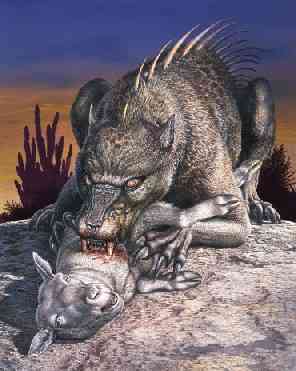
He opened the door, revealing a hairless, lightly scaled dog-like creature with a defined ridge of quills down its back and long fangs, which it bared at the students, before turning in place, grabbing a burlap sack with its teeth, and dragging it out into the room.

"Well now," Jenkins said, marveling. "This is a treat. It's brought along some of its homemade jerky." He leaned down, allowing the creature to sniff at the back of his hand before scooping the bag up. It whined in the back of its throat and wagged its tail. "This animal is, as far as I know, the only jerky-making chupacabra in the known multiverse, so all of you, please take a piece. Even if you don't eat it, it's sure to be scientifically fascinating!"
livingartifact: (Default)
[personal profile] livingartifact
"Ah, welcome back, class." Jenkins was looking slightly harried this week, with his lopsided bowtie and a few hairs out of place, but he still greeted them with his usual calm and a small bow. "M apologies for last week. Halloween got — interesting. As I gather it did for many of you as well."

Really, the less said about what Jenkins had managed to cook up after the party that night, the better.

This post is full of spiders )
livingartifact: (Default)
[personal profile] livingartifact
"Welcome back," Jenkins greeted at the top of class. "I apologize for last week. Suffice to say, when invited to go investigate a haunted toy factory, offering to burn it down from the outside and save everyone the trouble is a perfectly cromulent response."

Anyway.

"But, terrifying as they might be, toys are not considered part of the Animal Kingdom, so I shall speak no more on that topic. Instead, let us turn our attention to one of Earth's larger land-going mammals, a fantastically armored and horned creature known as the rhinoceros." A few presses of buttons on his remote had the classroom lights dimming and the slide projector clicking on, displaying an image of a single beast with two horns. "As might be expected of a creature whose name literally translates to 'nose horns', the rhinoceros is best recognized by the bony protrusions on the end of its snout. These are generally both the rhino's best weapon and worst weakness, as while one would generally not wish to experience a two-ton, ten-feet-at-the-shoulder beast bearing down on you with a two foot horn jutting from its leading end, humans have gotten extremely good at killing the creatures, which have no other natural predators, in order to harvest the horns for their purported magical properties. As a result, one species of rhinoceros, the African black rhino, has become functionally extinct in the wild, while many others remain in great danger of extinction themselves.

"Those with an interest in evolution — that is the slow process by which organic creatures tend to change to better fit the environments in which they find themselves — may find the rhinoceros particular interesting, in that human scientists have discovered a number of the rhino's evolutionary ancestors, as seen in this chart. Note the Baluchithere, whom I believe would seem almost absurdly large to even the tallest among us in this class. Unfortunately for our dear Prince, these creatures have been gone from most Earths for 23 million years, so we are unlikely to get to meet one of them. We shall, however, meet a pair of white rhinos today, named Thelma and Louise. I've arranged to have, ah." The Library's back door, since Jenkins had gotten into quite an argument with Portalocity over the cost of a quick trip to Massachusetts, "Portal set up through the classroom door there. Do mind the first step. It can be a bit of a doozy."
livingartifact: (my dad's a creep)
[personal profile] livingartifact
The classroom was just the same as it usually was, save for the conspicuous absence of the teacher. There was a note on the center of the table:

I have been unexpectedly and unavoidably detained. Please take the class time to look up and write a brief introductory report on the Earthen animal of your choice. You may use any of the moddable texts provided in this room.
livingartifact: (it was nothing)
[personal profile] livingartifact
"Welcome back, students," Jenkins greeted at the top of the class. The projector screen had been hung again, and an old reel-to-reel film projector was set out in the center of the table, behind the slide projector. "I hope you all had interesting weekends, whether or not you had any guests to visit. I certainly found my meetings with your varied friends and family quite enlightening.

"This is, I believe, our last class before the autumn break. The school is sponsoring a skiing trip during the break, so I thought it might be interesting to take a look at a creature native to snowy, mountainous regions — though I shouldn't think you'll be so unlucky as to encounter them in the Austrian Alps. If you should meet with one — and survive — I would be very much obliged if you could collect a sample or two. . . . I suppose I am getting ahead of myself. Our topic of the week is the Norwegian troll."

TROLL! )
livingartifact: (I'm not your butler)
[personal profile] livingartifact
Jenkins had sent notification this week for the class to meet at the Portalocity office in town, and to bring jackets. After a quick headcount and some quiet negotiations with the attendant, a portal opened, and Jenkins ushered the students through, straightening his jacket and adjusting his bow tie as he cleared the portal edge and it closed behind them. He gave the scenery around them a thoughtful look.

"Mountains in the distance, sparse and grassy vegetation, high altitude, lovely chill in the air. . . . I tell you, I did not think that would work." He set his hands on his hips and nodded. "Welcome, students, to the Tibetan Plateau."

Meet three not-unicorns? )

[tl;dr: chiru, kiang, and yak]
livingartifact: (this had better not muss my suit)
[personal profile] livingartifact
A note on the door of the usual classroom directed the students today to gather in the Danger Shop, where they would find Jenkins waiting for them in a room very much like the one where they usually met, only with perhaps even more miscellaneous ephemera.

"Ah," Jenkins said when it was time for class to start. "You've found the place. Excellent. Let's get down to business, then, we've got two animals to cover today, so any stragglers will simply have to do their best to catch up. Today we shall be discussing — and meeting, at least in a way — Mellivora capensis and Indicator indicator. Or as they are better known to English speaking audiences, 'the crazy nasty-ass honey badger' and 'the honeyguide'. I'm afraid that last one is one of those rare beasts whose latinate name is its most interesting."

We can categorically state that we have not released man-eating badgers into the area )
livingartifact: (it was nothing)
[personal profile] livingartifact
The classroom appeared much the same as it had last week, albeit much more dimly lit, and with the addition of two new chairs at the table, one extra large and one resembling a fancy barstool, extra-high with an almost ladder-like arrangement of horizontal supports. There were also a half dozen or so rolling step stools of varying heights.

Jenkins was glad to see his students were willing to assist each other when necessary, but was chagrined that such assistance had been required.

The chalkboard had been draped with a white cloth, and an old fashioned slide projector sat in the center of the table. A few warm, banker's lamps were scattered along the table for those who wished to take notes during the lecture.

Welcome back! )
livingartifact: (let me explain)
[personal profile] livingartifact
Introduction to Earth Zoology met in one of the standard classrooms, this week, though when the students stepped through they might be surprised to find that rather than the usual arrangement of whiteboard and individual desks, there was instead of a warmly lit room cluttered with aging electronics and ephemera, with a single long table featuring enough seats for every student, and a rolling blackboard.

Was Jenkins secretly abusing the Library's backdoor function to transport his students to a magical library full of madcap? Don't be absurd. That would be catastrophically foolish. He quite possibly did abuse it in order to make it easier to swap out the furniture about to create a more academically pleasing atmosphere though. Really, using the back door was barely using magic. It was almost impossible that it would have any lingering consequences for the students and their souls.

He promised to try not to get the students immediately killed )

(no subject)

Monday, September 5th, 2005 08:27 pm
[identity profile] humanenigma.livejournal.com
Syllabus.

Extra questions here, but answers not guaranteed.

Will be available for club sponsorships on Thursday.

Fandom High RPG


About the Game

---       Master Game Index
---       IC Community Tags
---       Thinking of Joining?
---       Application Information
---       Existing Character Directory

In-Character Comms

School and Grounds
---       Fandom High School
---       Staff Lounge
---       TA Lounge
---       Student Dorms

Around the Island
---       Fandom Town
---       Fandom Clinic

Communications
---       Radio News Recaps
---       Student Newspaper
---       IC Social Media Posts

Off-Island Travel
---       FH Trips

Once Upon a Time...
---       FH Wishverse AU


Out-of-Character Comms

---       Main OOC Comm
---       Plot Development
---       OOC-but-IC Fun


Disclaimer

Fandom High is a not-for-profit text-based game/group writing exercise, featuring fictional characters and settings from a variety of creators, used without permission but for entertainment purposes only.

Tags