
Kitty Pryde-Barton (![[personal profile]](https://www.dreamwidth.org/img/silk/identity/user.png) throughaphase) wrote in
throughaphase) wrote in ![[community profile]](https://www.dreamwidth.org/img/silk/identity/community.png) fandomhigh2016-01-17 08:33 pm
fandomhigh2016-01-17 08:33 pm
throughaphase) wrote in fandomhigh2016-01-17 08:33 pm


Entry tags:
Computer Science- Monday- 1st period
The class was definitely in the Danger Shop this week, which was made to look like a huge room filled with displays in glass, like in a museum.
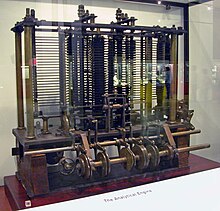
"Today we're going to start off with some history," Kitty began, leading them to the first display. "People have been computing forever, even back when all they had to use were their fingers, and then someone created an abacus, and then there were years and years of trying to make the sort of computer we know and love, with no success until 1833. That's when Charles Babbage, considered the father of the modern computer, created an Analytical Machine. It could do math, even finding square roots, and used programming language not too unlike what we use now. But it ran into problems because it had to be built by hand, which caused problems in production, which led to the whole thing being scrapped. After that, people kept coming up with analog computers, a lot for military and seafaring purposes, and that ended in hybrid computers-" Say hello to the second display! "-which bridged the gap between the analog and digital age.
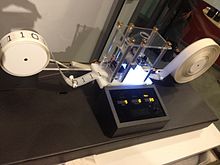
"The principle of the modern computer was invented by Alan Turing, who proposed that computers could do anything with algorithms. His hypothetical devices became known as Turing machines." Now they arrived at the third display. "They basically read data input onto it from a tape. Then World War II came along, and everyone was trying to come up with something. The first electromechanical computer came from German scientist Konrad Zuse, called the Z23, which ran on the Turing method. And then the first programmable, electronic, digital computer was known as the Colossus computers. It's ridiculously huge, and ran on vacuum tubes, and I'm going to let you guys all take a minute to check it out."
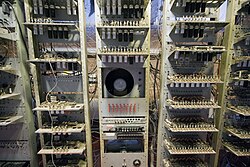
Needless to say, the Colossus was a big display.
When she felt they'd had enough time, Kitty led them to the next one. "The first stored-program computer was called Baby, and was created in 1948, though the EDSAC, or Electronic Delay Storage Automatic Calculator, was more recognizable to us now. By the fifties they started figuring out how to better use the CPU, and in the sixties we got the Atlas Computer, known as the world's first supercomputer. Looks a little more familiar, right? After that, companies like IBM and Apple started getting things to where we are now. The Apple II came out in the late seventies, and while it couldn't do much of anything by today's standards, all of a sudden people could use computers for themselves.
"Now, you've just had a long and probably boring lecture," Kitty said. "Now you're going to get on an old school computer and play a game, so time to wake up."
"Today we're going to start off with some history," Kitty began, leading them to the first display. "People have been computing forever, even back when all they had to use were their fingers, and then someone created an abacus, and then there were years and years of trying to make the sort of computer we know and love, with no success until 1833. That's when Charles Babbage, considered the father of the modern computer, created an Analytical Machine. It could do math, even finding square roots, and used programming language not too unlike what we use now. But it ran into problems because it had to be built by hand, which caused problems in production, which led to the whole thing being scrapped. After that, people kept coming up with analog computers, a lot for military and seafaring purposes, and that ended in hybrid computers-" Say hello to the second display! "-which bridged the gap between the analog and digital age.

"The principle of the modern computer was invented by Alan Turing, who proposed that computers could do anything with algorithms. His hypothetical devices became known as Turing machines." Now they arrived at the third display. "They basically read data input onto it from a tape. Then World War II came along, and everyone was trying to come up with something. The first electromechanical computer came from German scientist Konrad Zuse, called the Z23, which ran on the Turing method. And then the first programmable, electronic, digital computer was known as the Colossus computers. It's ridiculously huge, and ran on vacuum tubes, and I'm going to let you guys all take a minute to check it out."
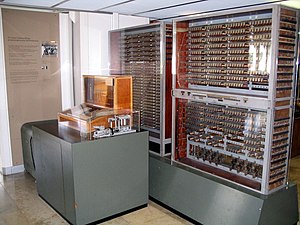

Needless to say, the Colossus was a big display.
When she felt they'd had enough time, Kitty led them to the next one. "The first stored-program computer was called Baby, and was created in 1948, though the EDSAC, or Electronic Delay Storage Automatic Calculator, was more recognizable to us now. By the fifties they started figuring out how to better use the CPU, and in the sixties we got the Atlas Computer, known as the world's first supercomputer. Looks a little more familiar, right? After that, companies like IBM and Apple started getting things to where we are now. The Apple II came out in the late seventies, and while it couldn't do much of anything by today's standards, all of a sudden people could use computers for themselves.


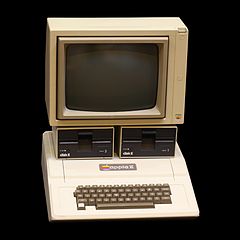
"Now, you've just had a long and probably boring lecture," Kitty said. "Now you're going to get on an old school computer and play a game, so time to wake up."
Re: Listen to the lecture
Look, this was like being in Jurassic Park for her, okay?