
http://bootlessjane.livejournal.com/ (![[identity profile]](https://www.dreamwidth.org/img/silk/identity/openid.png) bootlessjane.livejournal.com) wrote in
bootlessjane.livejournal.com) wrote in ![[community profile]](https://www.dreamwidth.org/img/silk/identity/community.png) fandomhigh2011-06-07 09:51 am
fandomhigh2011-06-07 09:51 am
bootlessjane.livejournal.com) wrote in fandomhigh2011-06-07 09:51 am


Entry tags:
Your African Expedition Adventure!, Tuesday, Period Four [06/07 ].
As difficult as it was, Jane was doing a spectacular job of putting aside the events of the weekend and the truly disgusting person she'd decided to be, so that she could focus on class and her lesson. Really, it was the perfect way to forget all about that, until she got back home to her apartment to clean up all the Slim Jim wrappers and send all the upending undergarments from her drawers through some incredibly thorough washing.
"Welcome back, ladies and gentleman," she greeted them with her usual smile, chalk at the ready as they gathered in their sunny jungle clearing classroom. "Now that we've finally gotten a break in the rain, let's go over our lesson in water procurement, especially since last week we talked about food. Food is important, but water is ever so much more important for survival in the sweltering African jungles. Thankfully, even if we should manage to empty out our canteens, there are many ways of finding more waters for replenishment.
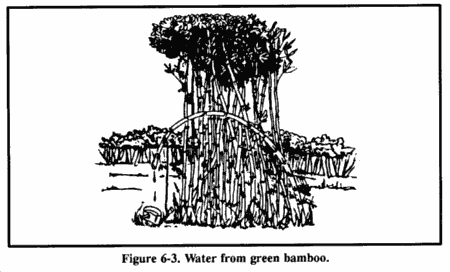
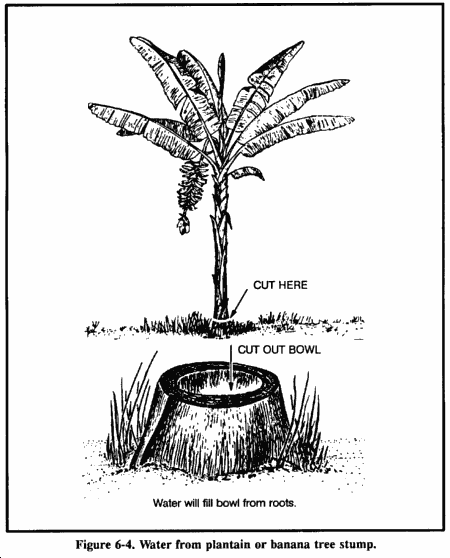
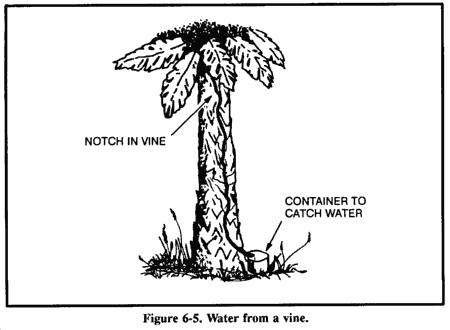
"As far as sources of water in the jungle, the best time for collecting water is just before sunrise, when dew may sometimes be found clinging to leaves and grass. You can just wring the leaves right into a container, and continue doing so until it's full right up. Water can be pooled inside trees; follow bees and ants as a good indication that there might be some, where then you can siphon or scoop the water up for your own use. And green bamboo can be thick in the African jungle; to get water from there, allow me to show you neat trick of bending the stalk and slicing the top, and, eventually, the water will helpfully just drip right out! You can also cut toward the stump of a banana tree to find water bowled inside, as well as with slicing open vines.
"But remember, always purify your water before drinking it. You want to be known for your explorations, not for discovering some new and terrible way of dying from awful and painful disease! If the water is sticky, milky, or has a bitter taste, you'd best avoid drinking it and seek elsewhere. Another thing to keep in mind is that if you extract the water from trees and there is sap involved, you'll want to use it within twenty four hours. After that, it begins to ferment, and, well, that just least to a whole world of trouble, if you know what I mean. But, of course, you're students, so I certainly hope you don't know too much. Purifying water can be very simple. You may have purifying tablets with you, or perhaps some iodine; a little pinch of that should help. But the best way is to simply boil the water, for at least ten minutes. This will kill off any nasty diseases that might be inside, so that you can avoid dying of, you know, dysentery, cholera, typhoid, and probably a treasure trove of other ones we don't even know about yet!
"There are also a few methods of water filtration that we'll go over, as well. And adding charcoal to the fire boiling your water and then letting it sit for three fourth of an hour will allow you to remove any unpleasant odors. Sometimes, ensuring to have clean water is an act in patience, so make sure you do it before you need it.
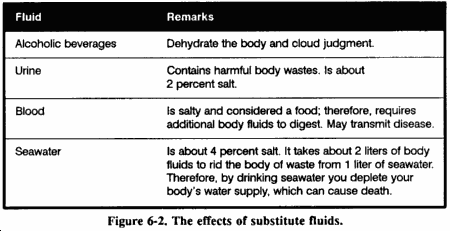
"Many people will resort to a few alternate sources of fluid, such as urine or blood, but there are very important considerations with those. Urine contains a great deal of salt which can continue to dehydrate you further; blood is considered more of a food than a source of water replenishment, so they are only to be considered in the most desperate of cases.
"Knowledge of how to build a still is also helpful, as they'll aid in drawing moisture from the ground and from plant material. There are several different kinds, from above ground and below ground, which I'll show you in a moment. The important thing to keep in mind with stills is to never use poisonous plants, else you'll get poisonous liquid."
Jane went on, with diagrams and words, until all boards were filled and then she demonstrated deftly some of the filtration systems and stills she had previously discussed. When that was finished, she beamed at the students, who seemed so good at following along. "So there you have it! Plenty of ways to extract water in the jungles so that you don't die of dehydration, and ways to purify it so that you don't die in other ways. If there are no questions, then let us traipse off and put some of these skills to use!"
[[here comes the OCD is well hydrated! ]]
"Welcome back, ladies and gentleman," she greeted them with her usual smile, chalk at the ready as they gathered in their sunny jungle clearing classroom. "Now that we've finally gotten a break in the rain, let's go over our lesson in water procurement, especially since last week we talked about food. Food is important, but water is ever so much more important for survival in the sweltering African jungles. Thankfully, even if we should manage to empty out our canteens, there are many ways of finding more waters for replenishment.
"As far as sources of water in the jungle, the best time for collecting water is just before sunrise, when dew may sometimes be found clinging to leaves and grass. You can just wring the leaves right into a container, and continue doing so until it's full right up. Water can be pooled inside trees; follow bees and ants as a good indication that there might be some, where then you can siphon or scoop the water up for your own use. And green bamboo can be thick in the African jungle; to get water from there, allow me to show you neat trick of bending the stalk and slicing the top, and, eventually, the water will helpfully just drip right out! You can also cut toward the stump of a banana tree to find water bowled inside, as well as with slicing open vines.
"But remember, always purify your water before drinking it. You want to be known for your explorations, not for discovering some new and terrible way of dying from awful and painful disease! If the water is sticky, milky, or has a bitter taste, you'd best avoid drinking it and seek elsewhere. Another thing to keep in mind is that if you extract the water from trees and there is sap involved, you'll want to use it within twenty four hours. After that, it begins to ferment, and, well, that just least to a whole world of trouble, if you know what I mean. But, of course, you're students, so I certainly hope you don't know too much. Purifying water can be very simple. You may have purifying tablets with you, or perhaps some iodine; a little pinch of that should help. But the best way is to simply boil the water, for at least ten minutes. This will kill off any nasty diseases that might be inside, so that you can avoid dying of, you know, dysentery, cholera, typhoid, and probably a treasure trove of other ones we don't even know about yet!
"There are also a few methods of water filtration that we'll go over, as well. And adding charcoal to the fire boiling your water and then letting it sit for three fourth of an hour will allow you to remove any unpleasant odors. Sometimes, ensuring to have clean water is an act in patience, so make sure you do it before you need it.

"Many people will resort to a few alternate sources of fluid, such as urine or blood, but there are very important considerations with those. Urine contains a great deal of salt which can continue to dehydrate you further; blood is considered more of a food than a source of water replenishment, so they are only to be considered in the most desperate of cases.
"Knowledge of how to build a still is also helpful, as they'll aid in drawing moisture from the ground and from plant material. There are several different kinds, from above ground and below ground, which I'll show you in a moment. The important thing to keep in mind with stills is to never use poisonous plants, else you'll get poisonous liquid."


Jane went on, with diagrams and words, until all boards were filled and then she demonstrated deftly some of the filtration systems and stills she had previously discussed. When that was finished, she beamed at the students, who seemed so good at following along. "So there you have it! Plenty of ways to extract water in the jungles so that you don't die of dehydration, and ways to purify it so that you don't die in other ways. If there are no questions, then let us traipse off and put some of these skills to use!"
[[
The Expedition - YAEA!, 06/07.
Jane handed each student an empty canteen on their way out of the 'classroom.'
"I expect you each to have a full canteen by the end of class," she chirped happily. "Good luck, and let me know if you should need anything."
Re: The Expedition - YAEA!, 06/07.
At the end of the class, he had a full canteen of water and a slight crik in his back.