
http://stargazer-ellie.livejournal.com/ (![[identity profile]](https://www.dreamwidth.org/img/silk/identity/openid.png) stargazer-ellie.livejournal.com) wrote in
stargazer-ellie.livejournal.com) wrote in ![[community profile]](https://www.dreamwidth.org/img/silk/identity/community.png) fandomhigh2006-07-12 08:12 am
fandomhigh2006-07-12 08:12 am
stargazer-ellie.livejournal.com) wrote in fandomhigh2006-07-12 08:12 am


Entry tags:
Observational Astronomy -- July 12
Week 1 - Introduction to Observational Astronomy II; the Milky Way; the Big and Little Dippers, Cassiopeia
Star maps: East | West | North | South | Overhead
Ellie waited for the students at the main campfire as her email had said. When everyone was there, she led them down to the beach for a unobstructed view of the sky. There were a few wispy clouds, but for the most part the skies were clear.Watch me mod the weather, whee! Ellie handed out copies of starmaps and extra binoculars for those who needed them, then began her lecture.
"Welcome to Observational Astronomy! I'm Dr. Ellie Arroway, but please, call me Ellie, and I'll be teaching you about the wonderful things you can find in the night sky. As you will soon learn I love astronomy and sometimes tend to ramble when I teach, so please feel free to interrupt with questions at any time, or let me know if you have trouble finding anything I'm pointing out. I see a couple of faces I recognize, and while some of this material is going to be familiar to you, we'll hit some new constellations toward the end of the session, as the fall constellations start to rise.
"If you look -- really look -- at the stars, you'll see they aren't just points of white light. Some are bright yellow, some are orange, almost red, and some are blue! So what do the star colors mean? Why would one star be blue and another red? Different colors show different temperatures. So which star color is the hottest? Just like a flame, blue is the hottest part, yellow is next, red is the coolest. Our sun is a yellow star, about 10,000°F at the surface. A red star is about half the sun's surface temperature, whereas a blue star is three to five times as hot as the sun. White stars are somewhere between the yellow ones and blue ones.
"Now, all stars are made of pretty much the same stuff -- about 90% hydrogen and the rest is helium with some traces of other stuff. So, why would one star be burning hotter than another? The answer is in the size of the star. The more massive it is, the more pressure there is at the center and therefore the hotter -- and for that matter the brighter -- the star burns. So blue stars are the biggest and brightest of stars, and red stars are the smallest and dimmest.
"There are exceptions to the rule, however. As a star burns up all the hydrogen at its center, it starts to burn helium (which is the 'ash' from the hydrogen burning), which makes it expand, get brighter, and turn red -- it becomes a red giant. This is the time you can get a bright red star, when the star is near the end of its life. When our sun starts burning out it will expand so big it will swallow up Mercury and Venus and scorch the surface of the earth to a cinder. If you are hoping to see all that happen you will have to wait about 5 billion years.
"Our Sun is a star in the Milky Way Galaxy. If you were looking down on the Milky Way, it would look like a large pinwheel rotating in space. In ancient times, before artificial light and other sorts of pollution in the night sky, our galaxy made a much more noticeable band of stars. A myth by the ancient Greeks said this white streak was a 'river of milk.' The ancient Romans called it the Via Galactica, or 'road made of milk.' This is how our galaxy became known as the Milky Way.And yes, that does mean 'Battlestar Galactica' means 'battlestar made of milk.'
"Tonight we're going to start with three of the easiest constellations to spot. You probably already know them. Look up and find the Big Dipper. It looks like a ladle, scooping up the stars. The Big Dipper is not actually a constellation. It's an asterism, which is a pattern of stars within or part of a constellation. Interestingly, in other parts of the world, these seven stars are known not as a Dipper, but as some sort of a wagon. In Ireland, for instance, it was recognized as 'King David's Chariot,' from one of that island's early kings; in France, it was the 'Great Chariot.' And in the British Isles, these seven stars are known widely as 'The Plough.'
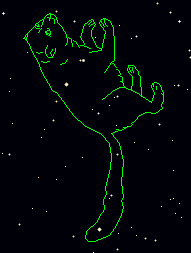
"The Big Dipper is part of Usra Major, or the Great Bear. If you use your imagination, you can see the head of the bear and its legs and tail. Legend says the bear is actually Callisto, a woman seduced by Zeus and changed into a bear by Hera in revenge. When Callisto's son nearly killed her in a hunt, Zeus placed them both in the sky as Ursa Major and Ursa Minor.
"The Bear's paws are also known as the Three Leaps of the Gazelle. This asterism is the sequence of three pairs of stars - normally seen as the paws of Ursa Major. The story is that Leo the Lion startled a gazelle, who in turn dashed off across a great celestial pond, leaving a pair of stars marking each of the three leaps.
"Take a close look at the handle of the Big Dipper. In the part that bends, you will see that there are actually two stars, not one. Most people are surprised by that because they never noticed it. Yet, once it is pointed out, most people can readily see the two stars. The larger star is Mizar. Alcor is the smaller star. Can you see them?
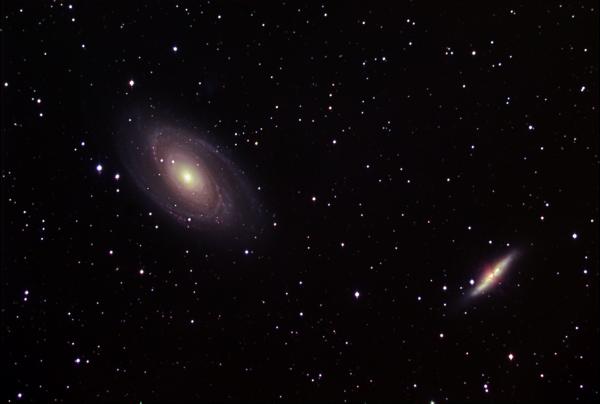
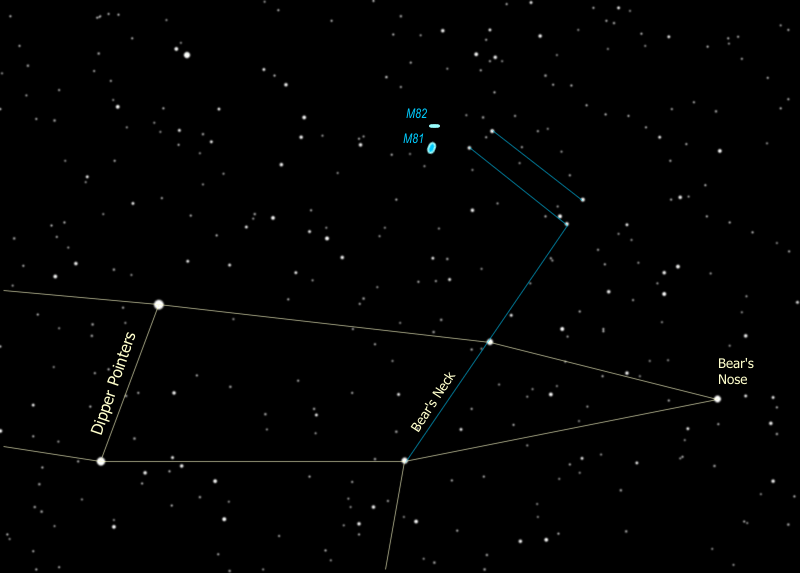
"We can find two of the best and brightest galaxies in the sky just above the two stars that form the neck of the Ursa Major -- they are M81, Bode's Galaxy, and its neighbor M82, the Cigar Galaxy. Use the binoculars and follow the line of the Bear's neck to a skinny triangle, then go sideways to find a pair of stars that point the same direction as the triangle does. Just a little farther you find M81, a faint fuzzy spot just off the end of the arc of three faint stars nearby. See it? This faint fuzzy spot is a huge galaxy, 4.5 MILLION light years away -- about twice as far away as the Andromeda galaxy. There are actually two galaxies there. The other one is M82 and it is much flatter than M81. It is also much farther -- about four times as far, 16 million light years away.
"The Big Dipper is very helpful when it comes to locating the North Star, also called Polaris, the pole star. If you were standing at the North Pole, it would be just about overhead. Unlike the rest of the stars, Polaris does not appear to change its position in the sky. Since it is not a bright star, it doesn't stand out. However, if you can find the Big Dipper, you can easily find Polaris. Draw an imaginary line through the two stars at the front of the bowl of the Big Dipper. The first star you come to will be Polaris. Polaris is the end of the tail of Ursa Minor, the Little Bear, or the Little Dipper. Ursa Minor is said to be Arcas, the son of Callisto and Zeus.
"The Big Dipper can also help you find Cassiopeia, the Queen. She and the Big Dipper are always on opposite sides of Polaris. Draw that imaginary line I just mentioned from the Big Dipper to Polaris and keep going. The line will pass just below Cassiopeia, who looks like the letter 'W' or 'M.' Cassiopeia is an ancient queen, reclining in her chair.
"There are several interesting objects in Cassiopeia, like Messier Object #52, or 'M52,' one of many 'M' objects named after a catalog published in the late 1700's by the Frenchman Charles Messier. Messier was a comet hunter of great renown who published a catalog of fuzzy things that might be confused with comets. These ended up being some of the most interesting objects in the sky. When you find M52 you are looking at a 'young' cluster of about 200 stars -- young means that it is only about 100 million years old. The cluster is 10 light years in diameter and 3000 light years away from us, which is why you need the binoculars to see it.
"Any questions?"
Star maps: East | West | North | South | Overhead
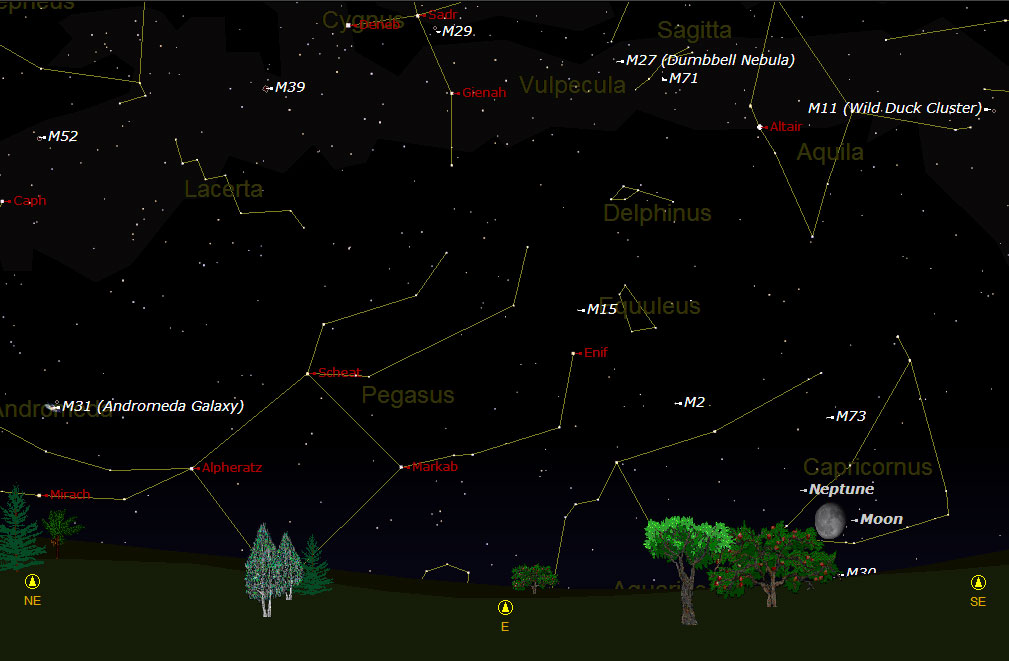

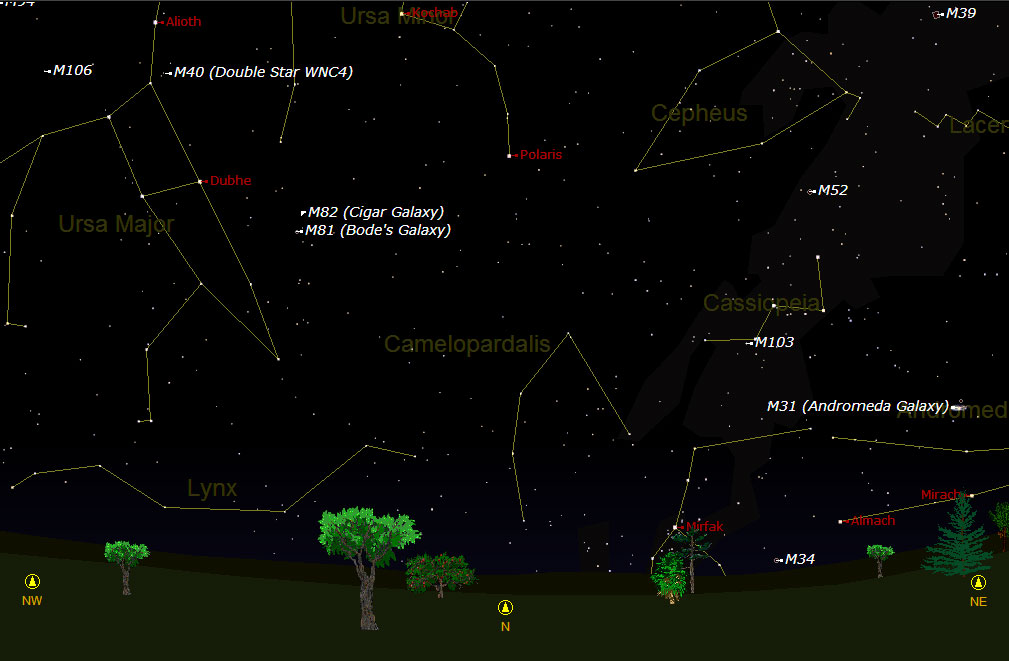
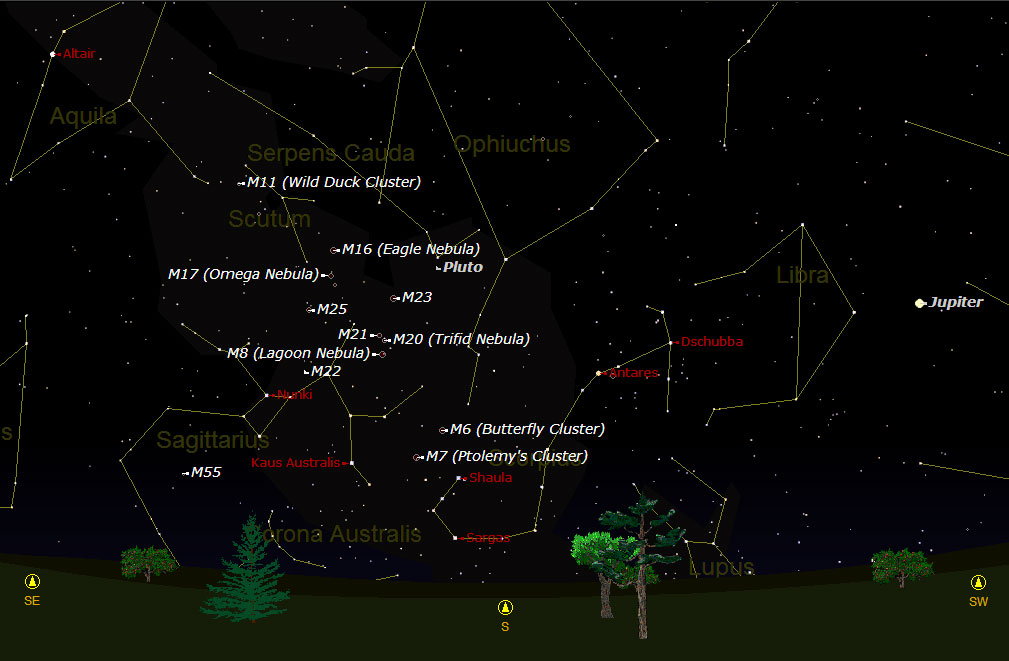

Ellie waited for the students at the main campfire as her email had said. When everyone was there, she led them down to the beach for a unobstructed view of the sky. There were a few wispy clouds, but for the most part the skies were clear.
"Welcome to Observational Astronomy! I'm Dr. Ellie Arroway, but please, call me Ellie, and I'll be teaching you about the wonderful things you can find in the night sky. As you will soon learn I love astronomy and sometimes tend to ramble when I teach, so please feel free to interrupt with questions at any time, or let me know if you have trouble finding anything I'm pointing out. I see a couple of faces I recognize, and while some of this material is going to be familiar to you, we'll hit some new constellations toward the end of the session, as the fall constellations start to rise.
"If you look -- really look -- at the stars, you'll see they aren't just points of white light. Some are bright yellow, some are orange, almost red, and some are blue! So what do the star colors mean? Why would one star be blue and another red? Different colors show different temperatures. So which star color is the hottest? Just like a flame, blue is the hottest part, yellow is next, red is the coolest. Our sun is a yellow star, about 10,000°F at the surface. A red star is about half the sun's surface temperature, whereas a blue star is three to five times as hot as the sun. White stars are somewhere between the yellow ones and blue ones.
"Now, all stars are made of pretty much the same stuff -- about 90% hydrogen and the rest is helium with some traces of other stuff. So, why would one star be burning hotter than another? The answer is in the size of the star. The more massive it is, the more pressure there is at the center and therefore the hotter -- and for that matter the brighter -- the star burns. So blue stars are the biggest and brightest of stars, and red stars are the smallest and dimmest.
"There are exceptions to the rule, however. As a star burns up all the hydrogen at its center, it starts to burn helium (which is the 'ash' from the hydrogen burning), which makes it expand, get brighter, and turn red -- it becomes a red giant. This is the time you can get a bright red star, when the star is near the end of its life. When our sun starts burning out it will expand so big it will swallow up Mercury and Venus and scorch the surface of the earth to a cinder. If you are hoping to see all that happen you will have to wait about 5 billion years.
"Our Sun is a star in the Milky Way Galaxy. If you were looking down on the Milky Way, it would look like a large pinwheel rotating in space. In ancient times, before artificial light and other sorts of pollution in the night sky, our galaxy made a much more noticeable band of stars. A myth by the ancient Greeks said this white streak was a 'river of milk.' The ancient Romans called it the Via Galactica, or 'road made of milk.' This is how our galaxy became known as the Milky Way.
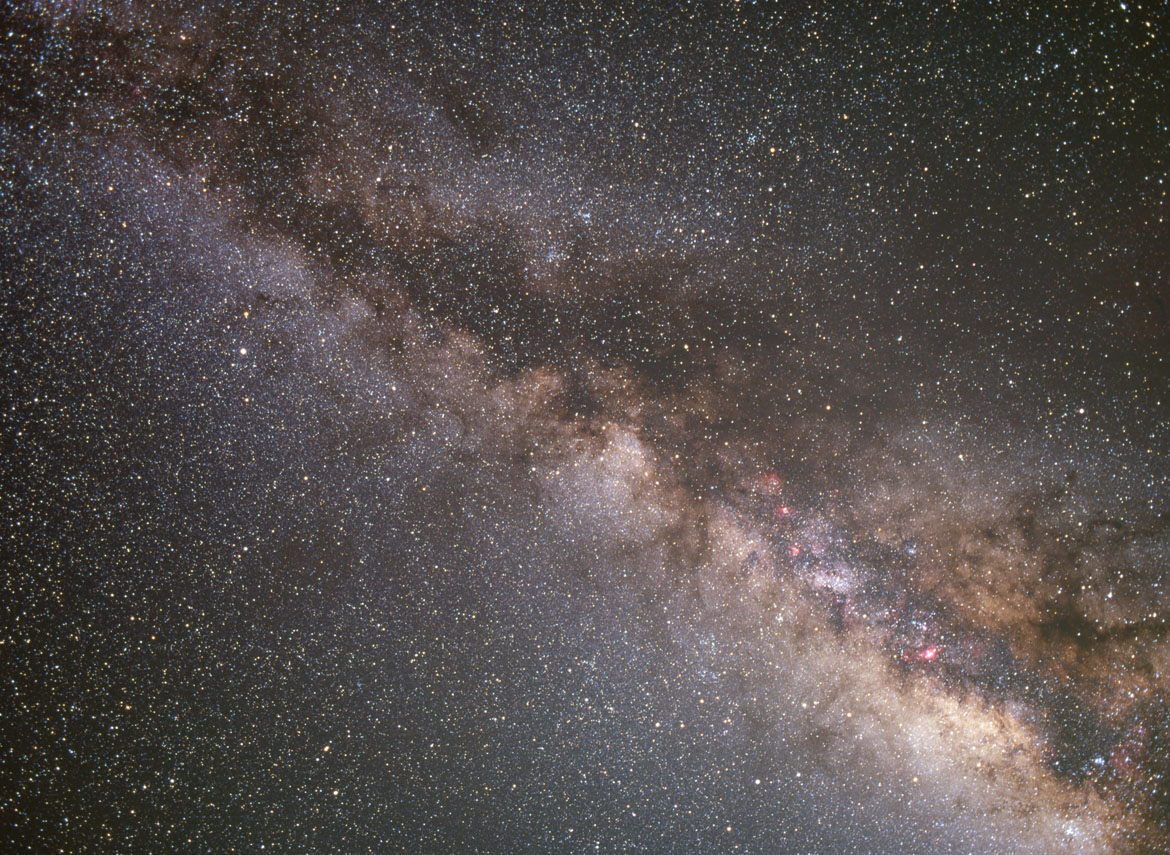
"Tonight we're going to start with three of the easiest constellations to spot. You probably already know them. Look up and find the Big Dipper. It looks like a ladle, scooping up the stars. The Big Dipper is not actually a constellation. It's an asterism, which is a pattern of stars within or part of a constellation. Interestingly, in other parts of the world, these seven stars are known not as a Dipper, but as some sort of a wagon. In Ireland, for instance, it was recognized as 'King David's Chariot,' from one of that island's early kings; in France, it was the 'Great Chariot.' And in the British Isles, these seven stars are known widely as 'The Plough.'
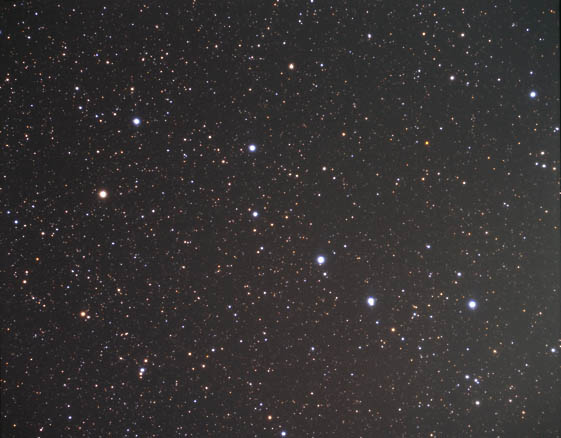
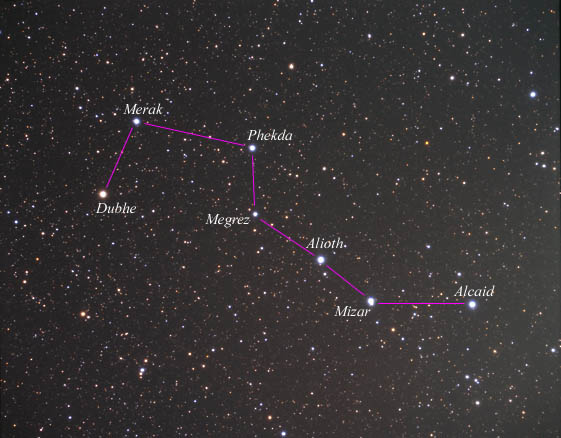
"The Big Dipper is part of Usra Major, or the Great Bear. If you use your imagination, you can see the head of the bear and its legs and tail. Legend says the bear is actually Callisto, a woman seduced by Zeus and changed into a bear by Hera in revenge. When Callisto's son nearly killed her in a hunt, Zeus placed them both in the sky as Ursa Major and Ursa Minor.
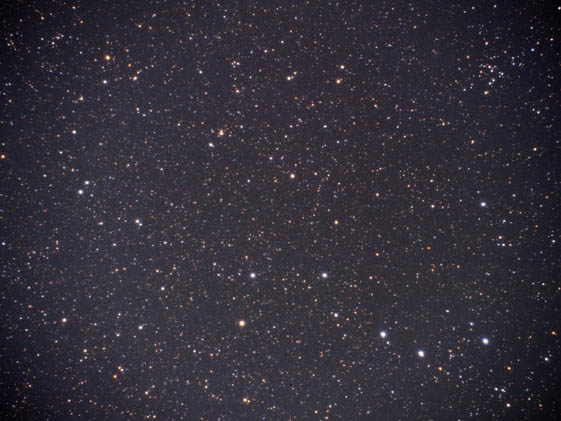
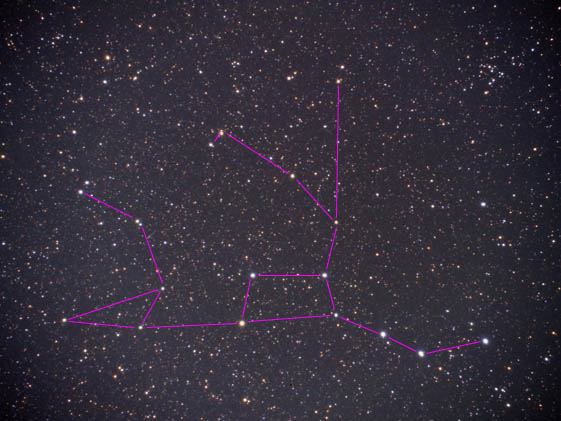

"The Bear's paws are also known as the Three Leaps of the Gazelle. This asterism is the sequence of three pairs of stars - normally seen as the paws of Ursa Major. The story is that Leo the Lion startled a gazelle, who in turn dashed off across a great celestial pond, leaving a pair of stars marking each of the three leaps.
"Take a close look at the handle of the Big Dipper. In the part that bends, you will see that there are actually two stars, not one. Most people are surprised by that because they never noticed it. Yet, once it is pointed out, most people can readily see the two stars. The larger star is Mizar. Alcor is the smaller star. Can you see them?
"We can find two of the best and brightest galaxies in the sky just above the two stars that form the neck of the Ursa Major -- they are M81, Bode's Galaxy, and its neighbor M82, the Cigar Galaxy. Use the binoculars and follow the line of the Bear's neck to a skinny triangle, then go sideways to find a pair of stars that point the same direction as the triangle does. Just a little farther you find M81, a faint fuzzy spot just off the end of the arc of three faint stars nearby. See it? This faint fuzzy spot is a huge galaxy, 4.5 MILLION light years away -- about twice as far away as the Andromeda galaxy. There are actually two galaxies there. The other one is M82 and it is much flatter than M81. It is also much farther -- about four times as far, 16 million light years away.
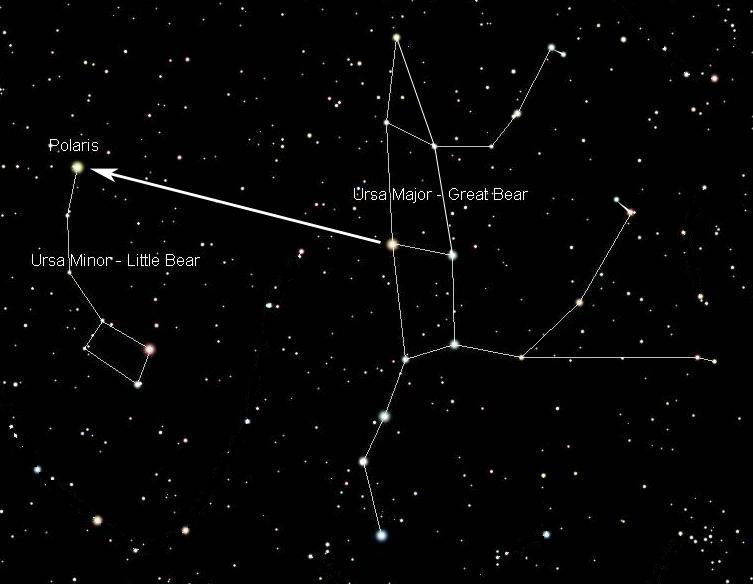
"The Big Dipper is very helpful when it comes to locating the North Star, also called Polaris, the pole star. If you were standing at the North Pole, it would be just about overhead. Unlike the rest of the stars, Polaris does not appear to change its position in the sky. Since it is not a bright star, it doesn't stand out. However, if you can find the Big Dipper, you can easily find Polaris. Draw an imaginary line through the two stars at the front of the bowl of the Big Dipper. The first star you come to will be Polaris. Polaris is the end of the tail of Ursa Minor, the Little Bear, or the Little Dipper. Ursa Minor is said to be Arcas, the son of Callisto and Zeus.
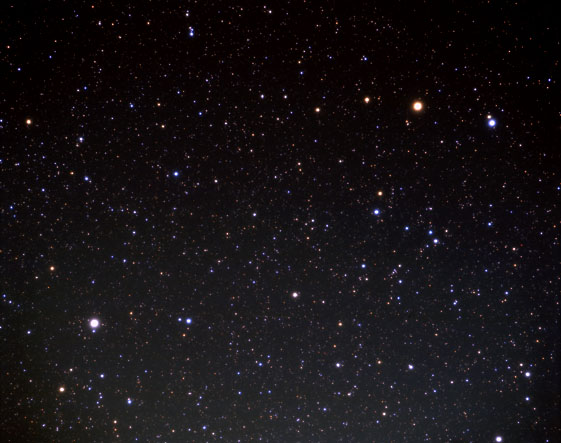
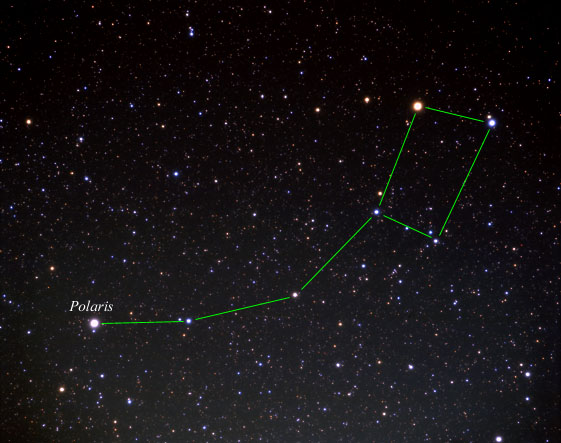
"The Big Dipper can also help you find Cassiopeia, the Queen. She and the Big Dipper are always on opposite sides of Polaris. Draw that imaginary line I just mentioned from the Big Dipper to Polaris and keep going. The line will pass just below Cassiopeia, who looks like the letter 'W' or 'M.' Cassiopeia is an ancient queen, reclining in her chair.
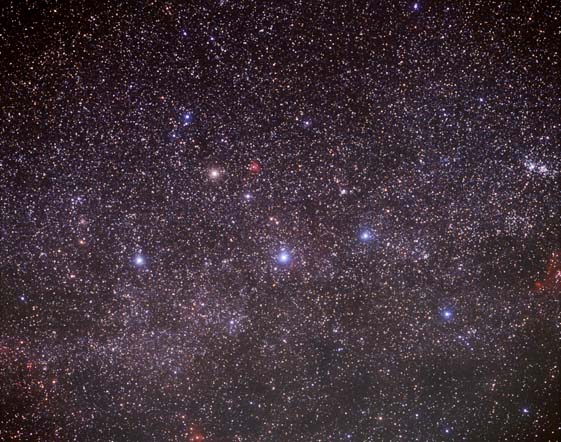
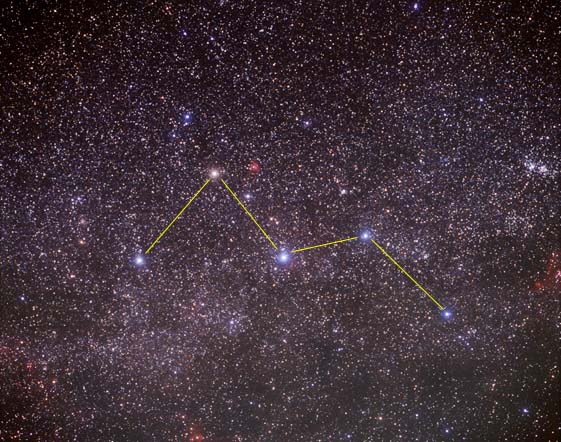

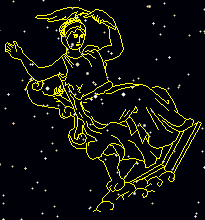
"There are several interesting objects in Cassiopeia, like Messier Object #52, or 'M52,' one of many 'M' objects named after a catalog published in the late 1700's by the Frenchman Charles Messier. Messier was a comet hunter of great renown who published a catalog of fuzzy things that might be confused with comets. These ended up being some of the most interesting objects in the sky. When you find M52 you are looking at a 'young' cluster of about 200 stars -- young means that it is only about 100 million years old. The cluster is 10 light years in diameter and 3000 light years away from us, which is why you need the binoculars to see it.

"Any questions?"
Sign In
Re: Sign In
Re: Sign In
Re: Sign In
Re: Sign In
Re: Sign In
Re: Sign In
Re: Sign In
Re: Sign In
Re: Sign In
Re: Sign In
Re: Sign In
Re: Sign In
Re: Sign In
Re: Sign In
Re: Sign In
Re: Sign In
Re: Sign In
Re: Sign In
Re: Sign In
Re: Sign In
Re: Sign In
Re: Sign In
Re: Sign In
Re: Sign In
Re: Sign In
Re: Sign In
Re: Sign In
Re: Sign In
Re: Sign In
Re: Sign In
Re: Sign In
Re: Sign In
Re: Sign In
Re: Sign In
Re: Sign In
Re: Sign In
Observe
Talk to Ellie
Re: Talk to Ellie
Re: Talk to Ellie
Re: Talk to Ellie
Re: Talk to Ellie
Re: Talk to Ellie
Re: Talk to Ellie
Re: Talk to Ellie
Re: Talk to Ellie
Re: Talk to Ellie
OOC
Re: OOC
Re: OOC
Re: OOC
*tosses you on the roof*
Re: OOC