
http://stargazer-ellie.livejournal.com/ (![[identity profile]](https://www.dreamwidth.org/img/silk/identity/openid.png) stargazer-ellie.livejournal.com) wrote in
stargazer-ellie.livejournal.com) wrote in ![[community profile]](https://www.dreamwidth.org/img/silk/identity/community.png) fandomhigh2006-07-05 08:12 am
fandomhigh2006-07-05 08:12 am
stargazer-ellie.livejournal.com) wrote in fandomhigh2006-07-05 08:12 am


Entry tags:
Observational Astronomy -- July 5
Week 7 - July 5 - The Zodiac: Libra, Scorpius, Saggitarius
[Class Roster ]
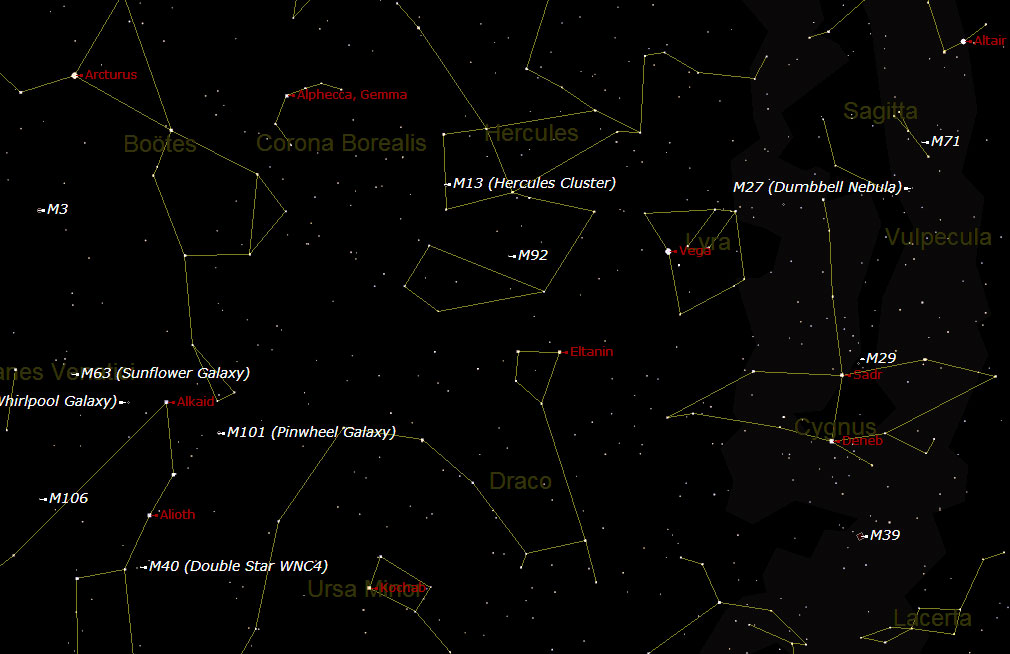
Star maps: East | West | North | South | Overhead
"Welcome to our last class for this workshop," Ellie began the class. "I hope you've enjoyed your tour of the night sky. If nothing else, you could impress a date some night." She grinned.
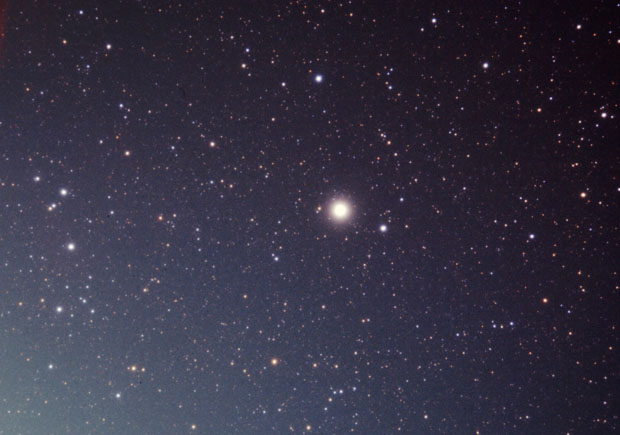
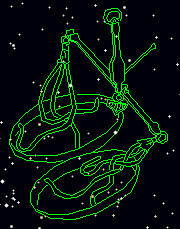
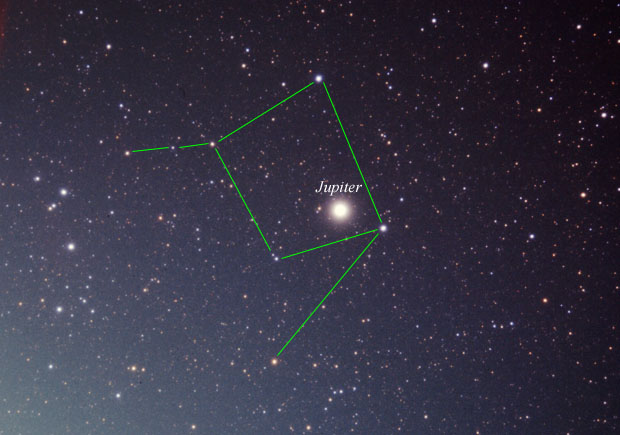
"We're going to go over some more zodiac constellations tonight. We'll start with Libra, the scales. Look west of Jupiter and the moon. Libra is next to Virgo and is made of three stars of the third magnitude. It's fairly dim and used to be part of Scorpius, which I'll show you in a minute. About over two thousand years ago, the sun passed through Libra at the autumnal equinox when day and night were of equal length, and the day would begin to shorten from that day on. It's thought that the constellation of Libra was invented to symbolize the equinox. Now the autumnal equinox has moved to Virgo because of the precession of Earth.
"Scorpius is a scorpion, a constellation that dominates the summer sky, and, unlike some constellations, looks exactly like what it's supposed to be. The asterism of a vast skewed shape of "S" was noted in many ancient cultures; for an example, it was regarded as a gigantic fishhook in Japanese fishing villages. The red star Antares is the heart of the Scorpion. Antares, which means 'Rival of Mars,' is a red super-giant and it is a first magnitude star. There is only one other red super-giant that is this bright and it's on the opposite side of the sky, in the constellation that dominates the winter sky -- the star Betelgeuse in the constellation Orion. Both stars are about 500 ly away in opposite directions so we lie just about halfway between the two. Such stars are rare -- there are only 200 known red super-giants and all are much dimmer, and therefore much farther away than these two stars.
"Even though it is a red super-giant near the end of it's life, Antares is actually a very young star, at least compared to the sun. Antares was born only about 20 million years ago, long after the dinosaurs died out, and is nearly at the end of its life already. This is because Antares is so much more massive than the sun. The greater mass causes greater pressure and forces the star to burn hotter (bluer) and faster. So Antares was once a blue supergiant with 12 times the mass of the sun, burning 6,000 times as fast as the sun. Its life as a star will only be about 2 thousandths as long the sun will live. As I've said before, with stars, the bigger they are, the harder they fall.
"The scorpion used to be a much bigger constellation. The two brightest stars of Libra have Arabic names that mean "Northern Claw" (Zubeneschamali) and "Southern Claw" (Zubenelgenubi). Say those real fast five times. The Romans cut off the scorpion's claws and created a new Zodiac constellation to fit their new, 12-month calendar.
"The bright star at the tip of the scorpion's tail is Shaula, a brilliant blue star about 310 light years away. Above and to the east of Shaula you will find two "open clusters", M6 and M7. Open clusters, also called 'galactic' clusters, are small groups of stars, maybe a hundred or so, that formed from the same (huge) cloud of gas and dust. They are very often young stars - blue ones which are large and very hot and don't last long. These two clusters are good examples, most of the brightest stars are blue ones. Groups like this eventually break up, mostly by random events, (our sun has left it's original cluster) so when they are still together like this it's another sign that the cluster is young.
"M6 is sometimes called the "Butterfly Cluster" because it looks like a butterfly with its wings open (flying toward the East). Can you see it in your binoculars? Can you spot the orange giant among the hot blue stars? M7 is more spread out (it's closer) - it can be seen perfectly well with binoculars and can even be spotted with the unaided (sharp) eye.
"The center of our galaxy is located to the South, in Sagittarius. Sagittarius represents Chiron the archer, who has a body of half-man and half-horse, taking a stance to shot an arrow at the scorpion. You can't see the entire constellation of Sagittarius but you can see the key asterisms, the Teapot and the Teaspoon. The front of the teapot is his bow and the tip of the spout is the tip of his arrow. The rest of the constellation doesn't look anything like an archer or a centaur. People often only reference the Teapot in Sagittarius, just as they talk about the Big
Dipper, instead of Ursa Major. The bright region of the Milky Way that looks like steam coming out of the spout of the Teapot marks where the center of the galaxy is, about 30,000 light years away.
"If you look at the top of the spout through binoculars then slowly scan up from there, you will come across the Lagoon Nebula (M8) and then the Trifid Nebula (M20). These are diffuse nebulae - clouds of dust and hydrogen gas - the stars you see in them are formed from the gas when it condenses together and compresses due to gravity then, under pressure, heats up and ignites. Nebulae like these, then, are the birthplaces of stars.
"This region of the sky, Sagittarius and its neighboring constellations, happens to be one that is dense with nebulae and young stars. The only other region of the sky with this much new-star formation activity is Orion and its neighboring constellations.
"If you put the binoculars right on the star at the top of the teapot, and slide to the left until the star is at the right edge of your field of view, then right in the center you will see a smudge of light. This is M22, and in a telescope you can see this is a dazzling ball made up of a half million stars, 9600 light years away. It turns out that this is pretty close for a globular cluster.
"Any questions?"
[Class Roster ]
Star maps: East | West | North | South | Overhead
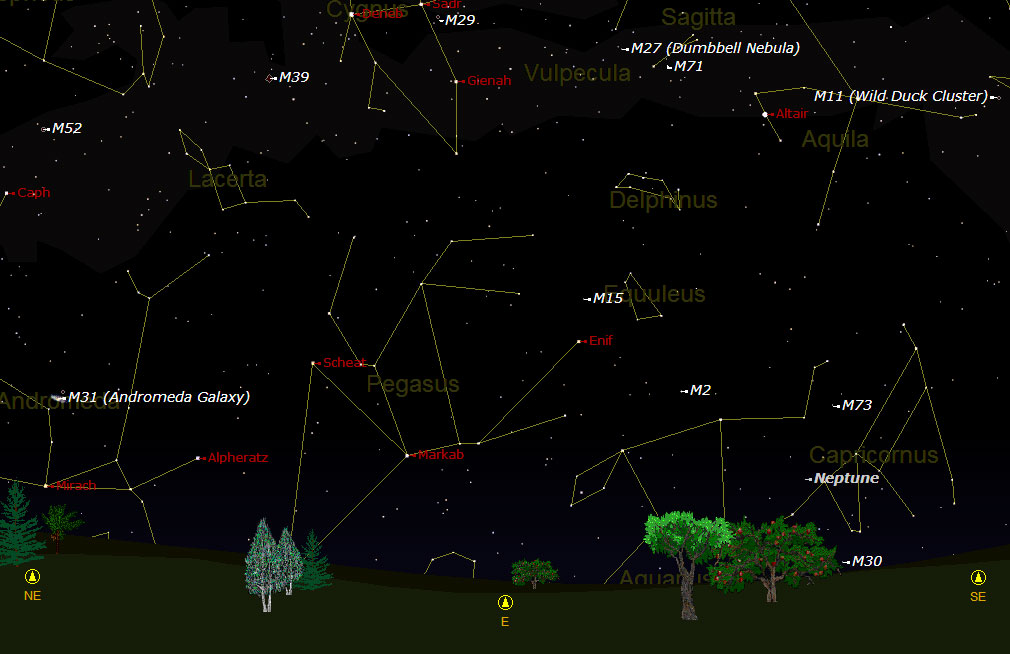
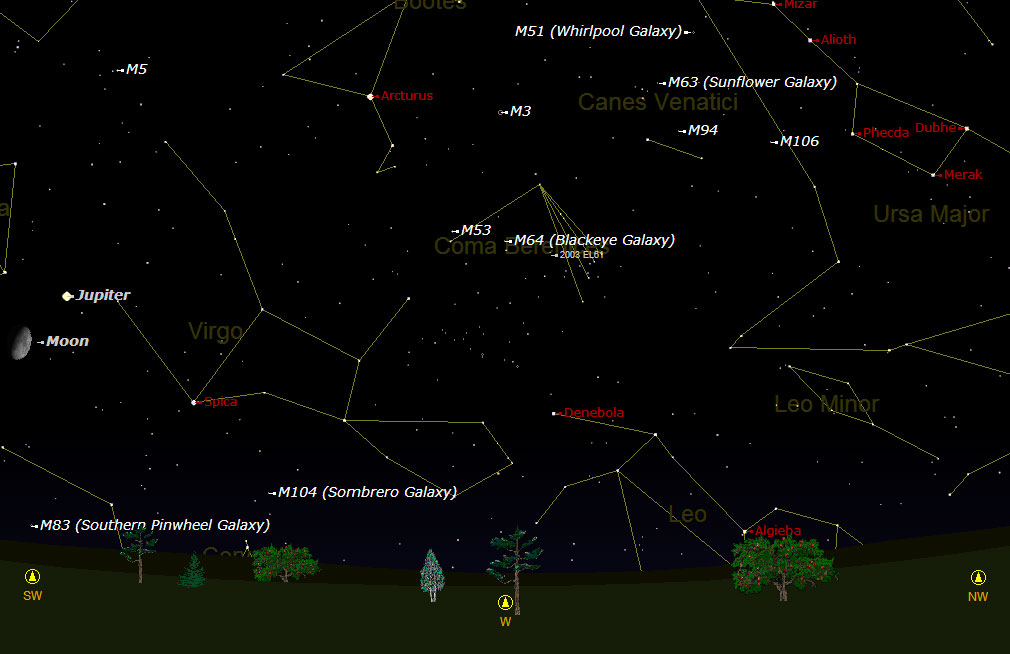
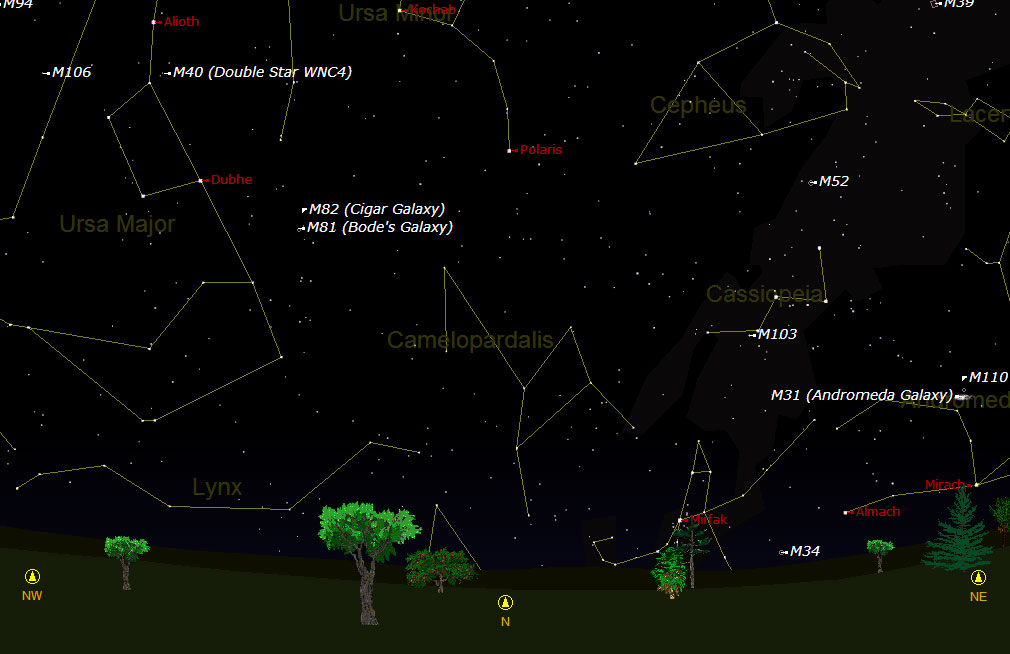
"Welcome to our last class for this workshop," Ellie began the class. "I hope you've enjoyed your tour of the night sky. If nothing else, you could impress a date some night." She grinned.
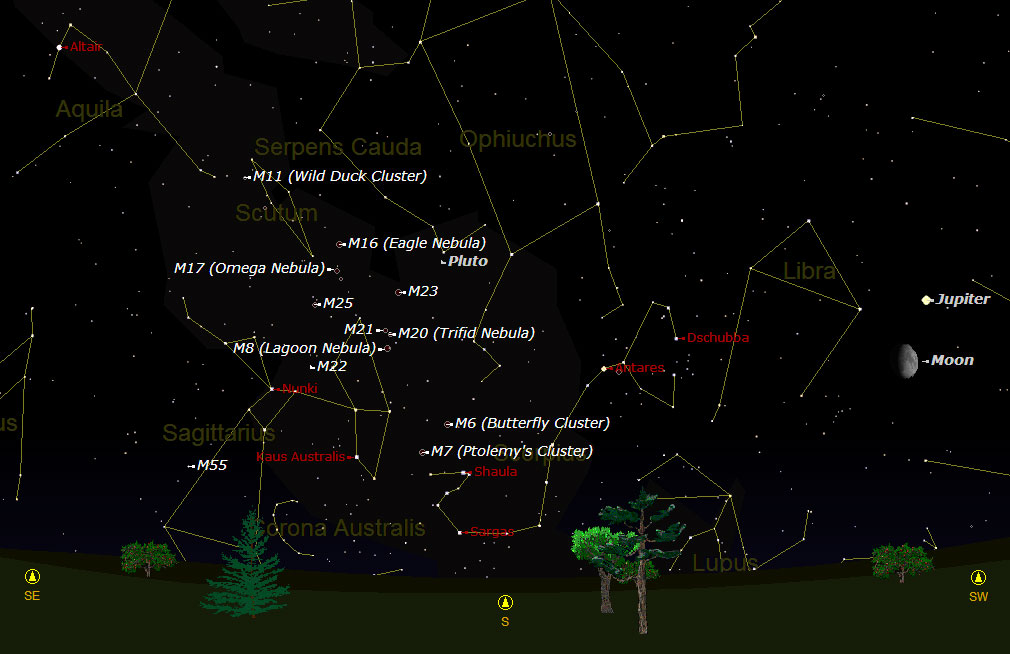
"We're going to go over some more zodiac constellations tonight. We'll start with Libra, the scales. Look west of Jupiter and the moon. Libra is next to Virgo and is made of three stars of the third magnitude. It's fairly dim and used to be part of Scorpius, which I'll show you in a minute. About over two thousand years ago, the sun passed through Libra at the autumnal equinox when day and night were of equal length, and the day would begin to shorten from that day on. It's thought that the constellation of Libra was invented to symbolize the equinox. Now the autumnal equinox has moved to Virgo because of the precession of Earth.
"Scorpius is a scorpion, a constellation that dominates the summer sky, and, unlike some constellations, looks exactly like what it's supposed to be. The asterism of a vast skewed shape of "S" was noted in many ancient cultures; for an example, it was regarded as a gigantic fishhook in Japanese fishing villages. The red star Antares is the heart of the Scorpion. Antares, which means 'Rival of Mars,' is a red super-giant and it is a first magnitude star. There is only one other red super-giant that is this bright and it's on the opposite side of the sky, in the constellation that dominates the winter sky -- the star Betelgeuse in the constellation Orion. Both stars are about 500 ly away in opposite directions so we lie just about halfway between the two. Such stars are rare -- there are only 200 known red super-giants and all are much dimmer, and therefore much farther away than these two stars.
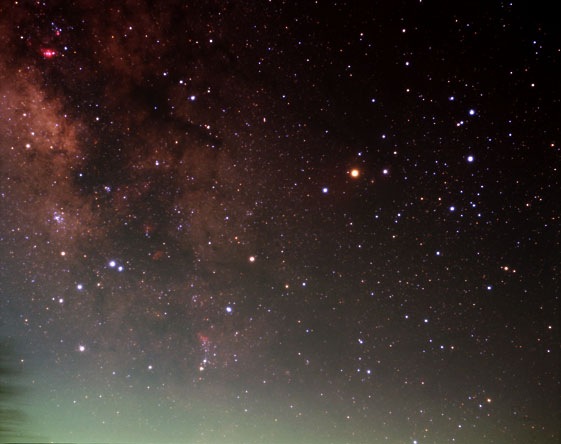

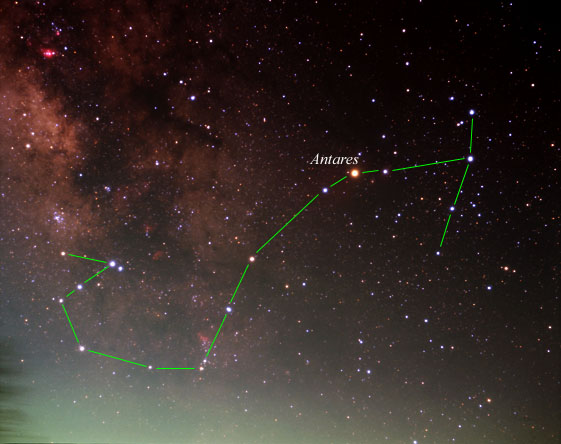
"Even though it is a red super-giant near the end of it's life, Antares is actually a very young star, at least compared to the sun. Antares was born only about 20 million years ago, long after the dinosaurs died out, and is nearly at the end of its life already. This is because Antares is so much more massive than the sun. The greater mass causes greater pressure and forces the star to burn hotter (bluer) and faster. So Antares was once a blue supergiant with 12 times the mass of the sun, burning 6,000 times as fast as the sun. Its life as a star will only be about 2 thousandths as long the sun will live. As I've said before, with stars, the bigger they are, the harder they fall.
"The scorpion used to be a much bigger constellation. The two brightest stars of Libra have Arabic names that mean "Northern Claw" (Zubeneschamali) and "Southern Claw" (Zubenelgenubi). Say those real fast five times. The Romans cut off the scorpion's claws and created a new Zodiac constellation to fit their new, 12-month calendar.

"The bright star at the tip of the scorpion's tail is Shaula, a brilliant blue star about 310 light years away. Above and to the east of Shaula you will find two "open clusters", M6 and M7. Open clusters, also called 'galactic' clusters, are small groups of stars, maybe a hundred or so, that formed from the same (huge) cloud of gas and dust. They are very often young stars - blue ones which are large and very hot and don't last long. These two clusters are good examples, most of the brightest stars are blue ones. Groups like this eventually break up, mostly by random events, (our sun has left it's original cluster) so when they are still together like this it's another sign that the cluster is young.
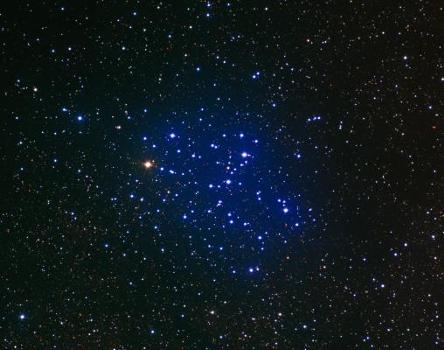
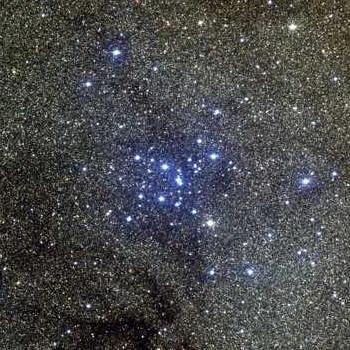
"M6 is sometimes called the "Butterfly Cluster" because it looks like a butterfly with its wings open (flying toward the East). Can you see it in your binoculars? Can you spot the orange giant among the hot blue stars? M7 is more spread out (it's closer) - it can be seen perfectly well with binoculars and can even be spotted with the unaided (sharp) eye.
"The center of our galaxy is located to the South, in Sagittarius. Sagittarius represents Chiron the archer, who has a body of half-man and half-horse, taking a stance to shot an arrow at the scorpion. You can't see the entire constellation of Sagittarius but you can see the key asterisms, the Teapot and the Teaspoon. The front of the teapot is his bow and the tip of the spout is the tip of his arrow. The rest of the constellation doesn't look anything like an archer or a centaur. People often only reference the Teapot in Sagittarius, just as they talk about the Big
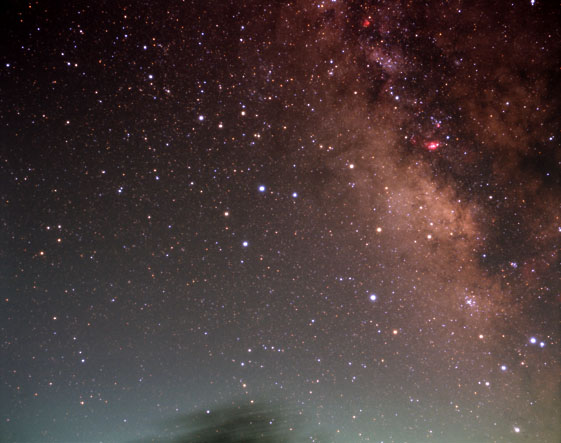
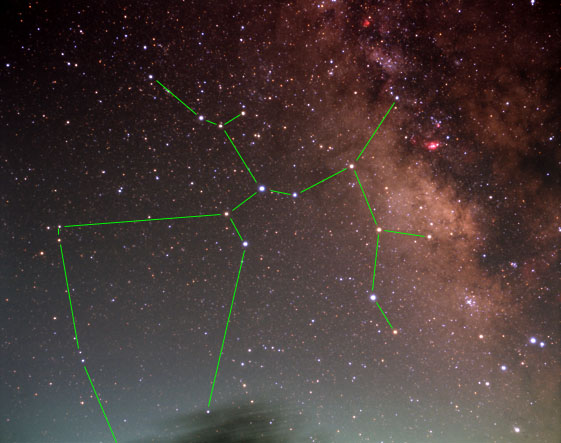

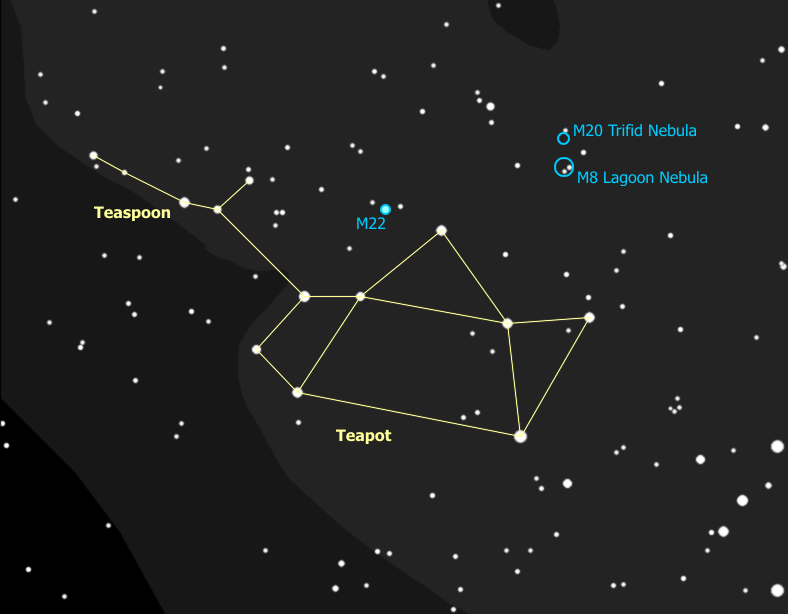
Dipper, instead of Ursa Major. The bright region of the Milky Way that looks like steam coming out of the spout of the Teapot marks where the center of the galaxy is, about 30,000 light years away.
"If you look at the top of the spout through binoculars then slowly scan up from there, you will come across the Lagoon Nebula (M8) and then the Trifid Nebula (M20). These are diffuse nebulae - clouds of dust and hydrogen gas - the stars you see in them are formed from the gas when it condenses together and compresses due to gravity then, under pressure, heats up and ignites. Nebulae like these, then, are the birthplaces of stars.
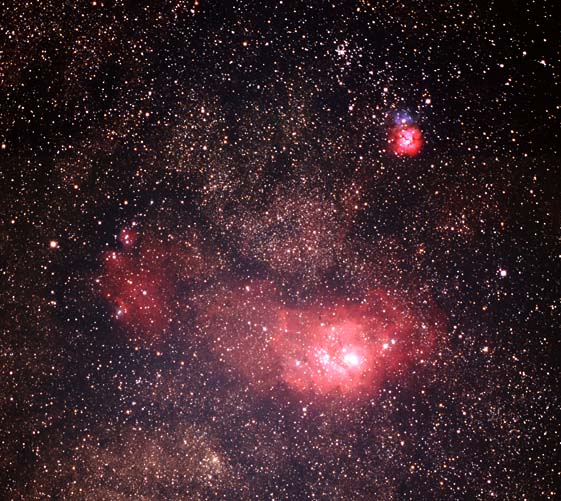
"This region of the sky, Sagittarius and its neighboring constellations, happens to be one that is dense with nebulae and young stars. The only other region of the sky with this much new-star formation activity is Orion and its neighboring constellations.
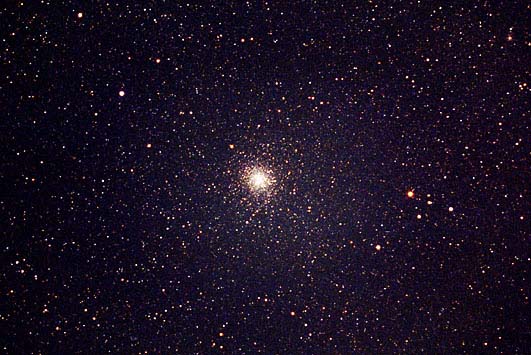
"If you put the binoculars right on the star at the top of the teapot, and slide to the left until the star is at the right edge of your field of view, then right in the center you will see a smudge of light. This is M22, and in a telescope you can see this is a dazzling ball made up of a half million stars, 9600 light years away. It turns out that this is pretty close for a globular cluster.
"Any questions?"
Re: Observe and talk amongst yourselves
Re: Observe and talk amongst yourselves
Re: Observe and talk amongst yourselves
Re: Observe and talk amongst yourselves
Re: Observe and talk amongst yourselves
Re: Observe and talk amongst yourselves
"They don't exist?"
Re: Observe and talk amongst yourselves
Re: Observe and talk amongst yourselves
Re: Observe and talk amongst yourselves
Re: Observe and talk amongst yourselves
Re: Observe and talk amongst yourselves
Re: Observe and talk amongst yourselves
Re: Observe and talk amongst yourselves
Re: Observe and talk amongst yourselves
Re: Observe and talk amongst yourselves
Re: Observe and talk amongst yourselves
Re: Observe and talk amongst yourselves