
http://stargazer-ellie.livejournal.com/ (![[identity profile]](https://www.dreamwidth.org/img/silk/identity/openid.png) stargazer-ellie.livejournal.com) wrote in
stargazer-ellie.livejournal.com) wrote in ![[community profile]](https://www.dreamwidth.org/img/silk/identity/community.png) fandomhigh2006-06-14 08:37 am
fandomhigh2006-06-14 08:37 am
stargazer-ellie.livejournal.com) wrote in fandomhigh2006-06-14 08:37 am


Entry tags:
Observational Astronomy -- June 14
Week 4 - June 14 - Hercules, Draco, Bootes
Star maps: East | West | North | South | Overhead
As usual, Ellie meets the class on the beach and begins her lecture.
"If you draw a line along the handle of the Big Dipper before it curves downward, you will find an asterism known as 'The Keystone.' Just like it says, it is four stars in the shape of a keystone. And like the other asterisms it is a part of a larger constellation -- the constellation Hercules. The star that represents Hercules' head, a Herculis, is a red supergiant. With a good telescope you can see that this reddish-orange star has a blue-green companion.
"Hercules is a fairly large constellation, but isn't very obvious. Named for the Greek hero, the constellation is represented as a kneeling man with his head turning south.
"The Keystone helps us locate M13 - the brightest and best globular cluster in the Northern Hemisphere. Globular clusters are rare -- only about 150 are known, and they are completely different from open clusters like the Beehive Cluster that we saw in Cancer. The Beehive Cluster is estimated to be about 730 million years old, while M13 is estimated at about 10 billion years old, making it so old that it formed before the disk of the Milky Way galaxy formed! M13 has no less than 1 million stars. Globular clusters are much, much bigger than open clusters, and they are much, much older -- some are nearly as old as the universe!
"Now, on to Boötes (pronounced boo-OH-teez). Boötes is known as 'the protector of the Bear' (Ursa Major) because of being on the tracks of the Great Bear. The constellation includes a major star of Arcturus, alpha Bootis. The star is easily found out by following the sweep of the Big Dipper's handle, and the curve also takes you to Spica in south sky, which we saw two weeks ago as part of Virgo. The curve across the night sky in spring from the Big Dipper to Spica called 'The Spring's Great Curve.'
"Arcturus is the brightest star in the Northern Hemisphere and the third brightest in all of the sky with a magnitude of -0.1 and a color of orange. Arcturus means 'Guardian of the Bear,' and has a name of the wheat star in Japan because the star is seen at zenith when the wheat is harvested in late spring.
"Boötes is a kite-shaped constellation. It used to be a shorter kite -- in ancient Greek and Roman times (2,000 years ago), Arcturus was half the distance closer to the two center stars (epsilon & rho Boötes). It is moving across the sky faster than any other bright star (except Alpha Centauri which is ten times closer) -- it couldn't be seen 500,000 years ago and 500,000 years from now it won't be visible any more. So why is Arcturus moving so fast?
"The stars of our galaxy are formed into a rotating disk and are all moving together around the disk. Some stars -- called "halo" stars -- form a dome over the disk, Arcturus is one of those stars, orbiting above and below the galactic center. It is cutting through the disk now, actually a little bit back against the general flow. Someone on a planet orbiting Arcturus would see the entire night sky changing constantly.
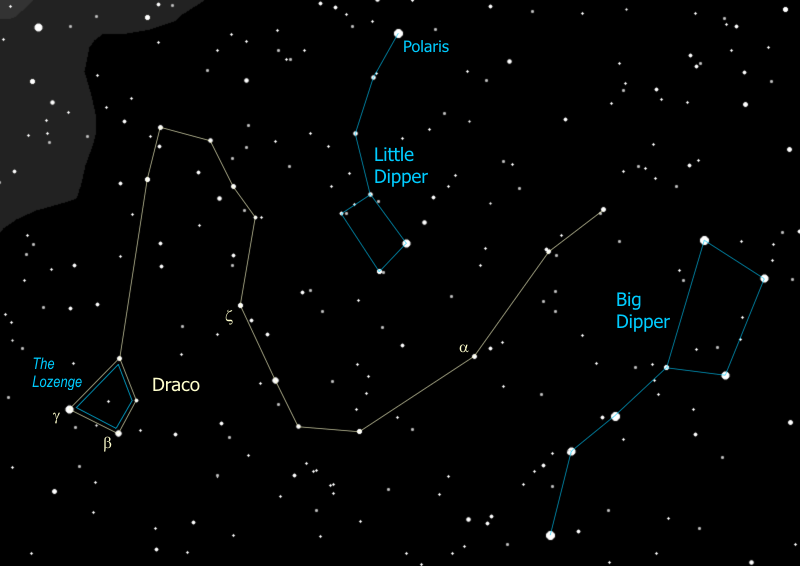
"Draco starts off with two bright yellow eyes (actually one's yellow, one's orange), and then winds around the Little Dipper with its tail between the two Dippers. The constellation of Draco is circumpolar; its gigantic curve surrounding the Little Dipper of Ursa Minor is one of characteristics. Stars forming the curve are fairly fine, but the head of dragon is clear as a strained square.
"The dragon was a guard of the golden apples in the Hesperides. A Greek Myth tells that Hercules stole the golden apple by outwitting the dragon.
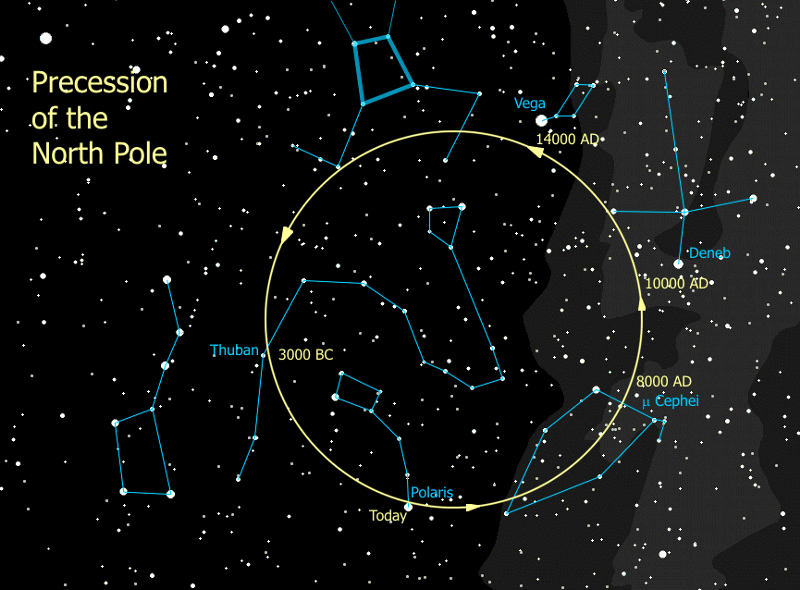
"The third star from the end of Draco's tail has its own name - Thuban - even though it's not very bright. What makes Thuban special is that it once was the North Star - about 5,000 years ago. Our North Pole is actually moving through the sky because the earth wobbles on its axis, just like a top does, particularly just before it falls over (no -- the earth is not about to fall over). With the axis wobbling like that, the North Pole is tracing a circle in the sky - it just happens to be passing by Polaris right now.
"It is about a degree away from our North Star now and will get about a half degree closer, then will start moving away as it continues on its circle through the sky. That circle will take it almost exactly right down the center of Cepheus, past Deneb in Cygnus, past Vega in Lyra, through Hercules' leg and right by his knee, then down past Thuban and back to Polaris.
Any questions?"
Star maps: East | West | North | South | Overhead
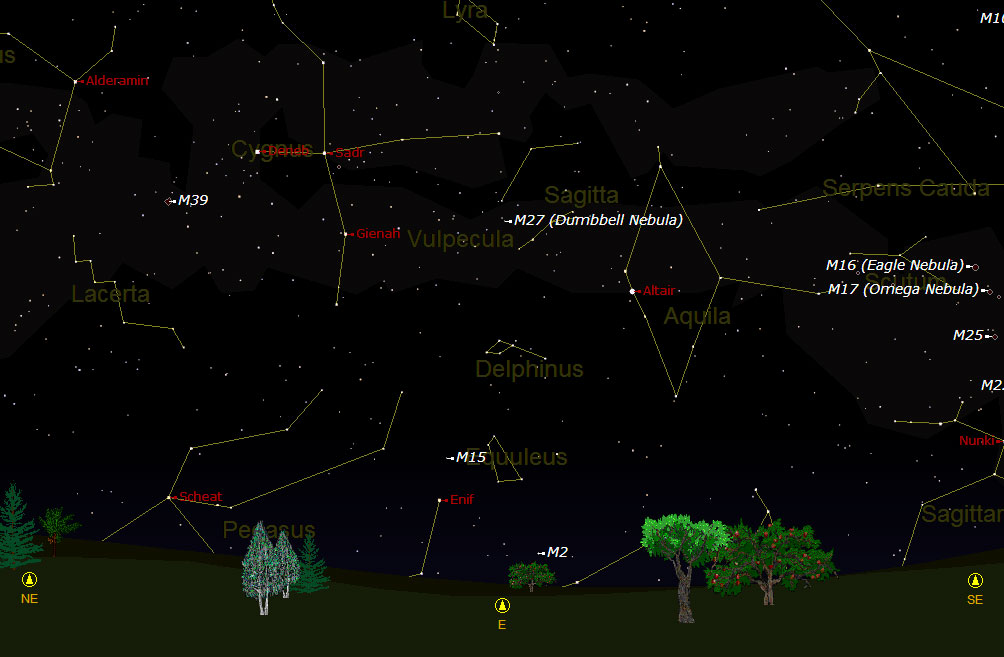
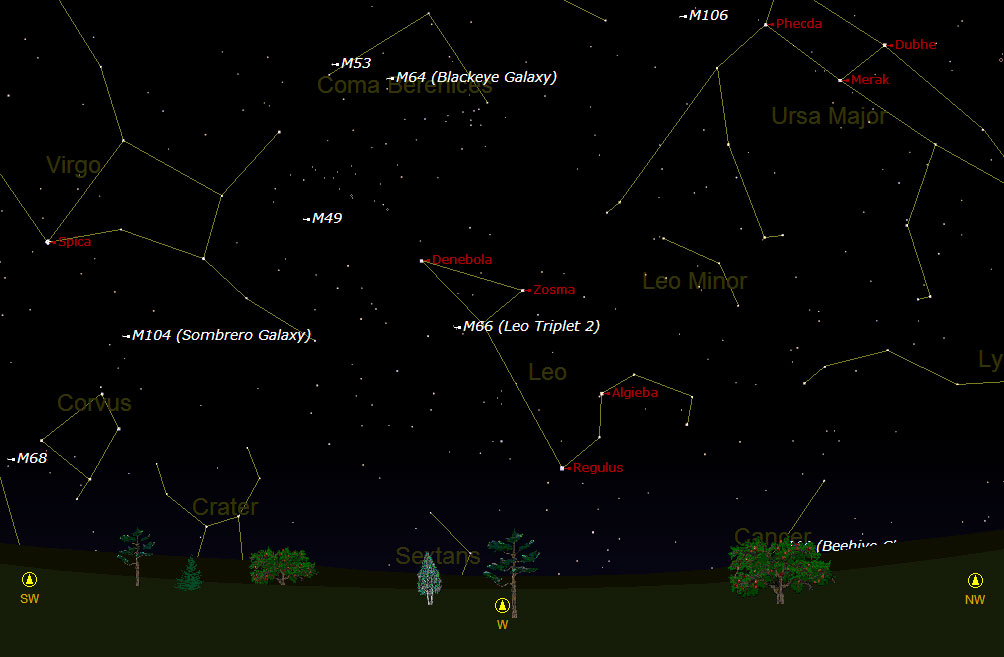
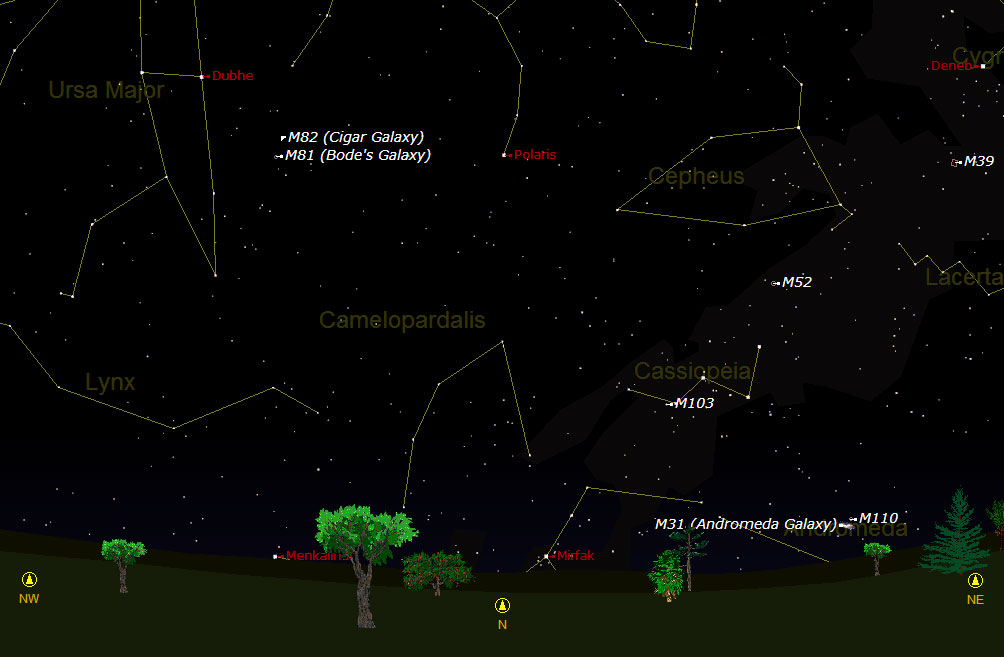
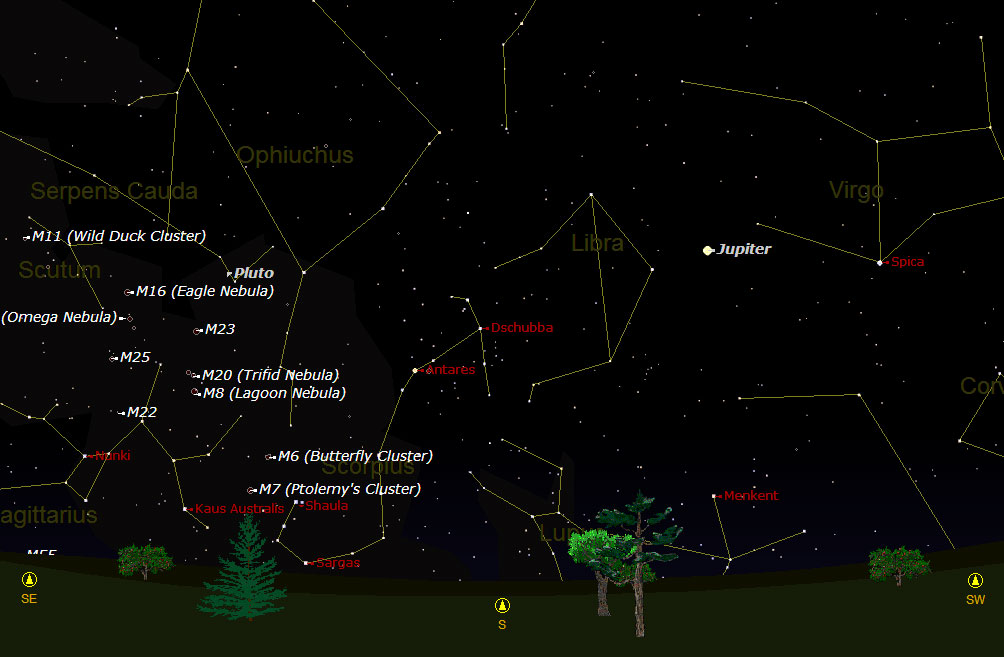

As usual, Ellie meets the class on the beach and begins her lecture.
"If you draw a line along the handle of the Big Dipper before it curves downward, you will find an asterism known as 'The Keystone.' Just like it says, it is four stars in the shape of a keystone. And like the other asterisms it is a part of a larger constellation -- the constellation Hercules. The star that represents Hercules' head, a Herculis, is a red supergiant. With a good telescope you can see that this reddish-orange star has a blue-green companion.
"Hercules is a fairly large constellation, but isn't very obvious. Named for the Greek hero, the constellation is represented as a kneeling man with his head turning south.
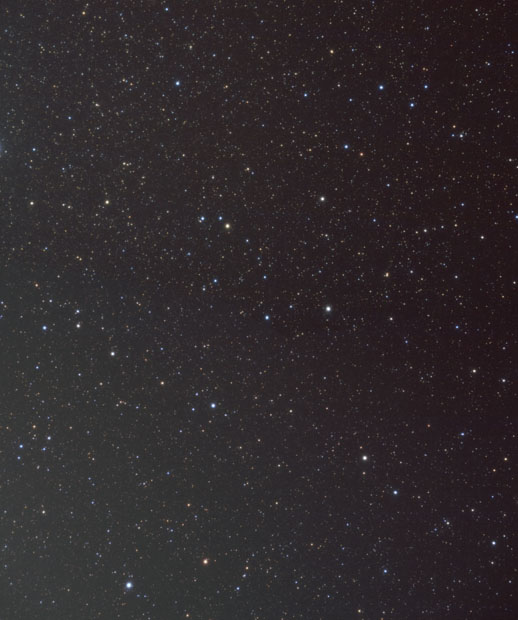
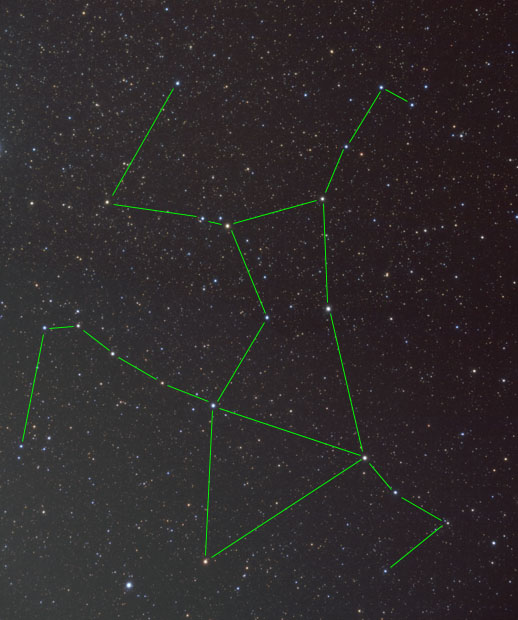
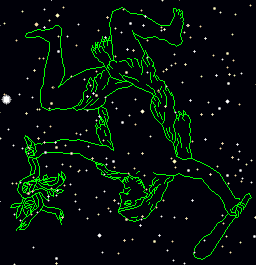
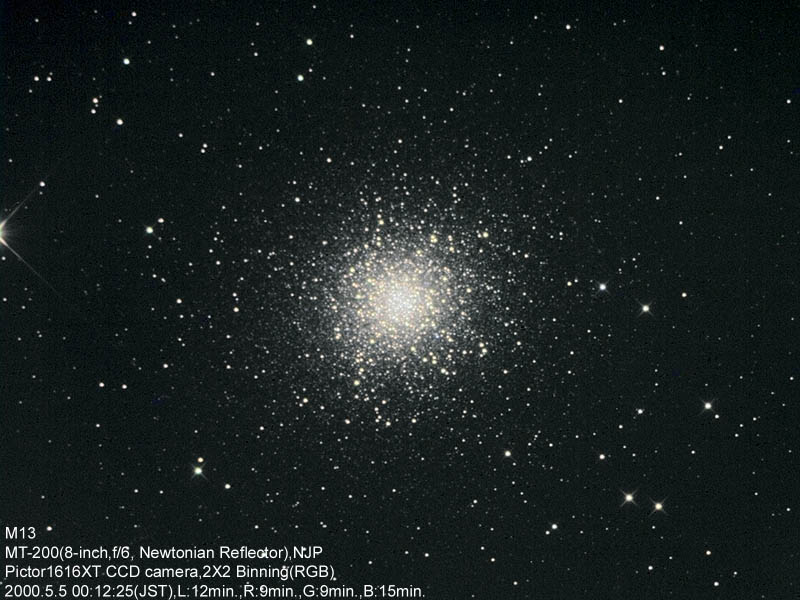
"The Keystone helps us locate M13 - the brightest and best globular cluster in the Northern Hemisphere. Globular clusters are rare -- only about 150 are known, and they are completely different from open clusters like the Beehive Cluster that we saw in Cancer. The Beehive Cluster is estimated to be about 730 million years old, while M13 is estimated at about 10 billion years old, making it so old that it formed before the disk of the Milky Way galaxy formed! M13 has no less than 1 million stars. Globular clusters are much, much bigger than open clusters, and they are much, much older -- some are nearly as old as the universe!
"Now, on to Boötes (pronounced boo-OH-teez). Boötes is known as 'the protector of the Bear' (Ursa Major) because of being on the tracks of the Great Bear. The constellation includes a major star of Arcturus, alpha Bootis. The star is easily found out by following the sweep of the Big Dipper's handle, and the curve also takes you to Spica in south sky, which we saw two weeks ago as part of Virgo. The curve across the night sky in spring from the Big Dipper to Spica called 'The Spring's Great Curve.'

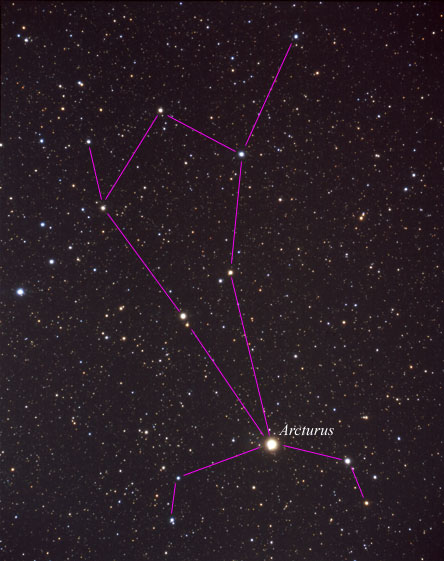
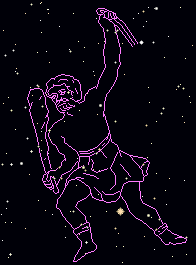
"Arcturus is the brightest star in the Northern Hemisphere and the third brightest in all of the sky with a magnitude of -0.1 and a color of orange. Arcturus means 'Guardian of the Bear,' and has a name of the wheat star in Japan because the star is seen at zenith when the wheat is harvested in late spring.
"Boötes is a kite-shaped constellation. It used to be a shorter kite -- in ancient Greek and Roman times (2,000 years ago), Arcturus was half the distance closer to the two center stars (epsilon & rho Boötes). It is moving across the sky faster than any other bright star (except Alpha Centauri which is ten times closer) -- it couldn't be seen 500,000 years ago and 500,000 years from now it won't be visible any more. So why is Arcturus moving so fast?
"The stars of our galaxy are formed into a rotating disk and are all moving together around the disk. Some stars -- called "halo" stars -- form a dome over the disk, Arcturus is one of those stars, orbiting above and below the galactic center. It is cutting through the disk now, actually a little bit back against the general flow. Someone on a planet orbiting Arcturus would see the entire night sky changing constantly.
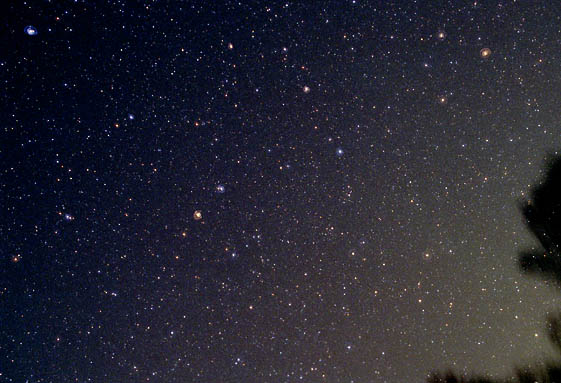
"Draco starts off with two bright yellow eyes (actually one's yellow, one's orange), and then winds around the Little Dipper with its tail between the two Dippers. The constellation of Draco is circumpolar; its gigantic curve surrounding the Little Dipper of Ursa Minor is one of characteristics. Stars forming the curve are fairly fine, but the head of dragon is clear as a strained square.
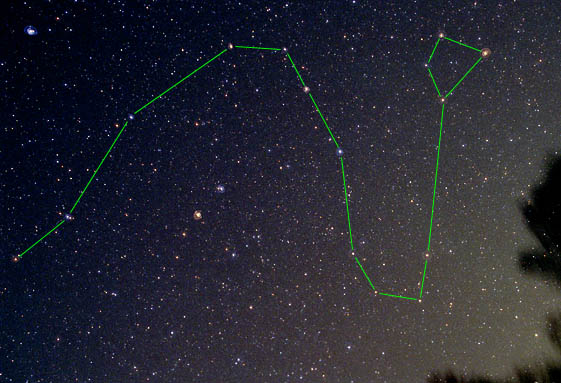
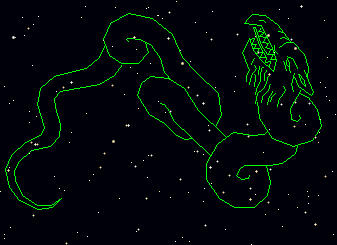
"The dragon was a guard of the golden apples in the Hesperides. A Greek Myth tells that Hercules stole the golden apple by outwitting the dragon.
"The third star from the end of Draco's tail has its own name - Thuban - even though it's not very bright. What makes Thuban special is that it once was the North Star - about 5,000 years ago. Our North Pole is actually moving through the sky because the earth wobbles on its axis, just like a top does, particularly just before it falls over (no -- the earth is not about to fall over). With the axis wobbling like that, the North Pole is tracing a circle in the sky - it just happens to be passing by Polaris right now.
"It is about a degree away from our North Star now and will get about a half degree closer, then will start moving away as it continues on its circle through the sky. That circle will take it almost exactly right down the center of Cepheus, past Deneb in Cygnus, past Vega in Lyra, through Hercules' leg and right by his knee, then down past Thuban and back to Polaris.
Any questions?"
Re: Observe and talk amongst yourselves
Re: Observe and talk amongst yourselves
Re: Observe and talk amongst yourselves
Re: Observe and talk amongst yourselves
"But he's okay and he's got clearance now to be in touch, so that's something." She smiled softly. "And I can sit out at night and watch where he is and know he's thinking about me."
Re: Observe and talk amongst yourselves
Re: Observe and talk amongst yourselves
"Any suggestions?" she asked jokingly.
Re: Observe and talk amongst yourselves
Re: Observe and talk amongst yourselves
Re: Observe and talk amongst yourselves
Re: Observe and talk amongst yourselves
Re: Observe and talk amongst yourselves
Re: Observe and talk amongst yourselves
Re: Observe and talk amongst yourselves
Re: Observe and talk amongst yourselves
Re: Observe and talk amongst yourselves
Re: Observe and talk amongst yourselves
Re: Observe and talk amongst yourselves
Re: Observe and talk amongst yourselves
Re: Observe and talk amongst yourselves
Re: Observe and talk amongst yourselves
Re: Observe and talk amongst yourselves
Re: Observe and talk amongst yourselves
Re: Observe and talk amongst yourselves
Re: Observe and talk amongst yourselves
Re: Observe and talk amongst yourselves
Re: Observe and talk amongst yourselves
Re: Observe and talk amongst yourselves
Re: Observe and talk amongst yourselves
Re: Observe and talk amongst yourselves
Re: Observe and talk amongst yourselves
Re: Observe and talk amongst yourselves
Re: Observe and talk amongst yourselves
Re: Observe and talk amongst yourselves
Re: Observe and talk amongst yourselves
Re: Observe and talk amongst yourselves
Re: Observe and talk amongst yourselves
Re: Observe and talk amongst yourselves
Re: Observe and talk amongst yourselves
Re: Observe and talk amongst yourselves
Re: Observe and talk amongst yourselves
Re: Observe and talk amongst yourselves
Re: Observe and talk amongst yourselves
Re: Observe and talk amongst yourselves
Re: Observe and talk amongst yourselves
Re: Observe and talk amongst yourselves
Re: Observe and talk amongst yourselves
Re: Observe and talk amongst yourselves