
http://stargazer-ellie.livejournal.com/ (![[identity profile]](https://www.dreamwidth.org/img/silk/identity/openid.png) stargazer-ellie.livejournal.com) wrote in
stargazer-ellie.livejournal.com) wrote in ![[community profile]](https://www.dreamwidth.org/img/silk/identity/community.png) fandomhigh2006-06-07 09:39 am
fandomhigh2006-06-07 09:39 am
stargazer-ellie.livejournal.com) wrote in fandomhigh2006-06-07 09:39 am


Entry tags:
Observational Astronomy -- June 7
Week 3 - The Moon and Planets: Jupiter, Saturn, Mars, Mercury, and Venus
[Class Roster ]
Star maps: East | West | North | South | Overhead
The skies were clear and pudding-free for the class. When everyone has gathered on the beach, Ellie began:
"Tonight we're going to look at the moon and the visible planets.
"The definition of a planet is a relatively large mass of accreted matter in orbit around a star. A mass that becomes massive enough to undergo nuclear reactions is considered a star, not a planet. The name comes from the Greek term planetes, meaning "wanderer" -- ancient astronomers noted how certain lights moved across the sky in relation to the other stars. The International Astronomical Union lists nine planets in our solar system -- Mercury, Venus, Earth, Mars, Jupiter, Saturn, Uranus (stop snickering), Neptune, and Pluto. However, some people say that Pluto isn't really a planet, and some people want to include "Planet Ten," a body that orbits beyond Pluto. Some people call that body Xena. Anyway, there's a trick to remembering the order of the planets: just remember the phrase My Very Eager Mother Just Served Us Nine Pizzas.
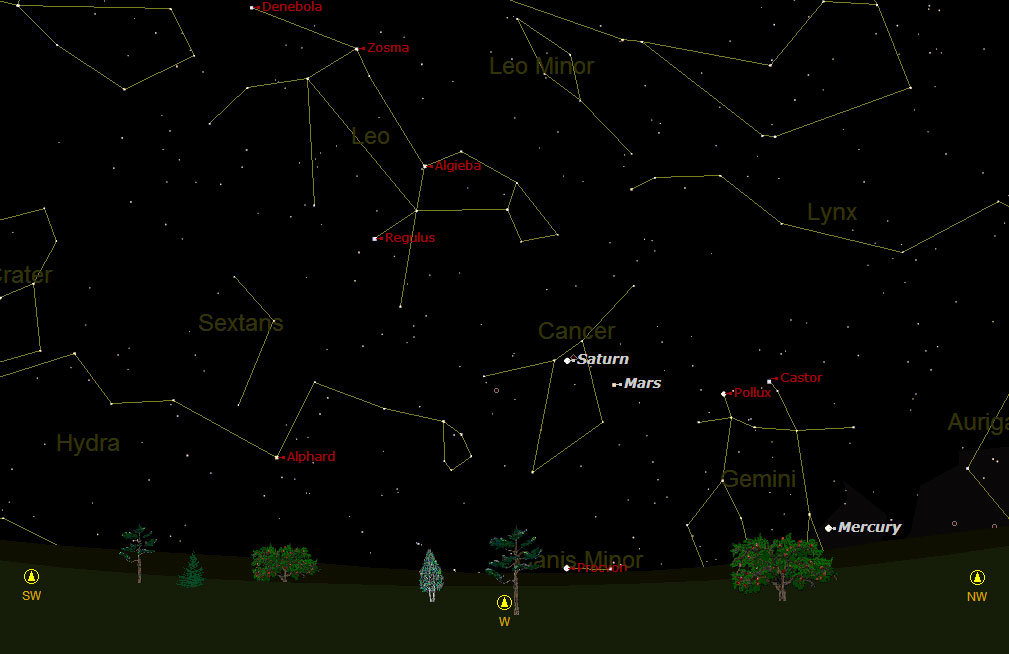
"Four out of the five planets visible with the naked eye are in the sky tonight. We'll start with Mercury first since it's going to set soon. Find Gemini on the northwestern horizon. Below and to the right of Mebsuta, the star that makes up the waist of Castor (he's the twin on the right), you can find the planet Mercury. Mercury is the planet closest to the sun and orbits once every 88 days. Mercury can only be seen at sunrise or sunset because of its closeness to the sun. The planet is heavily cratered, like the moon, and has no atmosphere. It was named after the Roman messenger god for its swift path across the sky. You won't see as good a view as the picture in your handout, not with binoculars, but with the telescopes if you take astronomy in the fall we can try for a better look.
"Now look west and find Cancer. Saturn is in the top middle of the "shell," and Mars, the red "star," is to the right. Mars was named for the Roman god of War, in part due to its red color, the color of blood. The color is caused by the iron oxide, or rust, on the planet's surface. Mars is half the size of the Earth, but its surface area is only slightly less than the total area of Earth's dry land. Mars has an atmosphere that is primarily carbon dioxide, but as this atmosphere is so thin, it does not retain heat like ours does. Some evidence suggests that the planet once was significantly more habitable than today, but the question on whether living organisms ever actually existed there is an open one. We've sent many probes to Mars, but so far we have no conclusive proof.
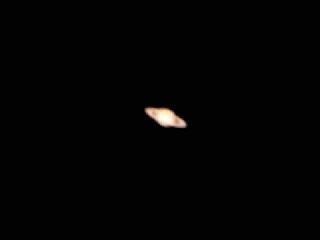
"Above and to the left of Mars we can find Saturn, the sixth planet from the Sun. It is a gas giant (also known as a Jovian planet), the second-largest planet in the solar system after Jupiter. Saturn has a prominent system of rings, consisting mostly of ice particles with a smaller amount of rocky debris and dust. The rings were first seen by Galileo through his telescope. He thought that "Saturn has ears"!
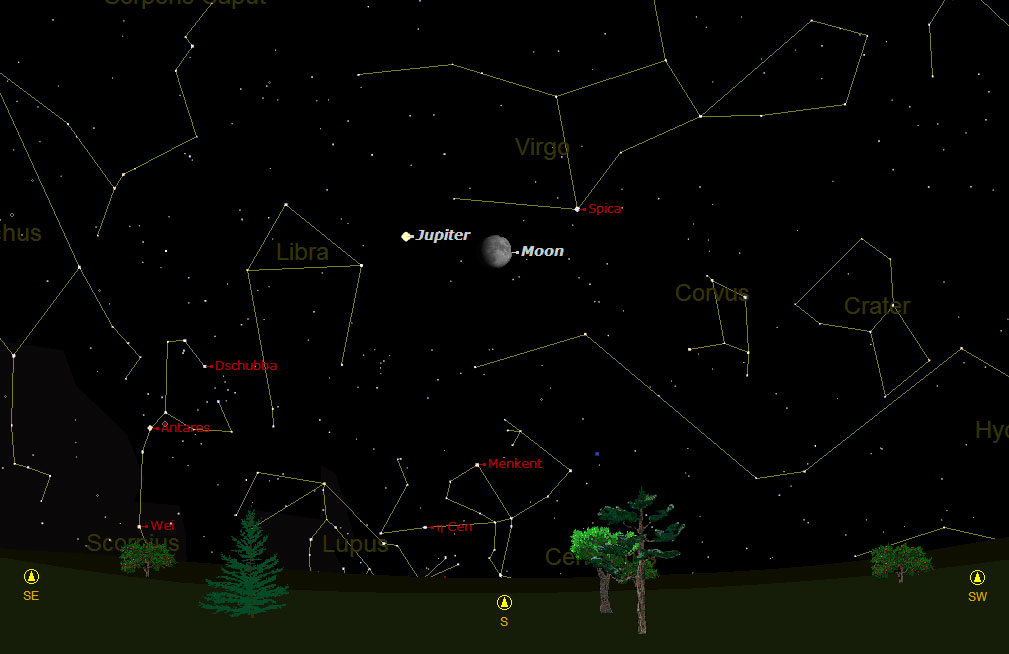
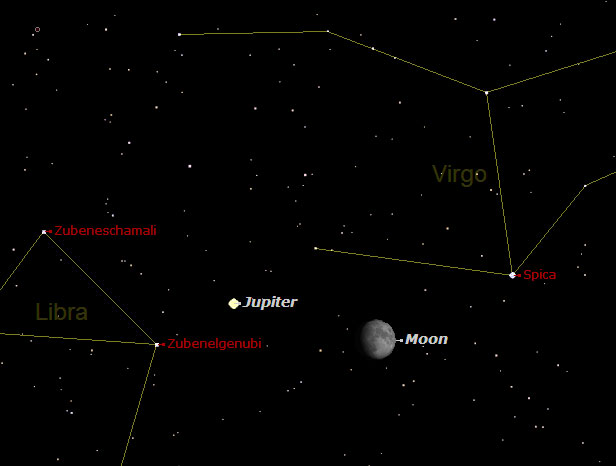
"Now look over to Virgo and the moon. That very bright "star" to the left of the moon is Jupiter. Jupiter is the fifth planet from the Sun and by far the largest within the solar system. It is usually the fourth brightest object in the sky (after the Sun, the Moon and Venus); however at times Mars appears brighter. Jupiter is 2.5 times more massive than all the other planets combined, and it is 318 times more massive than Earth, with a diameter 11 times that of Earth, and with a volume 1300 times that of Earth. Its best known feature is the Great Red Spot, a storm larger than Earth which was first observed by Galileo four centuries ago. Some astronomers have termed Jupiter as a "failed star." If Jupiter had been more massive and become a star, life on earth would be very different.
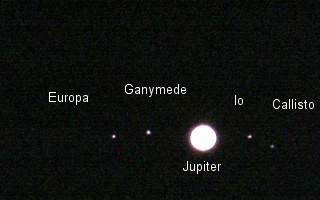
"Jupiter has at least 63 moons. The four largest moons are known as the "Galilean moons" -- Io, Europa, Ganymede and Callisto. If you have a steady hand, you might be able to see some of the moons through your binoculars. Galileo's discovery of these moons was further evidence that the Earth was not the center of the universe.
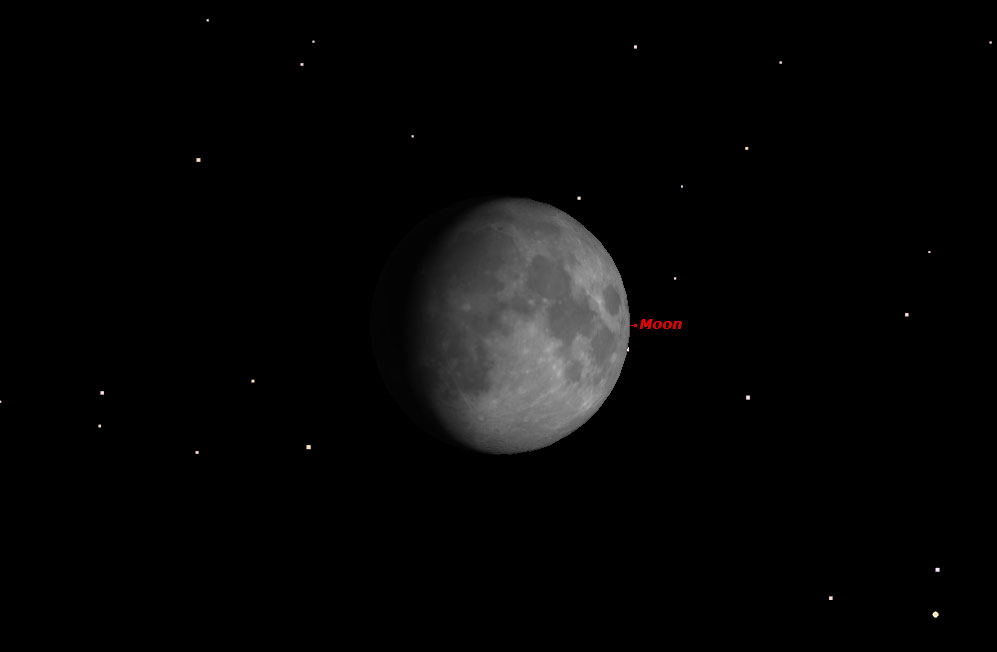
"And now to the Moon, Earth's only natural satellite. I don't think I have to tell you how to find it! The Moon is in synchronous rotation, meaning that it keeps nearly the same face turned toward Earth at all times. The side of the Moon that faces Earth is called the near side, and the opposite side is called the dark side or the far side. The Moon makes a complete orbit about the Earth approximately once every 27.3 days. Right now the Moon is waxing gibbous and is just over 11 days old.
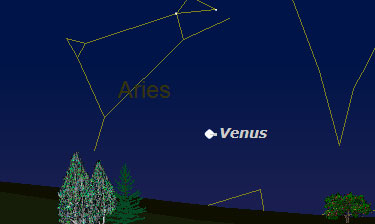
"If you want to stay up until sunrise, you can see Venus on the horizon, brighter than any star in the sky. You can't miss it.
"Any questions?"
[Class Roster ]
Star maps: East | West | North | South | Overhead
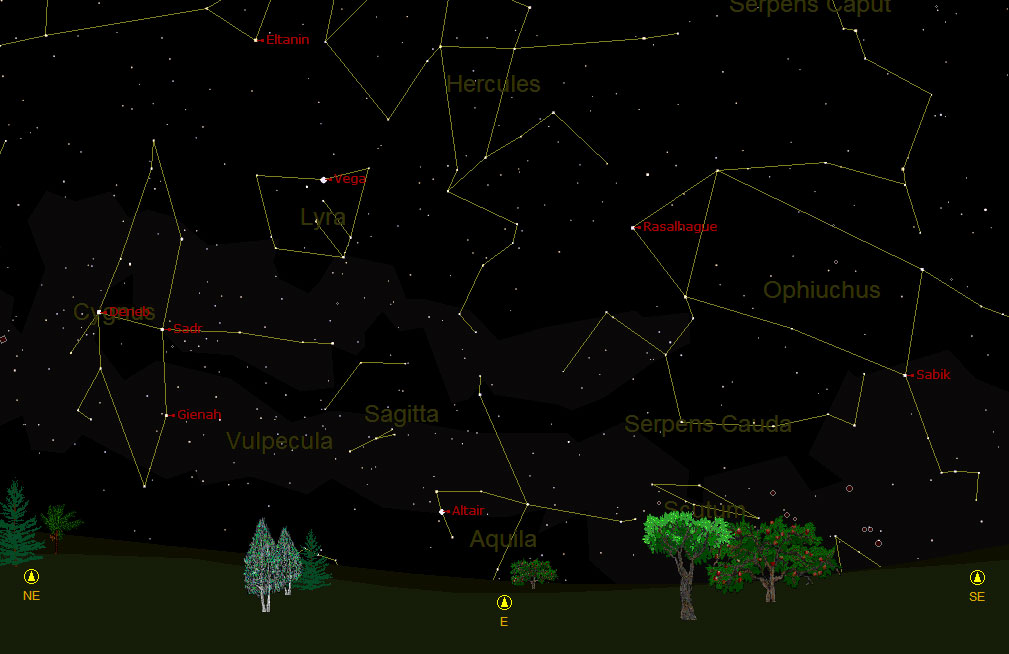

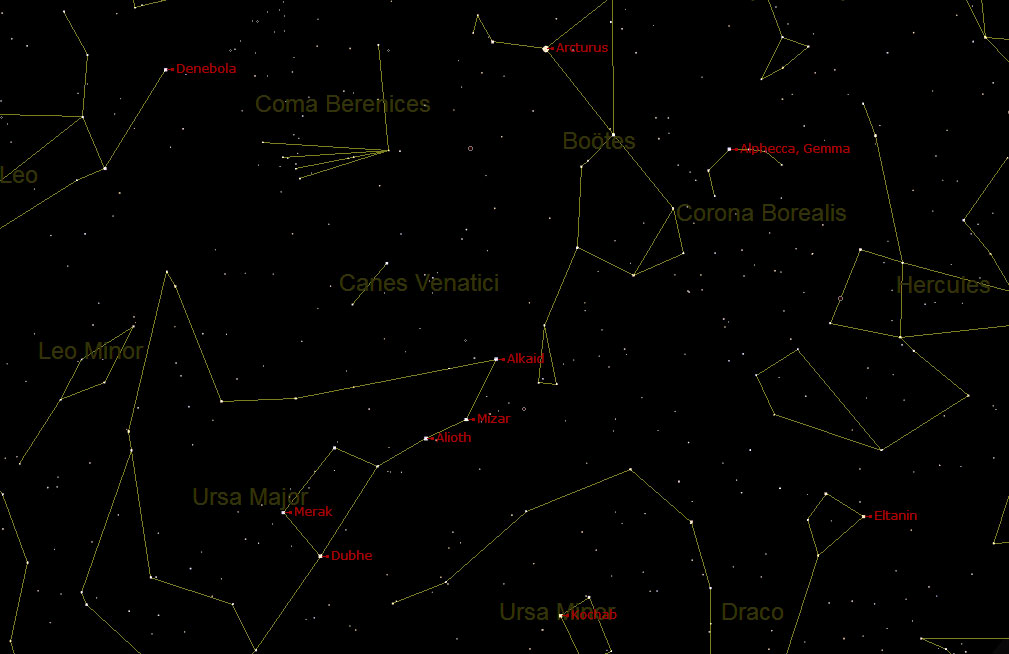
The skies were clear and pudding-free for the class. When everyone has gathered on the beach, Ellie began:
"Tonight we're going to look at the moon and the visible planets.
"The definition of a planet is a relatively large mass of accreted matter in orbit around a star. A mass that becomes massive enough to undergo nuclear reactions is considered a star, not a planet. The name comes from the Greek term planetes, meaning "wanderer" -- ancient astronomers noted how certain lights moved across the sky in relation to the other stars. The International Astronomical Union lists nine planets in our solar system -- Mercury, Venus, Earth, Mars, Jupiter, Saturn, Uranus (stop snickering), Neptune, and Pluto. However, some people say that Pluto isn't really a planet, and some people want to include "Planet Ten," a body that orbits beyond Pluto. Some people call that body Xena. Anyway, there's a trick to remembering the order of the planets: just remember the phrase My Very Eager Mother Just Served Us Nine Pizzas.
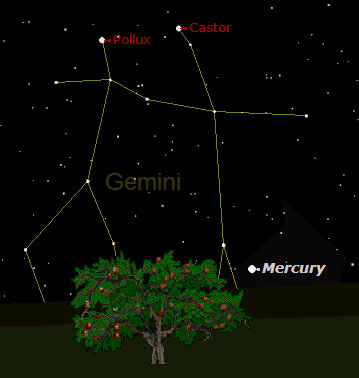
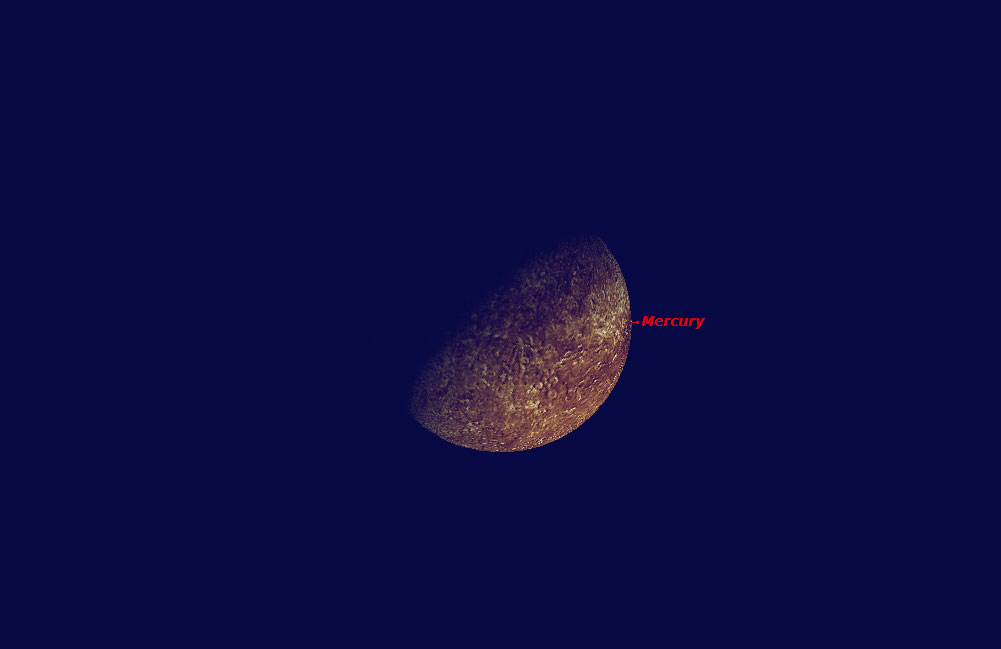
"Four out of the five planets visible with the naked eye are in the sky tonight. We'll start with Mercury first since it's going to set soon. Find Gemini on the northwestern horizon. Below and to the right of Mebsuta, the star that makes up the waist of Castor (he's the twin on the right), you can find the planet Mercury. Mercury is the planet closest to the sun and orbits once every 88 days. Mercury can only be seen at sunrise or sunset because of its closeness to the sun. The planet is heavily cratered, like the moon, and has no atmosphere. It was named after the Roman messenger god for its swift path across the sky. You won't see as good a view as the picture in your handout, not with binoculars, but with the telescopes if you take astronomy in the fall we can try for a better look.
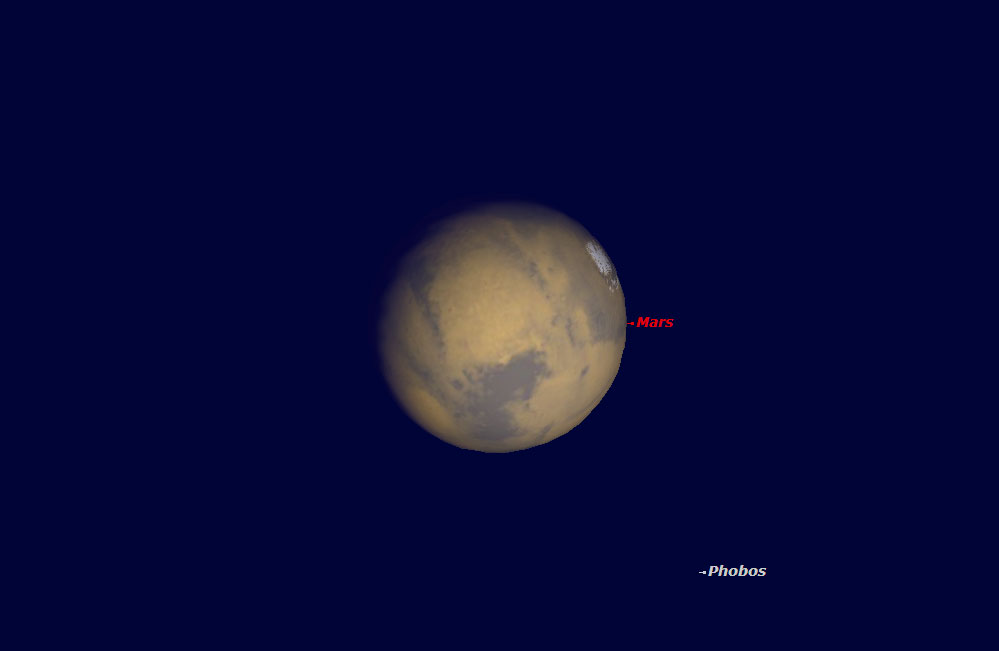
"Now look west and find Cancer. Saturn is in the top middle of the "shell," and Mars, the red "star," is to the right. Mars was named for the Roman god of War, in part due to its red color, the color of blood. The color is caused by the iron oxide, or rust, on the planet's surface. Mars is half the size of the Earth, but its surface area is only slightly less than the total area of Earth's dry land. Mars has an atmosphere that is primarily carbon dioxide, but as this atmosphere is so thin, it does not retain heat like ours does. Some evidence suggests that the planet once was significantly more habitable than today, but the question on whether living organisms ever actually existed there is an open one. We've sent many probes to Mars, but so far we have no conclusive proof.

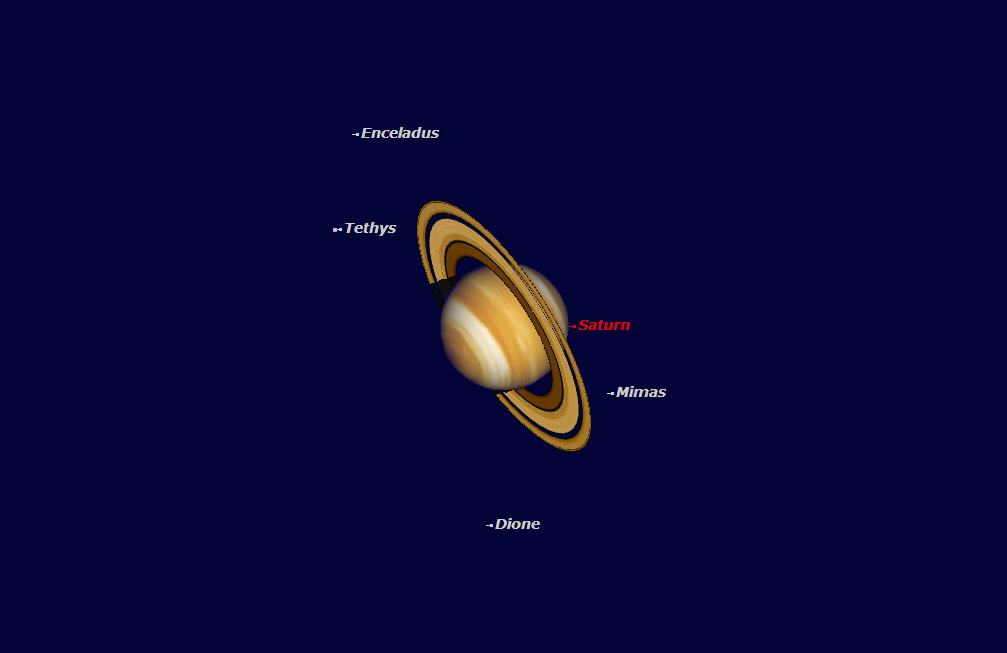
"Above and to the left of Mars we can find Saturn, the sixth planet from the Sun. It is a gas giant (also known as a Jovian planet), the second-largest planet in the solar system after Jupiter. Saturn has a prominent system of rings, consisting mostly of ice particles with a smaller amount of rocky debris and dust. The rings were first seen by Galileo through his telescope. He thought that "Saturn has ears"!
"Now look over to Virgo and the moon. That very bright "star" to the left of the moon is Jupiter. Jupiter is the fifth planet from the Sun and by far the largest within the solar system. It is usually the fourth brightest object in the sky (after the Sun, the Moon and Venus); however at times Mars appears brighter. Jupiter is 2.5 times more massive than all the other planets combined, and it is 318 times more massive than Earth, with a diameter 11 times that of Earth, and with a volume 1300 times that of Earth. Its best known feature is the Great Red Spot, a storm larger than Earth which was first observed by Galileo four centuries ago. Some astronomers have termed Jupiter as a "failed star." If Jupiter had been more massive and become a star, life on earth would be very different.
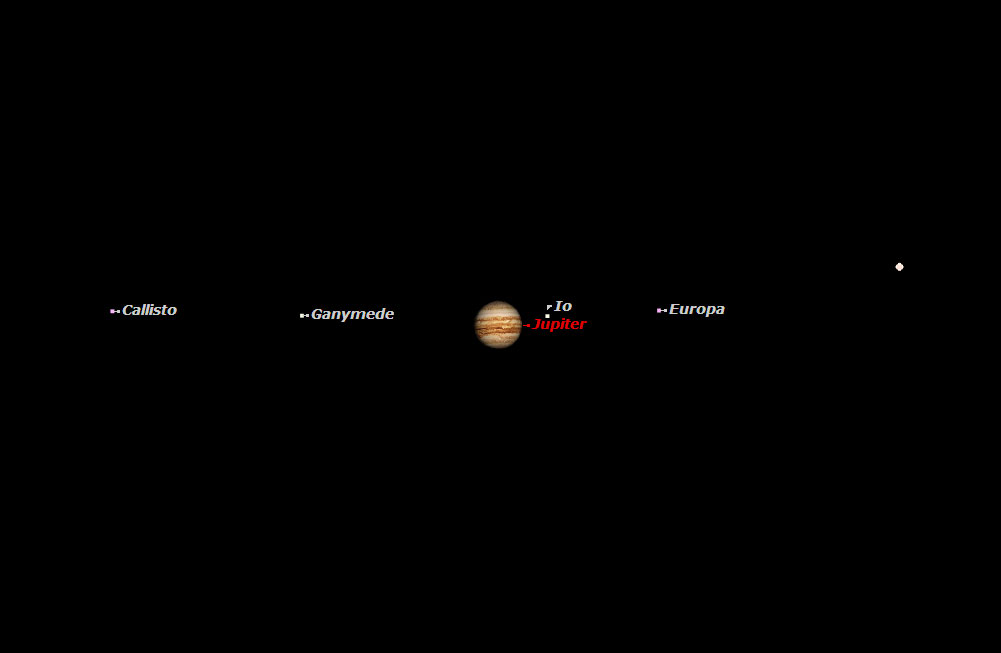
"Jupiter has at least 63 moons. The four largest moons are known as the "Galilean moons" -- Io, Europa, Ganymede and Callisto. If you have a steady hand, you might be able to see some of the moons through your binoculars. Galileo's discovery of these moons was further evidence that the Earth was not the center of the universe.
"And now to the Moon, Earth's only natural satellite. I don't think I have to tell you how to find it! The Moon is in synchronous rotation, meaning that it keeps nearly the same face turned toward Earth at all times. The side of the Moon that faces Earth is called the near side, and the opposite side is called the dark side or the far side. The Moon makes a complete orbit about the Earth approximately once every 27.3 days. Right now the Moon is waxing gibbous and is just over 11 days old.
"If you want to stay up until sunrise, you can see Venus on the horizon, brighter than any star in the sky. You can't miss it.
"Any questions?"
Sign In
Re: Sign In
Re: Sign In
Re: Sign In
Re: Sign In
Re: Sign In
Re: Sign In
Re: Sign In
Re: Sign In
Re: Sign In
Re: Sign In
Re: Sign In
Re: Sign In
Re: Sign In
Re: Sign In
Observe & talk amongst yourselves
Re: Observe & talk amongst yourselves
Re: Observe & talk amongst yourselves
Re: Observe & talk amongst yourselves
She sighed happily. Staring up at the stars reminded her that the universe was bigger than just the frequently fallible people on Earth.
Re: Observe & talk amongst yourselves
Re: Observe & talk amongst yourselves
Re: Observe & talk amongst yourselves
Re: Observe & talk amongst yourselves
Re: Observe & talk amongst yourselves
Re: Observe & talk amongst yourselves
Re: Observe & talk amongst yourselves
He was also wondering, quietly, why it was apparently so difficult to find other life with all those other planets and moons right there.
Talk to Ellie
OOC
Re: OOC
No I don't.
Re: OOC
Re: OOC