
Liliana Vess (![[personal profile]](https://www.dreamwidth.org/img/silk/identity/user.png) deathsmajesty) wrote in
deathsmajesty) wrote in ![[community profile]](https://www.dreamwidth.org/img/silk/identity/community.png) fandomhigh2025-07-17 01:59 am
fandomhigh2025-07-17 01:59 am
deathsmajesty) wrote in fandomhigh2025-07-17 01:59 am


5 Times Urza Ruined Everything, Thursday, Per 1
Liliana was once again leaning against the front of her desk; hardly the position when one wanted to command the respect and attention due a professor, but this barely counted as a class. It was more a vehicle for her ranting, with the very thin sheen of 'history' to make it seem like a credible academic topic. So she was just going to lean, sipping her heavily honeyed tea that Ignis had provided her to soothe her throat after her generally long lectures, waiting until the clock ticked over to nine. As soon as it did so, she began today's...discussion, sure.
"Officially, the war between Yotia and the Fallaji is called the Antiquities War; however, since the war was actually between Urza and Mishra and they were using the armies of both countries like little toy soldiers, it is more commonly known as the Brothers' War. And by 'more commonly known,' I mean that if you ask someone what the Antiquities War was, the more scholarly and educated would eventually remember what you're referring to. If you ask damn near anyone on Dominaria what the Brothers' War was, even the most illiterate peasant could tell you, probably after spitting first. That's because the effects of the war impacted the entire plane, both in its immediate aftermath and for centuries - millennia, really - later. The war itself lasted from 28 AR to 64 AR, when Urza ended it in a truly spectacular and definitive fashion that we'll be discussing next week."
That's right! This grand fight over rocks sparked a war that lasted almost forty years!
"Roughly two generations of Terisiarans were born, grew up, and fought in this wasteful, wanton war. Three generations of the same family could end up fighting along side - or even against - one another on the field. Scholars have generally given up attempting to calculate the number of deaths resulting directly from combat, wartime actions, or war-related civilian deaths, declaring it an impossible task. The conservative estimate is several tens of millions." Reaching behind her, she grabbed a small sheaf of papers to hand out to everyone, printed copies of a hand-drawn map though Ignis' had raised lines and textures to indicate borders and other notable features. "The continent of Terisiare, roughly at the time of the start of the Brother's War." She looked forward to comparing it next week to the map of modern Terisiare, and making everyone guess what had happened to it. (Hint: The answer was Urza.) "To give you an idea of the scale, Terisiare is roughly the size of the combined landmass of Canada and the United States, while Argoth, the smaller subcontinent to the lower right, generally seems to be on par with Australia. Lat-Nam, on the other side of Terisiare, seems to be comparable to India, if one counts only the greater landmass and ignores the outlying islands.
"The College of Lat-Nam is one of the reasons that we have so much information about Urza and Mishra and what was happening at the time. It was the very first college of magic on Terisiare and made great strides to understanding the nature of mana and how spellcasters used it. The college attempted to stay neutral during the conflict. In 45 AR, when it became obvious that Mishra was coming to destroy Terisia City, there was an organized evacuation via secret tunnels moving people - especially wizards and scholars - as well as records, relics, and artifacts, across the Lat-Nam Straits to the College, and thence to other islands and continents away from Terisiare and, hopefully, the brothers and their war-machines. The College's neutrality did not protect it; it was attacked and destroyed sometime between 46 and 54 AR, and we genuinely don't know which side did it. No records of the fall of the College exist, nor were there any survivors, and the site of the college itself was a desert of poisoned glass for four thousand years. What fragments of information scholars collected from the areas around the College say it was visited by 'terrible retribution', that it was 'laid to waste', and that 'all the knowledge of Lat-Nam could not protect its sages.'"
She paused and drank some more of her tea. Look, there was a lot to cover, okay?
"While millions of people died to Urza and Mishra's war machines and the battles between Yotia, the Fallaji, and every other country that got sucked into the war as it expanded, we believe that the civilian casualties were significantly higher. Both sides practiced absolute warfare, where the only acceptable victory is the complete annihilation of one's opponent, accomplished through the rapid and intense application of force and with no limits on potential targets, the appropriation of resources, or the potential damage and destruction on one's own side in the pursuit of complete victory. We know that in some areas, youths as young as thirteen, were conscripted into the armies of whoever held the territory at the time, regardless of gender. Famine ran rampant through the war, even affecting the soldiers of both armies. Neither Urza nor Mishra were content to simply burn the fields of their enemy - or their own fields to deny them to the enemy - they deliberately poisoned and ruined them so nothing could grow and any living creatures who existed on the land would sicken and die from the effects. They did the same to waterways, to deny water and potential transportation avenues. Whole areas that had been vital for feeding Terisiare were turned to dust or slagged from the attacks of the war machines. The Sword Marches, disputed territory that was the ostensible reason for the start of the war was reduced to blackened glass and was completely uninhabitable."
All this. Over. Godsdamned. Rocks.
"Furthermore, Mishra and Urza were not mages, they were artificers. They built things, which meant that they needed resources. The areas they didn't deliberately ruin to harm their enemies, they strip-mined for the wood or stone or anything else they needed. Urza and Mishra made the land itself a casualty of the war. All those forests on the map? They were gone by 55 AR. Completely gone. Nothing replanted for the future, just harvested and abandoned. Ronom Lake was so badly polluted that you were said to be able to walk from one side to the other on the bellies of the dead fish, and in the summer it stank so bad that it could be smelled as far as Tornakul. The air in the Sardian Mountains was said to be unbreathable on days there was no wind, as the mountains were plundered for their resources and turned into workshops cranking out war machines. Many of the people who didn't die of starvation or from violence died instead to the various diseases that sprang up in the wake of ecological devastation."
Honestly, it was a wonder there was anybody left on Terisiare by the time Urza used his ultimate weapon.
"Argoth is perhaps the perfect encapsulation of this," she continued. "Populated by elves, the druidic descendants of the few Thran refugees that made their way there after the fall of the Empire, and a semi-sentient forest, it was an unspoiled natural wonder. For all that it appears very close to Terisiare itself, it had managed to hide itself from the outside world for several thousands of years. Harbin, Urza's son, discovered it towards the end of the war when he crash landed there in a storm. Once he managed to repair his ornithopter, he rushed home to tell his father about the wealth of natural resources that he'd found. Urza immediately brought his side to Argoth to begin to harvest the resources. Mishra was not far behind, and began doing the same thing. The island's residents, including the very forests and the creatures that lived within them, spent six years attempting to repel both invaders from their shores. The destruction of the land drove the druids mad as it corrupted and broke their links with the forest.
"Now, in Dominaria, every wood, from a sprawling forest or a shady grove, has a spirit or avatar that keeps the site safe: these creatures can be befriended with the right magic and are called maro. Sometimes, incredibly powerful elemental manifestations of the land can arise, either brought about by strong magic or of nature's own will. These are called Maro-Sorcerers and they are basically forces of nature with consciousness. Argoth's Maro-Sorcerer was named Titania. Both sides tried to convince her to side with them, but she refused to aid anyone who had harmed the forests of Argoth. After six years of devastation and depletion, however, she had weakened significantly, since her power was tied directly to the land. Urza, tired of Argoth's native peoples defending themselves and their land, sent his Colossus of Sardia after her during the Battle of Argoth. Titania, unable to fight the Colossus off in her weakened state, drew on the power of Gaea, Dominaria's Worldsoul, and became a living Avatar. Although this made her powerful enough to defeat the Colossus, it also drained the land's last remaining life, leading to the mass extinction of all but a small fraction of Argoth's natural lifeforms. And, as we will discuss next week, this mass extinction did not actually matter in the grand scheme of things."
Because...you guessed it! Urza!
Now she settled back to open the floor to any questions and comments folks might have, especially after throwing concepts like 'Worldsoul' and 'Maro-Sorcerer' out there.
"Officially, the war between Yotia and the Fallaji is called the Antiquities War; however, since the war was actually between Urza and Mishra and they were using the armies of both countries like little toy soldiers, it is more commonly known as the Brothers' War. And by 'more commonly known,' I mean that if you ask someone what the Antiquities War was, the more scholarly and educated would eventually remember what you're referring to. If you ask damn near anyone on Dominaria what the Brothers' War was, even the most illiterate peasant could tell you, probably after spitting first. That's because the effects of the war impacted the entire plane, both in its immediate aftermath and for centuries - millennia, really - later. The war itself lasted from 28 AR to 64 AR, when Urza ended it in a truly spectacular and definitive fashion that we'll be discussing next week."
That's right! This grand fight over rocks sparked a war that lasted almost forty years!
"Roughly two generations of Terisiarans were born, grew up, and fought in this wasteful, wanton war. Three generations of the same family could end up fighting along side - or even against - one another on the field. Scholars have generally given up attempting to calculate the number of deaths resulting directly from combat, wartime actions, or war-related civilian deaths, declaring it an impossible task. The conservative estimate is several tens of millions." Reaching behind her, she grabbed a small sheaf of papers to hand out to everyone, printed copies of a hand-drawn map though Ignis' had raised lines and textures to indicate borders and other notable features. "The continent of Terisiare, roughly at the time of the start of the Brother's War." She looked forward to comparing it next week to the map of modern Terisiare, and making everyone guess what had happened to it. (Hint: The answer was Urza.) "To give you an idea of the scale, Terisiare is roughly the size of the combined landmass of Canada and the United States, while Argoth, the smaller subcontinent to the lower right, generally seems to be on par with Australia. Lat-Nam, on the other side of Terisiare, seems to be comparable to India, if one counts only the greater landmass and ignores the outlying islands.
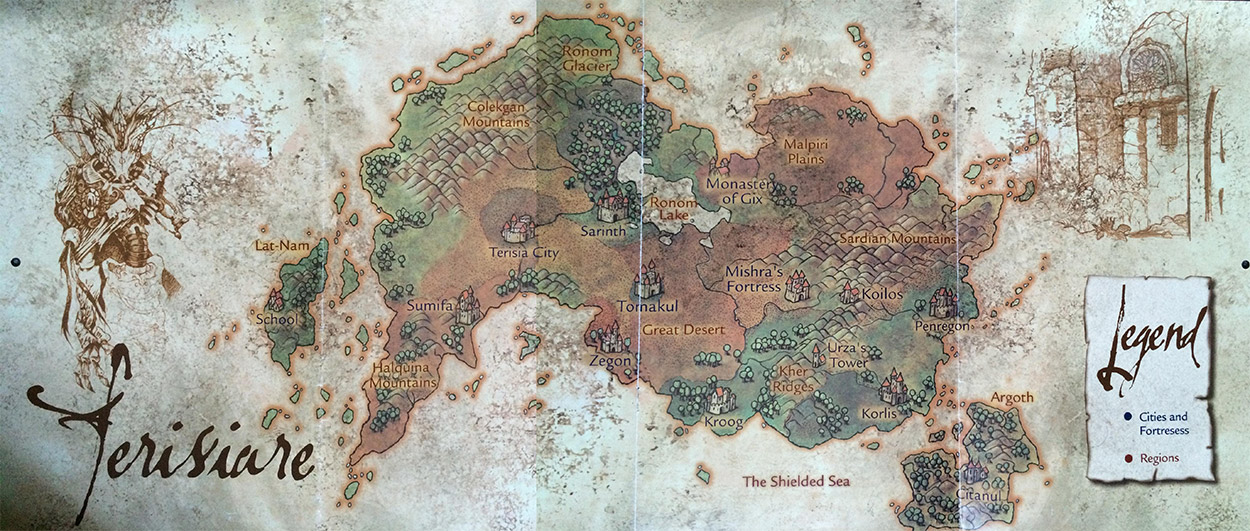
"The College of Lat-Nam is one of the reasons that we have so much information about Urza and Mishra and what was happening at the time. It was the very first college of magic on Terisiare and made great strides to understanding the nature of mana and how spellcasters used it. The college attempted to stay neutral during the conflict. In 45 AR, when it became obvious that Mishra was coming to destroy Terisia City, there was an organized evacuation via secret tunnels moving people - especially wizards and scholars - as well as records, relics, and artifacts, across the Lat-Nam Straits to the College, and thence to other islands and continents away from Terisiare and, hopefully, the brothers and their war-machines. The College's neutrality did not protect it; it was attacked and destroyed sometime between 46 and 54 AR, and we genuinely don't know which side did it. No records of the fall of the College exist, nor were there any survivors, and the site of the college itself was a desert of poisoned glass for four thousand years. What fragments of information scholars collected from the areas around the College say it was visited by 'terrible retribution', that it was 'laid to waste', and that 'all the knowledge of Lat-Nam could not protect its sages.'"
She paused and drank some more of her tea. Look, there was a lot to cover, okay?
"While millions of people died to Urza and Mishra's war machines and the battles between Yotia, the Fallaji, and every other country that got sucked into the war as it expanded, we believe that the civilian casualties were significantly higher. Both sides practiced absolute warfare, where the only acceptable victory is the complete annihilation of one's opponent, accomplished through the rapid and intense application of force and with no limits on potential targets, the appropriation of resources, or the potential damage and destruction on one's own side in the pursuit of complete victory. We know that in some areas, youths as young as thirteen, were conscripted into the armies of whoever held the territory at the time, regardless of gender. Famine ran rampant through the war, even affecting the soldiers of both armies. Neither Urza nor Mishra were content to simply burn the fields of their enemy - or their own fields to deny them to the enemy - they deliberately poisoned and ruined them so nothing could grow and any living creatures who existed on the land would sicken and die from the effects. They did the same to waterways, to deny water and potential transportation avenues. Whole areas that had been vital for feeding Terisiare were turned to dust or slagged from the attacks of the war machines. The Sword Marches, disputed territory that was the ostensible reason for the start of the war was reduced to blackened glass and was completely uninhabitable."
All this. Over. Godsdamned. Rocks.
"Furthermore, Mishra and Urza were not mages, they were artificers. They built things, which meant that they needed resources. The areas they didn't deliberately ruin to harm their enemies, they strip-mined for the wood or stone or anything else they needed. Urza and Mishra made the land itself a casualty of the war. All those forests on the map? They were gone by 55 AR. Completely gone. Nothing replanted for the future, just harvested and abandoned. Ronom Lake was so badly polluted that you were said to be able to walk from one side to the other on the bellies of the dead fish, and in the summer it stank so bad that it could be smelled as far as Tornakul. The air in the Sardian Mountains was said to be unbreathable on days there was no wind, as the mountains were plundered for their resources and turned into workshops cranking out war machines. Many of the people who didn't die of starvation or from violence died instead to the various diseases that sprang up in the wake of ecological devastation."
Honestly, it was a wonder there was anybody left on Terisiare by the time Urza used his ultimate weapon.
"Argoth is perhaps the perfect encapsulation of this," she continued. "Populated by elves, the druidic descendants of the few Thran refugees that made their way there after the fall of the Empire, and a semi-sentient forest, it was an unspoiled natural wonder. For all that it appears very close to Terisiare itself, it had managed to hide itself from the outside world for several thousands of years. Harbin, Urza's son, discovered it towards the end of the war when he crash landed there in a storm. Once he managed to repair his ornithopter, he rushed home to tell his father about the wealth of natural resources that he'd found. Urza immediately brought his side to Argoth to begin to harvest the resources. Mishra was not far behind, and began doing the same thing. The island's residents, including the very forests and the creatures that lived within them, spent six years attempting to repel both invaders from their shores. The destruction of the land drove the druids mad as it corrupted and broke their links with the forest.
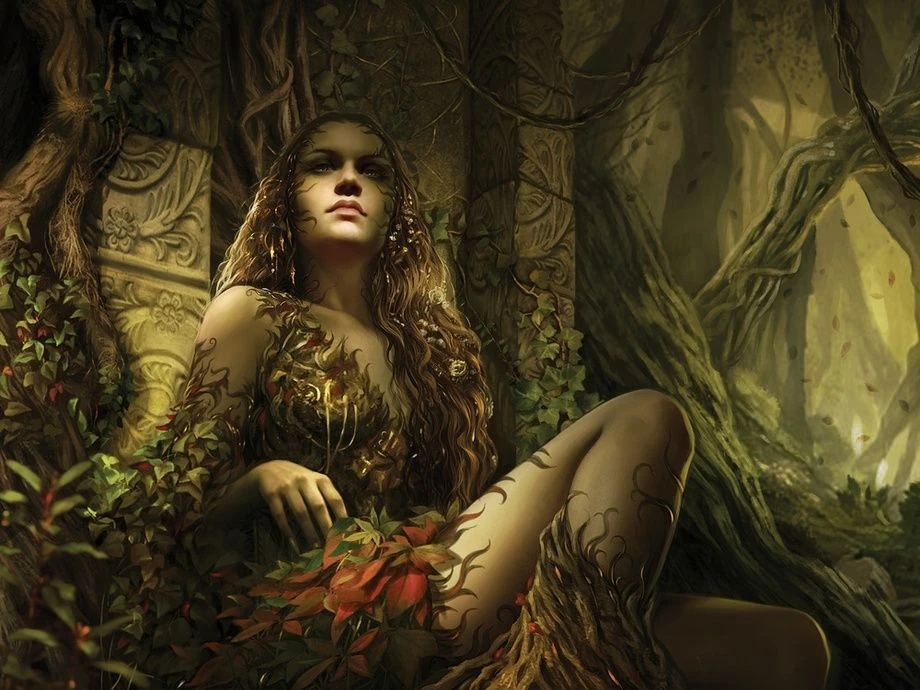
"Now, in Dominaria, every wood, from a sprawling forest or a shady grove, has a spirit or avatar that keeps the site safe: these creatures can be befriended with the right magic and are called maro. Sometimes, incredibly powerful elemental manifestations of the land can arise, either brought about by strong magic or of nature's own will. These are called Maro-Sorcerers and they are basically forces of nature with consciousness. Argoth's Maro-Sorcerer was named Titania. Both sides tried to convince her to side with them, but she refused to aid anyone who had harmed the forests of Argoth. After six years of devastation and depletion, however, she had weakened significantly, since her power was tied directly to the land. Urza, tired of Argoth's native peoples defending themselves and their land, sent his Colossus of Sardia after her during the Battle of Argoth. Titania, unable to fight the Colossus off in her weakened state, drew on the power of Gaea, Dominaria's Worldsoul, and became a living Avatar. Although this made her powerful enough to defeat the Colossus, it also drained the land's last remaining life, leading to the mass extinction of all but a small fraction of Argoth's natural lifeforms. And, as we will discuss next week, this mass extinction did not actually matter in the grand scheme of things."
Because...you guessed it! Urza!
Now she settled back to open the floor to any questions and comments folks might have, especially after throwing concepts like 'Worldsoul' and 'Maro-Sorcerer' out there.
Re: Listen to the Lecture