
http://stargazer-ellie.livejournal.com/ (![[identity profile]](https://www.dreamwidth.org/img/silk/identity/openid.png) stargazer-ellie.livejournal.com) wrote in
stargazer-ellie.livejournal.com) wrote in ![[community profile]](https://www.dreamwidth.org/img/silk/identity/community.png) fandomhigh2006-05-31 09:09 am
fandomhigh2006-05-31 09:09 am
stargazer-ellie.livejournal.com) wrote in fandomhigh2006-05-31 09:09 am


Entry tags:
Observational Astronomy -- May 31
Week 2 - The Zodiac: Gemini, Cancer, Leo, Virgo
Star maps: East | West | North | South | Overhead
Ellie waited at the main campfire again for the class to assemble, then led them down to the beach for observations.
"Tonight we're going to look at some of the constellations of the Zodiac. As the earth goes around the sun, the sun appears to move through the constellations. Theoretically there are twelve constellations through which the sun moves, one per month, and these are the Zodiac constellations. In reality there is a 13th constellation through which the sun passes, but Ophiuchus gets little credit for being in the Zodiac. Because the path of the sun is also the plane of our solar system, the planets are also found on or very close to this path as well, so the line along which the sun travels has its own special name -- it's called the "ecliptic."
"Now, astrology takes a different approach to the constellations of the Zodiac, using them to explain personality traits or to write horoscopes. There is a huge difference between astronomy and astrology: astronomy is the study and observation of celestial objects and their movements through space, astrology is the study of the supposed correlation of those objects with earthly affairs. Most astronomers will be annoyed if you ask them to write a horoscope!
"Look over to the west and see if you can spot two very bright stars below and to the right of the crescent moon. These are Castor and Pollux, the heads of the Gemini twins. According to mythology, the Gemini twins are only half-brothers. They share the same mother, Leda, but have different fathers. Castor's father was Tyndareus, a king of Sparta, and the father of Pollux was Zeus. Pollux, the brighter star, is on the left, and Castor is on the right.
"That really bright star at the horizon to the left of Pollux's feet is Procyon, the "Little Dog Star," which is a mere 12 light years away. It's the eighth brightest star in the sky, not counting the sun, of course. Procyon is part of the constellation Canis Minor, the Little Dog, which is just those two stars right there. The little dog belongs to Orion the great hunter, but we won't see that constellation until the fall.
"Due west, right where the moon is, is Cancer, the crab. The constellation is in the shape of a monster of crab crushed by Hercules. It's not a very noticable constellation, but if you look closely you can see a faint fuzzy spot in the middle of Cancer's shell, right below the moon. This is M44, the Beehive Cluster. Look at it through binoculars. Wow, huh? It's a cluster of stars 500 light years away. The Beehive Cluster is an open cluster, which means the stars in it were formed from the same molecular cloud.
"We will now return to the Big Dipper and follow the two stars at the back of the cup down, which will lead us to the star Regulus in the constellation Leo the Lion, which dominates the center of the spring sky. Leo is one of the most recognizable constellations in spring skies. See the stars that look like a backwards question mark? That's Leo's head, sometimes called "the Lion's sickle." According to Greek mythology, Leo is the Nemean Lion, which was killed by Heracles during one of his twelve labours, and subsequently put into the sky.
"Regulus is the brightest star in Leo and is sometimes known as the Heart of the Lion, or "Cor Leonis." If you can get the binoculars focused on this star you'll find a surprise waiting there for you, up and to the right -- a fainter, golden yellow star right next to the brilliant blue-white Regulus. The fainter star is in orbit about Regulus, and in fact that fainter star is really two stars, too close for us to resolve, a yellow dwarf and a red dwarf. So you are looking at a three-star system. That may seem weird to you, three stars locked in orbit together, but in fact three quarters of the stars you see up there have at least one, maybe two or more companions. So we're the weird ones, circling a single solitary star -- the sun.
"There are quite a few galaxies in Leo. You can look with the binoculars just south of Leo and see the very close pair of galaxies, M65 & M66. There is a third galaxy you can see with a telescope, NGC3628. These three galaxies are a well-known group called the Leo Trio, a true grouping, all about 30 million light years away.
"Now on to Virgo. If you look due south and up, you will see a very bright star, the 15th brightest star in the sky after the sun -- Spica, which is part of Virgo, the second largest constellation after Hydra. The constellation is very hard one to identify its shape because most of stars are fainter than third magnitude except Spica. It's positioned far away from the milky way, so you can observe lots of galaxies -- over two thousand are visible with medium-sized telescopes.
"Just who the virgin is is up for debate. One myth says that it's Astraea, the virgin daughter of the god Zeus and the goddess Themis. Astraea was known as the goddess of justice, and was identified as this constellation due to the presence of the scales of justice Libra nearby, and supposedly ruled the world at one point with her wise ways until mankind became so callous she returned to skies disgusted. She's also believed to be Persephone, Ishtar, Isis, Cybele, Mary, Mother of Jesus, Athena or Callisto.
"Spica means "ear of wheat," which is carried by the Virgo, and has an another name of "the pearl star" in Japan. Spica is 275 light years away and is more than two thousand times as bright as our sun. See how blue it is? That is the sign of a bright, fast-burning star.
"Even though it's ten times as massive as our sun, Spica will burn itself out in less than 5% of the time our sun will live, because it's burning its fuel up so fast. That means that this star was probably born around the time that dinosaurs appeared on earth, a cosmic blink of the eye ago, and will burn out in about that much time again. Meanwhile our sun, ten times smaller, and born five billion years ago, just keeps on burning. So it goes with stars - the bigger they are, the harder they fall.
"Any questions?"
Star maps: East | West | North | South | Overhead
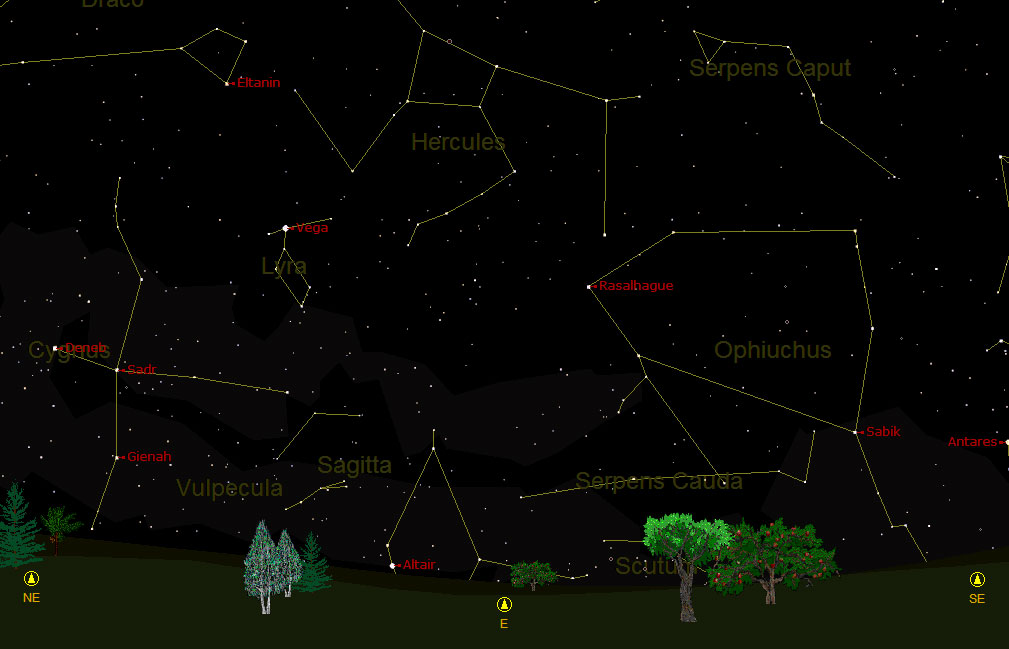
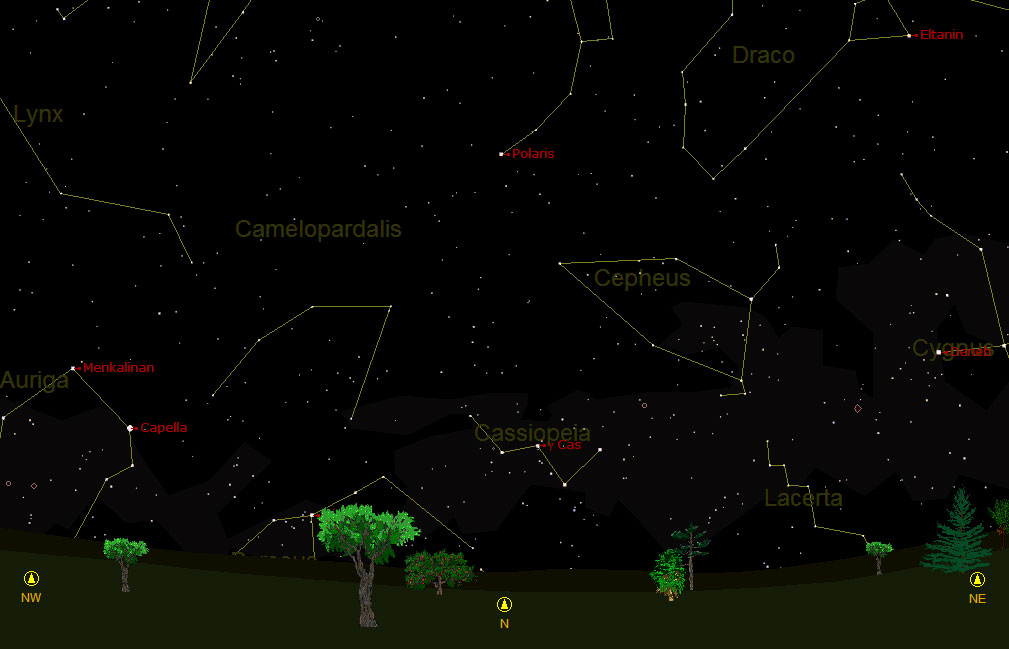

Ellie waited at the main campfire again for the class to assemble, then led them down to the beach for observations.
"Tonight we're going to look at some of the constellations of the Zodiac. As the earth goes around the sun, the sun appears to move through the constellations. Theoretically there are twelve constellations through which the sun moves, one per month, and these are the Zodiac constellations. In reality there is a 13th constellation through which the sun passes, but Ophiuchus gets little credit for being in the Zodiac. Because the path of the sun is also the plane of our solar system, the planets are also found on or very close to this path as well, so the line along which the sun travels has its own special name -- it's called the "ecliptic."
"Now, astrology takes a different approach to the constellations of the Zodiac, using them to explain personality traits or to write horoscopes. There is a huge difference between astronomy and astrology: astronomy is the study and observation of celestial objects and their movements through space, astrology is the study of the supposed correlation of those objects with earthly affairs. Most astronomers will be annoyed if you ask them to write a horoscope!
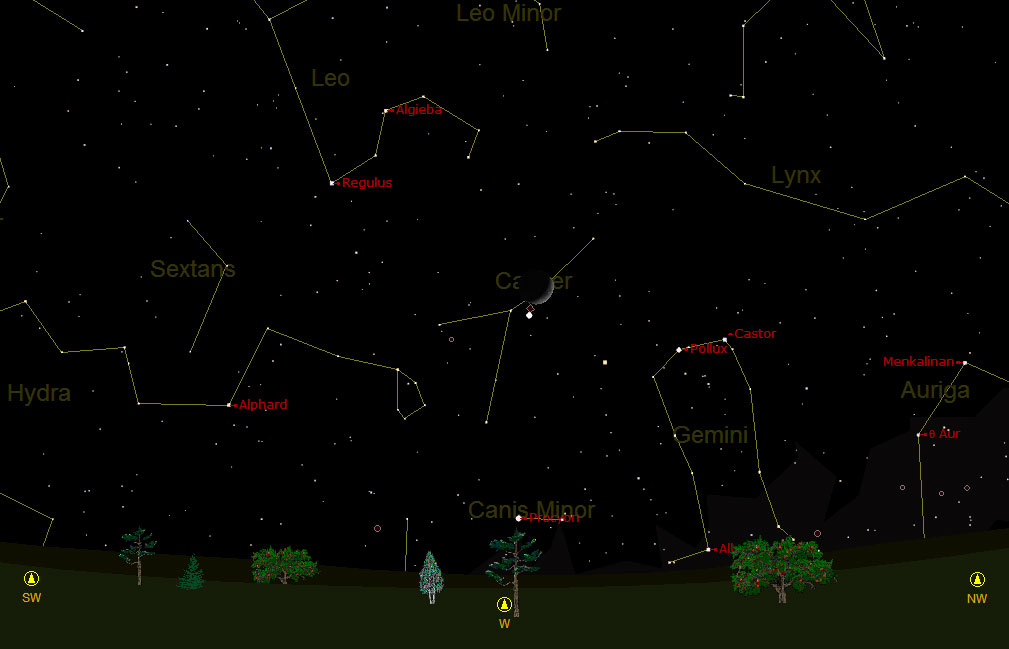
"Look over to the west and see if you can spot two very bright stars below and to the right of the crescent moon. These are Castor and Pollux, the heads of the Gemini twins. According to mythology, the Gemini twins are only half-brothers. They share the same mother, Leda, but have different fathers. Castor's father was Tyndareus, a king of Sparta, and the father of Pollux was Zeus. Pollux, the brighter star, is on the left, and Castor is on the right.
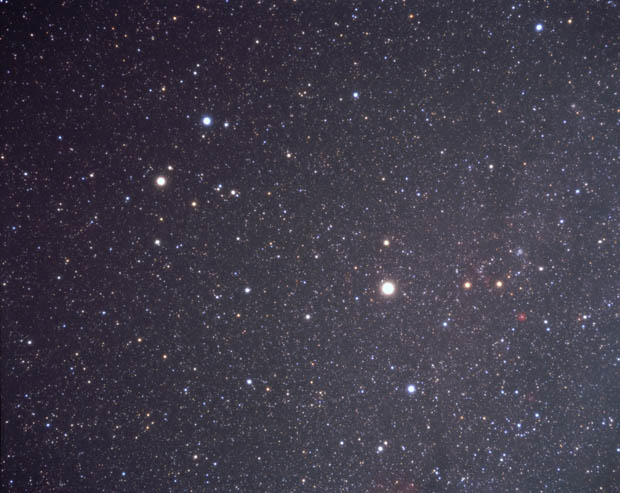
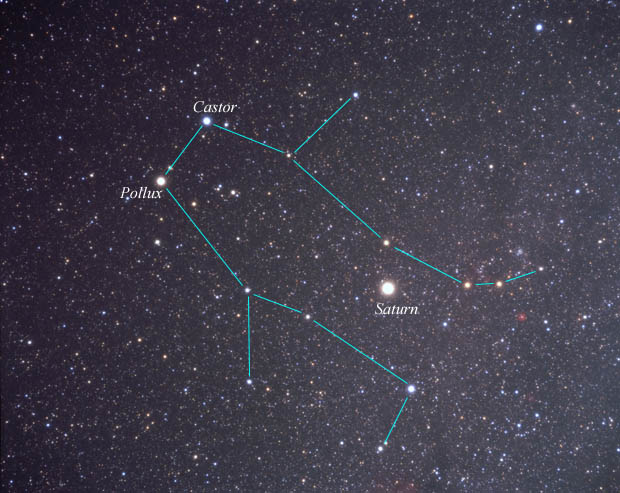
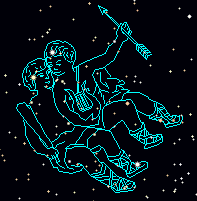
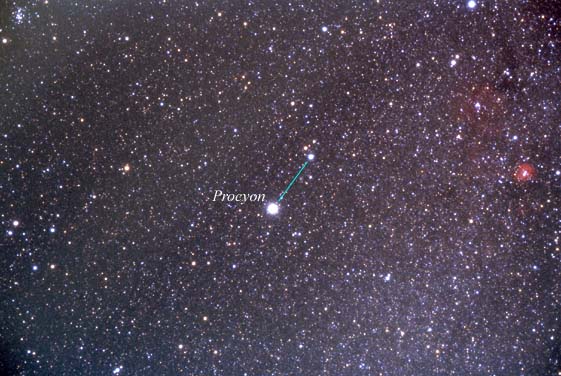
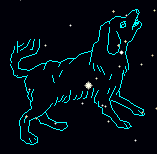
"That really bright star at the horizon to the left of Pollux's feet is Procyon, the "Little Dog Star," which is a mere 12 light years away. It's the eighth brightest star in the sky, not counting the sun, of course. Procyon is part of the constellation Canis Minor, the Little Dog, which is just those two stars right there. The little dog belongs to Orion the great hunter, but we won't see that constellation until the fall.

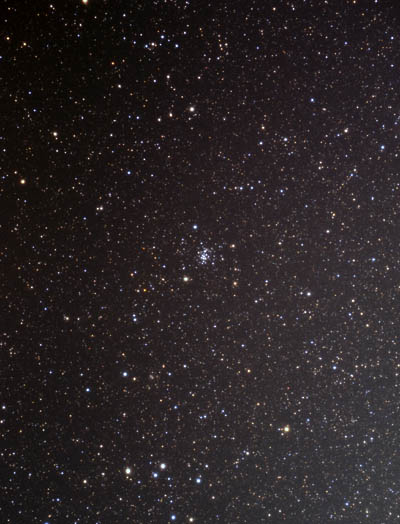
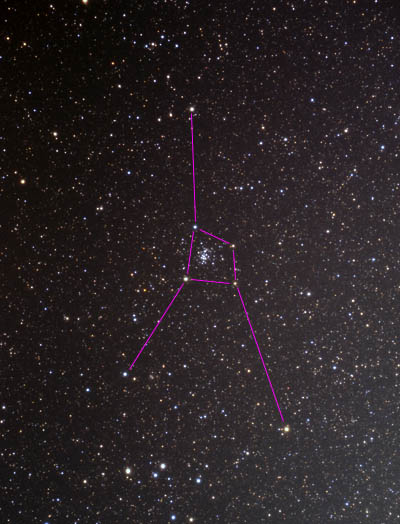
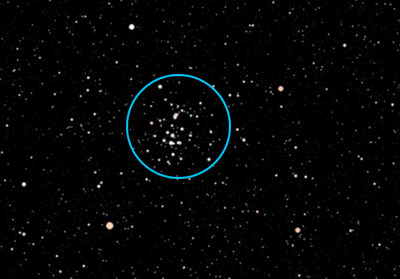
"Due west, right where the moon is, is Cancer, the crab. The constellation is in the shape of a monster of crab crushed by Hercules. It's not a very noticable constellation, but if you look closely you can see a faint fuzzy spot in the middle of Cancer's shell, right below the moon. This is M44, the Beehive Cluster. Look at it through binoculars. Wow, huh? It's a cluster of stars 500 light years away. The Beehive Cluster is an open cluster, which means the stars in it were formed from the same molecular cloud.

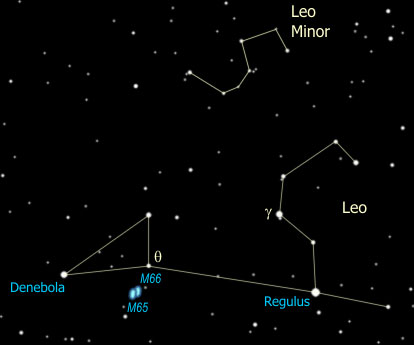
"We will now return to the Big Dipper and follow the two stars at the back of the cup down, which will lead us to the star Regulus in the constellation Leo the Lion, which dominates the center of the spring sky. Leo is one of the most recognizable constellations in spring skies. See the stars that look like a backwards question mark? That's Leo's head, sometimes called "the Lion's sickle." According to Greek mythology, Leo is the Nemean Lion, which was killed by Heracles during one of his twelve labours, and subsequently put into the sky.
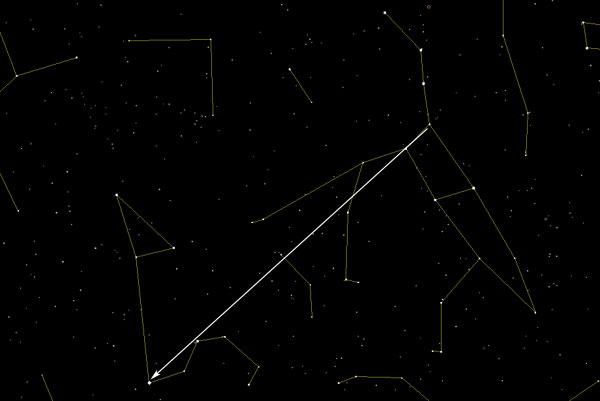
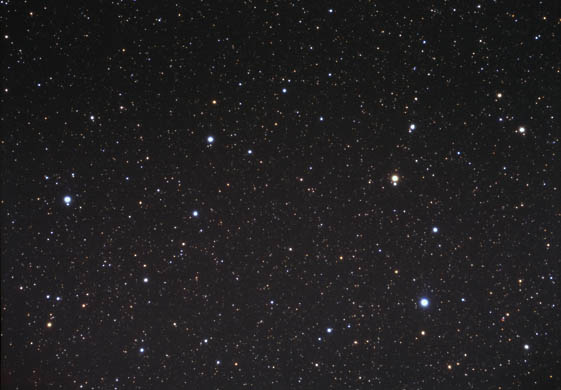

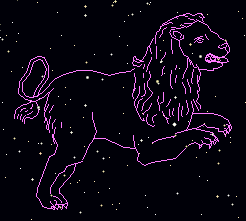
"Regulus is the brightest star in Leo and is sometimes known as the Heart of the Lion, or "Cor Leonis." If you can get the binoculars focused on this star you'll find a surprise waiting there for you, up and to the right -- a fainter, golden yellow star right next to the brilliant blue-white Regulus. The fainter star is in orbit about Regulus, and in fact that fainter star is really two stars, too close for us to resolve, a yellow dwarf and a red dwarf. So you are looking at a three-star system. That may seem weird to you, three stars locked in orbit together, but in fact three quarters of the stars you see up there have at least one, maybe two or more companions. So we're the weird ones, circling a single solitary star -- the sun.
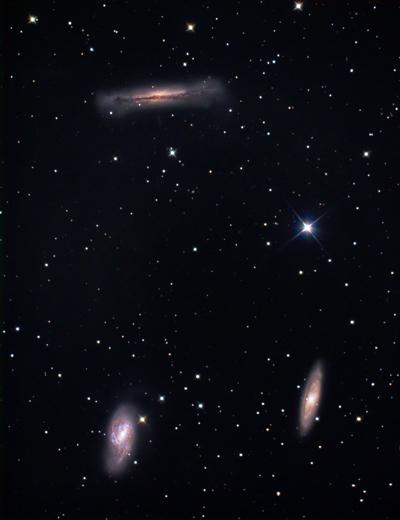
"There are quite a few galaxies in Leo. You can look with the binoculars just south of Leo and see the very close pair of galaxies, M65 & M66. There is a third galaxy you can see with a telescope, NGC3628. These three galaxies are a well-known group called the Leo Trio, a true grouping, all about 30 million light years away.
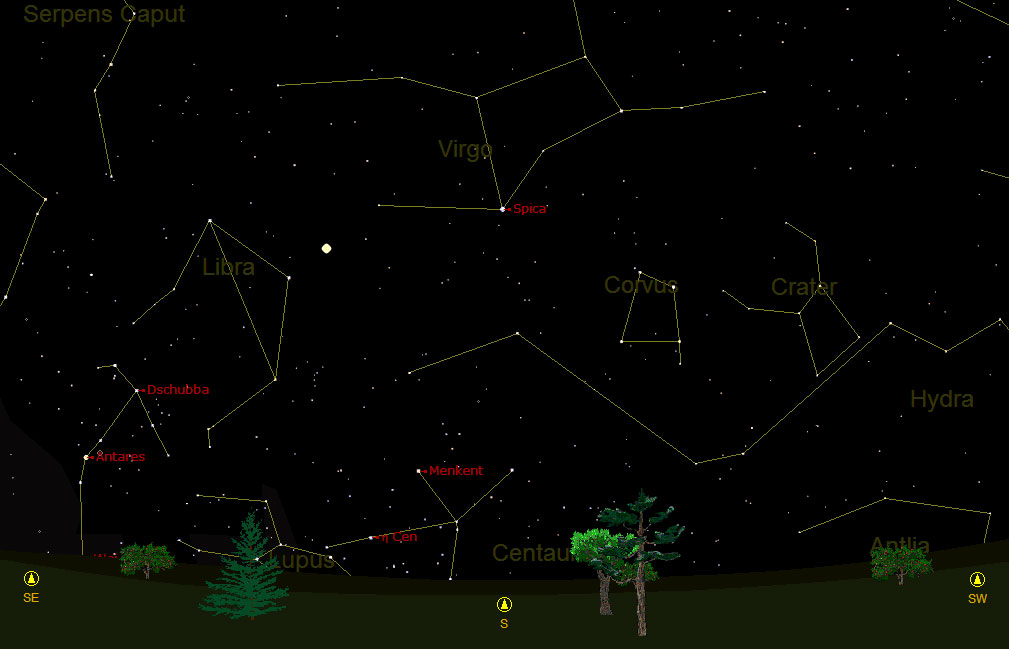
"Now on to Virgo. If you look due south and up, you will see a very bright star, the 15th brightest star in the sky after the sun -- Spica, which is part of Virgo, the second largest constellation after Hydra. The constellation is very hard one to identify its shape because most of stars are fainter than third magnitude except Spica. It's positioned far away from the milky way, so you can observe lots of galaxies -- over two thousand are visible with medium-sized telescopes.

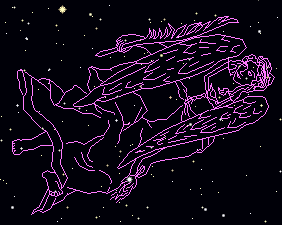
"Just who the virgin is is up for debate. One myth says that it's Astraea, the virgin daughter of the god Zeus and the goddess Themis. Astraea was known as the goddess of justice, and was identified as this constellation due to the presence of the scales of justice Libra nearby, and supposedly ruled the world at one point with her wise ways until mankind became so callous she returned to skies disgusted. She's also believed to be Persephone, Ishtar, Isis, Cybele, Mary, Mother of Jesus, Athena or Callisto.
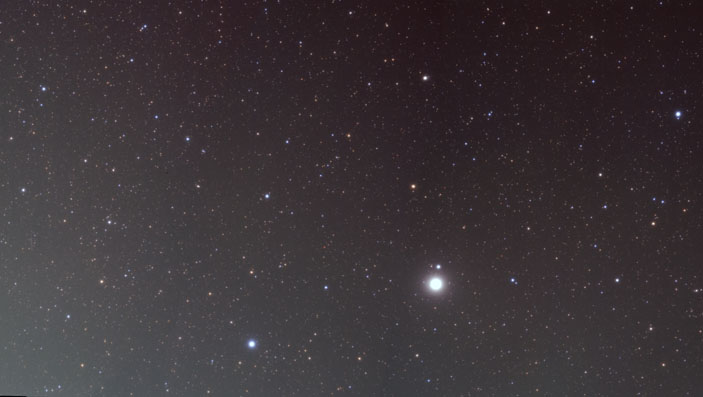
"Spica means "ear of wheat," which is carried by the Virgo, and has an another name of "the pearl star" in Japan. Spica is 275 light years away and is more than two thousand times as bright as our sun. See how blue it is? That is the sign of a bright, fast-burning star.
"Even though it's ten times as massive as our sun, Spica will burn itself out in less than 5% of the time our sun will live, because it's burning its fuel up so fast. That means that this star was probably born around the time that dinosaurs appeared on earth, a cosmic blink of the eye ago, and will burn out in about that much time again. Meanwhile our sun, ten times smaller, and born five billion years ago, just keeps on burning. So it goes with stars - the bigger they are, the harder they fall.
"Any questions?"
Sign In
Re: Sign In
Re: Sign In
Re: Sign In
Re: Sign In
Re: Sign In
Re: Sign In
Re: Sign In
Re: Sign In
Re: Sign In
Re: Sign In
Re: Sign In
Re: Sign In
Re: Sign In
Re: Sign In
Observe, talk amongst yourselves
Re: Observe, talk amongst yourselves
Re: Observe, talk amongst yourselves
Re: Observe, talk amongst yourselves
And how on earth had she forgotten how much she loved this?
Re: Observe, talk amongst yourselves
Re: Observe, talk amongst yourselves
Re: Observe, talk amongst yourselves
Re: Observe, talk amongst yourselves
Re: Observe, talk amongst yourselves
Re: Observe, talk amongst yourselves
So pretty...
Talk to Ellie
OOC
Re: OOC
Re: OOC
Re: OOC