
http://notsobadatall.livejournal.com/ (![[identity profile]](https://www.dreamwidth.org/img/silk/identity/openid.png) notsobadatall.livejournal.com) wrote in
notsobadatall.livejournal.com) wrote in ![[community profile]](https://www.dreamwidth.org/img/silk/identity/community.png) fandomhigh2009-10-07 10:40 am
fandomhigh2009-10-07 10:40 am
notsobadatall.livejournal.com) wrote in fandomhigh2009-10-07 10:40 am


Entry tags:
Art 101 - Wednesday, Period Four - 10/07
The classroom today was transformed into an african village, the soft sounds of a river flowing not far from it rushing in the background. There were trees, some plants, but the ground was hard and dry.
"Today, as you might have guessed," he said, standing out in the Danger Shop's sunlight quite happily, "we'll be covering African art. As a vast majority of African art is sculpture, I decided to skip the slide show and just program the objects right into the landscape. That does mean we'll be doing a bit of walking, however."
He gestured to the small path between the huts and started leading them along.
"Unfortunately, I'm generalizing when I say 'African' art. As many of you know, there are any number of different tribes, religions, civilizations, cultures... But I've only got one period, since this is a survey class, so please forgive me for it. Suffice to say if any of you are interested further in this subject, my office is always open." There was a small smile. "However, I'm in it on Wednesdays."
He kept walking.
"African art generally focuses on the human figure. This focus even influenced certain European artists, such as the Portuguese who traded for salt with certain cultures during the 15th century. The human figures can be just about anyone or anything, though there is also a number of items which deal with the combination of man and animal, or even the metamorphosis between them.
"As I said, they generally preferred sculpture and carving to flat surfaces, but it should be mentioned that most African art was to be used in performances or rituals of some kind as opposed to sitting static on display. African art predates most history; rock art found in the Sahara is over 6000 years old, in fact. Most people consider the oldest and best known African cultures to be the Egyptians, but considering material available, as well as the visibility of the culture, I thought this might be more interesting."
He finally pointed to one of the objects, a terracotta lifesized statue.
"The earliest sub-Saharan art comes from the Nok culture in Nigeria. As you can see, it is a human figure, though heavily abstracted. Most art found from this period is in pieces, and the focus is on human beings and animals, as said, with a focus on the abundance of nature."
He walked a little farther and pointed to a series of masks.
"Here you have some of the performance pieces I mentioned. Wooden masks were made for most ceremoniesand raising inconvenient zombies. Later on, during the 10th century, bronze working techniques allowed for the making of items like this vessel" he pointed across the way at a large bronze piece "from Igbo Ukwu."
Then he pointed beneath it.
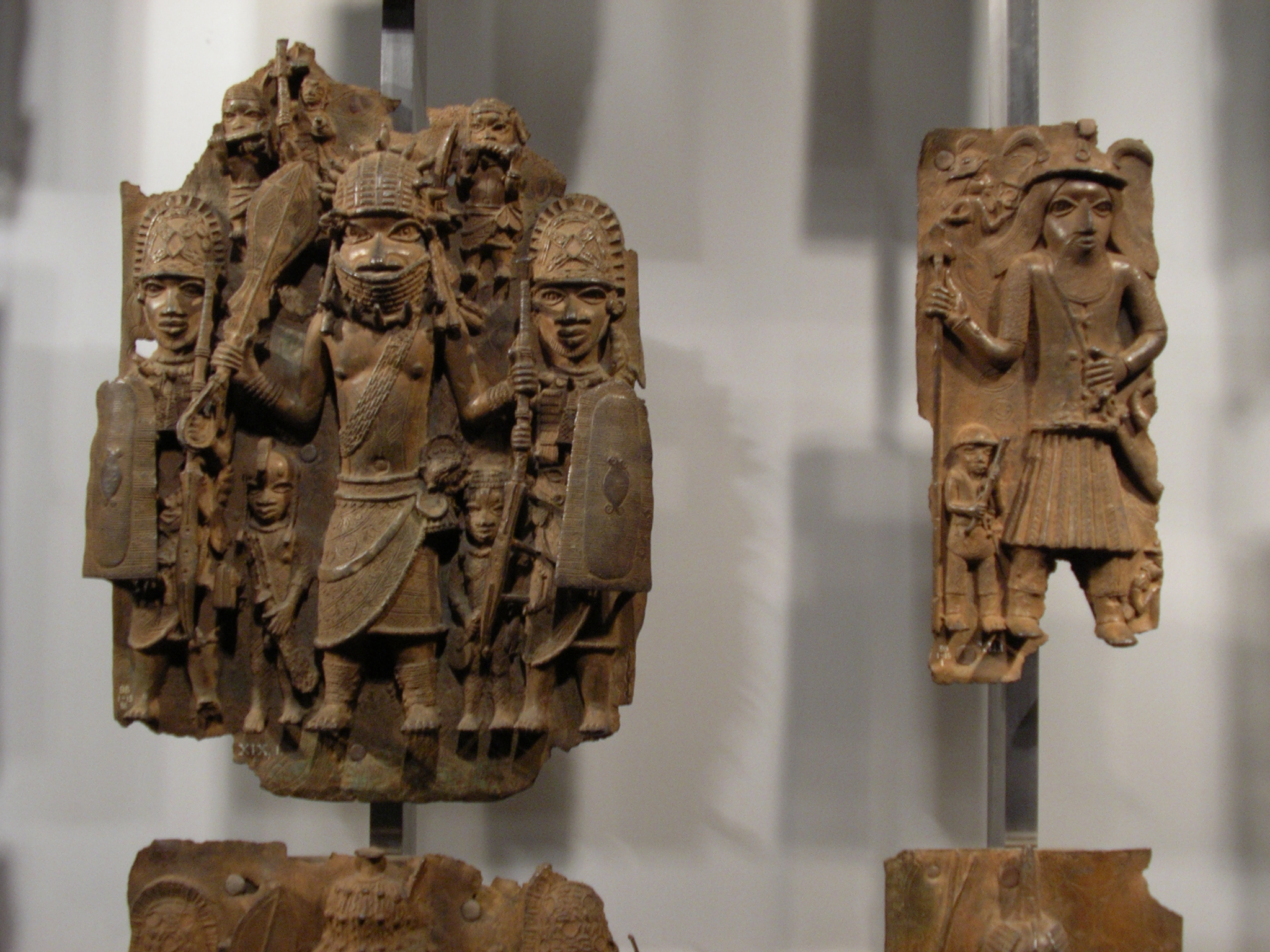
"Or the bronze cast of a Yoruba king from Ife." They kept walking and he kept talking. "Metal and ivory, as well as precious stones, were used to denote royalty. In some places, they were restricted to royalty, such as in Benin. Some of the most famous artwork are the Benin Bronzes, over 1000 plaques made for the palace of the King of Benin. A couple of examples are hanging right over there." More pointing, and he paused.
"Now, obviously none of you are going to make these items yourselves, and probably a few of you are wondering what this has to do with you. As artists, you should know that people like Picasso, Matisse, Vincent van Gogh, Paul Gauguin and Modigliani became aware of, and inspired by, African art early in the twentieth century. They weren't the only ones, though, as Antonio Sant'Elia, Le Corbusier, Pier Luigi Nervi, Theo Van Doesburg and Erich Mendelsohn, famous architects, also found something in the work of these cultures. Much of the geometrics and wall reliefs found in 50's design come from the kind of works I've just shown you. Most importantly, African art never established boundaries between body art, painting, sculpture and architecture and it is this lack of division which could be said to have changed entire established concepts in European art."
He breathed out.
"So, I've just yammered on for a bit," and that came with a smile, "so let me direct you to the supplies. They're in that hut there" and he pulled back a covering to show easels, sketchbooks, canvases... the works.
"Feel free to work in there, or to bring your supplies out and be inspired by the climate or the provided artwork. You know where to find me or Shilo if you need anything or if you have any questions. On anything.
"Begin."
[ocd up!]

"Today, as you might have guessed," he said, standing out in the Danger Shop's sunlight quite happily, "we'll be covering African art. As a vast majority of African art is sculpture, I decided to skip the slide show and just program the objects right into the landscape. That does mean we'll be doing a bit of walking, however."
He gestured to the small path between the huts and started leading them along.
"Unfortunately, I'm generalizing when I say 'African' art. As many of you know, there are any number of different tribes, religions, civilizations, cultures... But I've only got one period, since this is a survey class, so please forgive me for it. Suffice to say if any of you are interested further in this subject, my office is always open." There was a small smile. "However, I'm in it on Wednesdays."
He kept walking.
"African art generally focuses on the human figure. This focus even influenced certain European artists, such as the Portuguese who traded for salt with certain cultures during the 15th century. The human figures can be just about anyone or anything, though there is also a number of items which deal with the combination of man and animal, or even the metamorphosis between them.
"As I said, they generally preferred sculpture and carving to flat surfaces, but it should be mentioned that most African art was to be used in performances or rituals of some kind as opposed to sitting static on display. African art predates most history; rock art found in the Sahara is over 6000 years old, in fact. Most people consider the oldest and best known African cultures to be the Egyptians, but considering material available, as well as the visibility of the culture, I thought this might be more interesting."
He finally pointed to one of the objects, a terracotta lifesized statue.

"The earliest sub-Saharan art comes from the Nok culture in Nigeria. As you can see, it is a human figure, though heavily abstracted. Most art found from this period is in pieces, and the focus is on human beings and animals, as said, with a focus on the abundance of nature."
He walked a little farther and pointed to a series of masks.

"Here you have some of the performance pieces I mentioned. Wooden masks were made for most ceremonies

Then he pointed beneath it.
"Or the bronze cast of a Yoruba king from Ife." They kept walking and he kept talking. "Metal and ivory, as well as precious stones, were used to denote royalty. In some places, they were restricted to royalty, such as in Benin. Some of the most famous artwork are the Benin Bronzes, over 1000 plaques made for the palace of the King of Benin. A couple of examples are hanging right over there." More pointing, and he paused.

"Now, obviously none of you are going to make these items yourselves, and probably a few of you are wondering what this has to do with you. As artists, you should know that people like Picasso, Matisse, Vincent van Gogh, Paul Gauguin and Modigliani became aware of, and inspired by, African art early in the twentieth century. They weren't the only ones, though, as Antonio Sant'Elia, Le Corbusier, Pier Luigi Nervi, Theo Van Doesburg and Erich Mendelsohn, famous architects, also found something in the work of these cultures. Much of the geometrics and wall reliefs found in 50's design come from the kind of works I've just shown you. Most importantly, African art never established boundaries between body art, painting, sculpture and architecture and it is this lack of division which could be said to have changed entire established concepts in European art."
He breathed out.
"So, I've just yammered on for a bit," and that came with a smile, "so let me direct you to the supplies. They're in that hut there" and he pulled back a covering to show easels, sketchbooks, canvases... the works.
"Feel free to work in there, or to bring your supplies out and be inspired by the climate or the provided artwork. You know where to find me or Shilo if you need anything or if you have any questions. On anything.
"Begin."
[ocd up!]
Sign In
Re: Sign In
Re: Sign In
Re: Sign In
Re: Sign In
Re: Sign In
Re: Sign In
Listen to the lecture / Chat Amongst Yourselves
Re: Listen to the lecture / Chat Amongst Yourselves
Artistic Work
Re: Artistic Work
Re: Artistic Work
"Something the matter, Raven?"
Re: Artistic Work
Re: Artistic Work
Re: Artistic Work
Re: Artistic Work
"Then may I make a suggestion, Raven?"
Re: Artistic Work
Re: Artistic Work
*hides from the Cousins*"Draw his face, as you did, but change one feature. Change one feature every time you feel compelled to draw him until the face is entirely different. In this way, you take control of the image in your own mind. In this way," he told her with a soft smile, "even you won't remember what he quite looks like. And it's very hard to be haunted by something you can't remember."
Re: Artistic Work
Re: Artistic Work
"Anything else, Raven?"
Re: Artistic Work
Re: Artistic Work
"Yes. And it's worked for others I know."
Re: Artistic Work
Re: Artistic Work
One day she'd get good at it...
Really.
Re: Artistic Work
Re: Artistic Work
Re: Artistic Work
TA
Nick
OOC
Also, once more, office hours happily on request.
Re: OOC
Re: OOC