
http://stargazer-ellie.livejournal.com/ (![[identity profile]](https://www.dreamwidth.org/img/silk/identity/openid.png) stargazer-ellie.livejournal.com) wrote in
stargazer-ellie.livejournal.com) wrote in ![[community profile]](https://www.dreamwidth.org/img/silk/identity/community.png) fandomhigh2006-11-15 08:03 am
fandomhigh2006-11-15 08:03 am
stargazer-ellie.livejournal.com) wrote in fandomhigh2006-11-15 08:03 am


Entry tags:
Astronomy 101: Moons and Planets - Class 10
Week 10 -- November 15: Neptune, the blue world
Syllabus | Class Roster
Handouts:
Starmaps: North | South | East | West | Overhead
Surprise, surprise, it's more Holst playing today, "Neptune, the Mystic." Ellie waited until everyone took their seats and began the lecture. "Neptune is the eighth and outermost planet in our solar system. It is the fourth-largest planet by diameter and the third-largest by mass; Neptune is 17 times the mass of Earth and is slightly more massive than its near twin Uranus which is 14 Earth Masses, but slightly smaller due to its higher density. The planet is named after the Roman god of the sea.
"Neptune's atmosphere is primarily composed of hydrogen and helium, with traces of methane that account for the planet's blue appearance. Neptune's blue colour is much more vivid than that of Uranus, which has a similar amount of methane, so an unknown component is presumed to cause Neptune's intense color. Neptune also has the strongest winds of any planet in the solar system, with estimates as high as 2,500 km/h or 1,500 mph. At the time of the 1989 Voyager 2 flyby, it had in its southern hemisphere a Great Dark Spot comparable to the Great Red Spot on Jupiter. Neptune's temperature at its cloud tops is usually close to -346°F, one of the coldest in the solar system, due to its long distance from the sun. Neptune's center is about 13,000°F, however, hotter than the sun's surface. This is due to extremely hot gases and rock in the center.
"Discovered on September 23, 1846, Neptune is notable for being the first planet discovered based on mathematical prediction rather than regular observations. Perturbations in the orbit of Uranus led astronomers to deduce Neptune's existence. It has been visited by only one spacecraft, Voyager 2, which flew by the planet on August 25, 1989."
After Ellie finished up the lecture, she said, "Now, for those of you who did not give presentations last week -- that would be all but two of you -- this is your last chance to do so, or you'll get a 0 for that part of the course."
Syllabus | Class Roster
Handouts:
Starmaps: North | South | East | West | Overhead
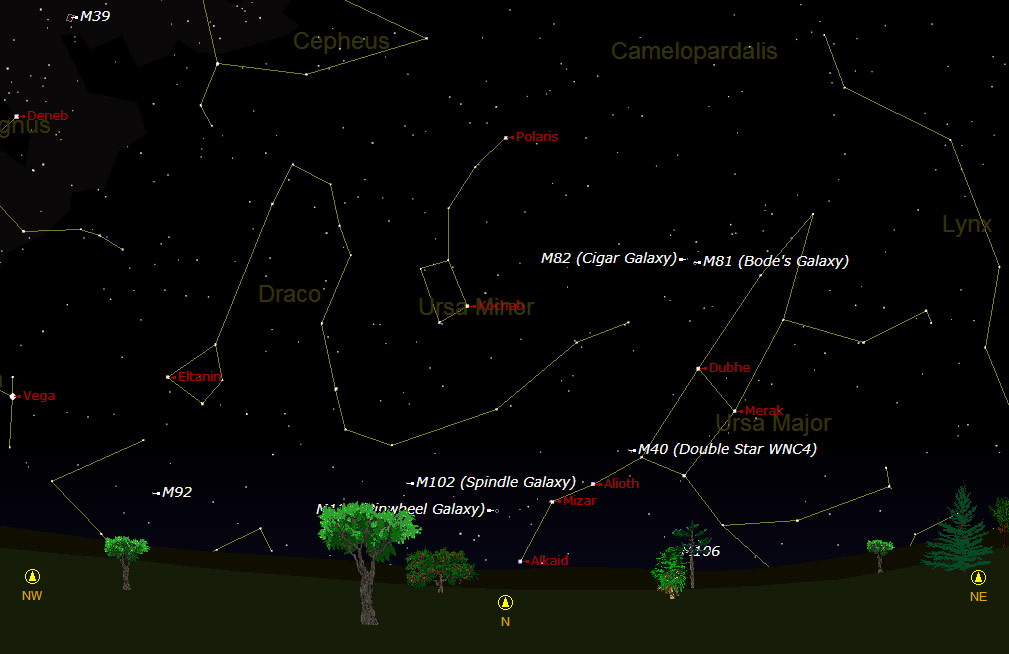
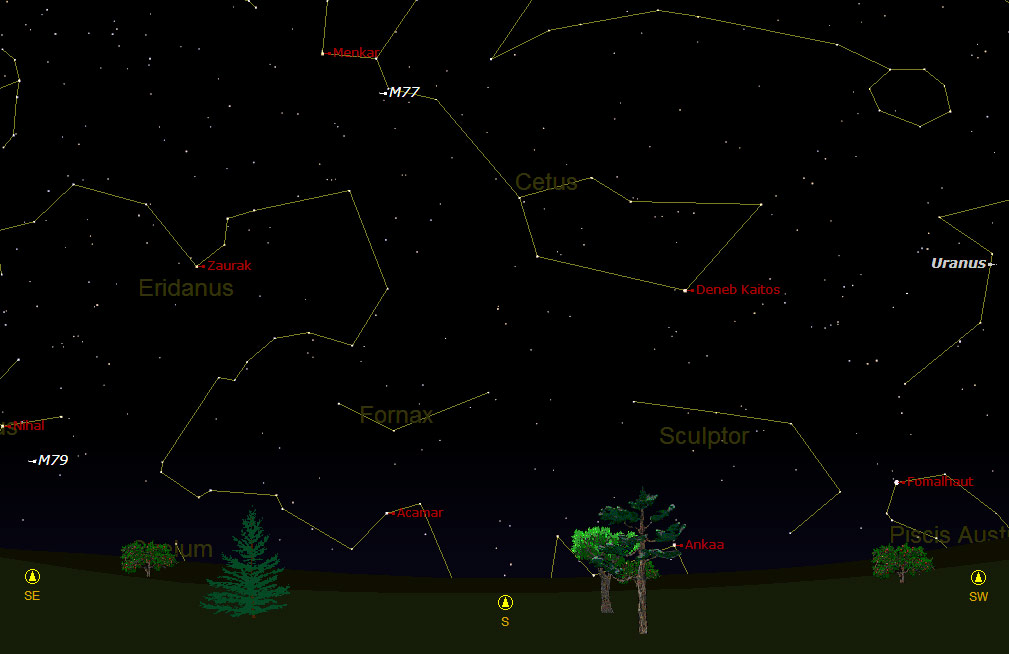
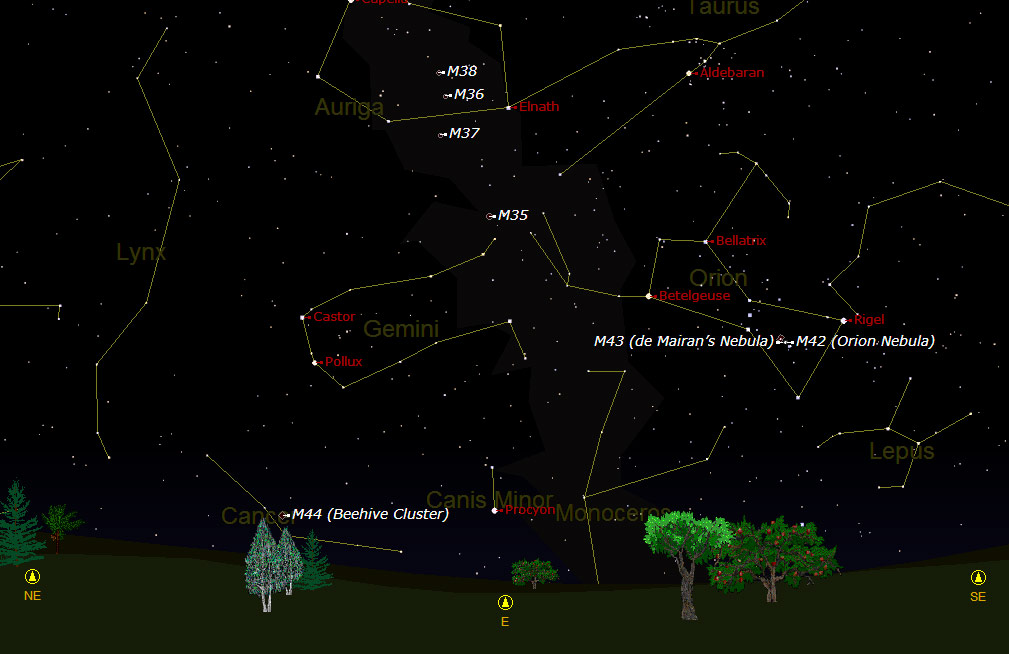
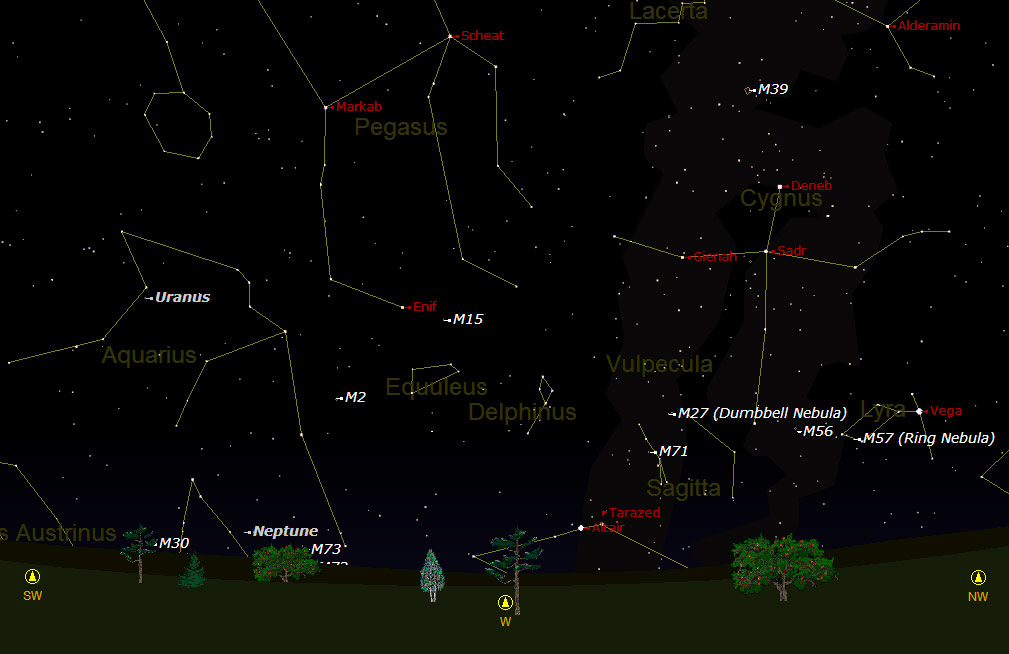

Surprise, surprise, it's more Holst playing today, "Neptune, the Mystic." Ellie waited until everyone took their seats and began the lecture. "Neptune is the eighth and outermost planet in our solar system. It is the fourth-largest planet by diameter and the third-largest by mass; Neptune is 17 times the mass of Earth and is slightly more massive than its near twin Uranus which is 14 Earth Masses, but slightly smaller due to its higher density. The planet is named after the Roman god of the sea.
"Neptune's atmosphere is primarily composed of hydrogen and helium, with traces of methane that account for the planet's blue appearance. Neptune's blue colour is much more vivid than that of Uranus, which has a similar amount of methane, so an unknown component is presumed to cause Neptune's intense color. Neptune also has the strongest winds of any planet in the solar system, with estimates as high as 2,500 km/h or 1,500 mph. At the time of the 1989 Voyager 2 flyby, it had in its southern hemisphere a Great Dark Spot comparable to the Great Red Spot on Jupiter. Neptune's temperature at its cloud tops is usually close to -346°F, one of the coldest in the solar system, due to its long distance from the sun. Neptune's center is about 13,000°F, however, hotter than the sun's surface. This is due to extremely hot gases and rock in the center.
"Discovered on September 23, 1846, Neptune is notable for being the first planet discovered based on mathematical prediction rather than regular observations. Perturbations in the orbit of Uranus led astronomers to deduce Neptune's existence. It has been visited by only one spacecraft, Voyager 2, which flew by the planet on August 25, 1989."
After Ellie finished up the lecture, she said, "Now, for those of you who did not give presentations last week -- that would be all but two of you -- this is your last chance to do so, or you'll get a 0 for that part of the course."
Sign In
Re: Sign In
Re: Sign In
Re: Sign In
Re: Sign In
Re: Sign In
Re: Sign In
Re: Sign In
Re: Sign In
Re: Sign In
Re: Sign In
During the lecture
Re: During the lecture
Re: During the lecture
Re: During the lecture
Re: During the lecture
He didn't even think to ask Professor Arroway about the giraffes being from Neptune.
Re: During the lecture
Presentations
Re: Presentations
Re: Presentations
Re: Presentations
And the strange fact that Luke's home had no jello. Poor guy.
Re: Presentations
Re: Presentations
Re: Presentations
Re: Presentations
Talk to Ellie
OOC