
http://stargazer-ellie.livejournal.com/ (![[identity profile]](https://www.dreamwidth.org/img/silk/identity/openid.png) stargazer-ellie.livejournal.com) wrote in
stargazer-ellie.livejournal.com) wrote in ![[community profile]](https://www.dreamwidth.org/img/silk/identity/community.png) fandomhigh2006-11-08 07:53 am
fandomhigh2006-11-08 07:53 am
stargazer-ellie.livejournal.com) wrote in fandomhigh2006-11-08 07:53 am


Entry tags:
Astronomy 101: Moons and Planets - Class 9
Week 9 -- November 8: Uranus, the tilted world
Syllabus | Class Roster
Handouts:
Starmaps: North | South | East | West | Overhead
"Good afternoon," Ellie said cheerfully, as the music of Holst's "Uranus - the Magician" played softly. "Your midterm projects are due today. You were to conduct an interview with a student from a planet other than Earth, and I'd like you to present a few facts you learned." She peered around the class. "For those of you who I'm sure have forgotten this, I can be convinced to give you an extension.
"I'll keep the lecture short so we can hear your presentations. Today we're going to learn about Uranus. Stop snickering. Uranus is the seventh planet from the Sun. It is a gas giant, the third largest by diameter and fourth largest by mass. It is named after Uranus, the Greek god of the sky and progenitor of the other gods.
"NASA's Voyager 2 is the only spacecraft to have visited the planet and no other visits are currently planned. Launched in 1977, Voyager 2 made its closest approach to Uranus on January 24, 1986, before continuing its journey to Neptune.
"Uranus is the first planet discovered in modern times. Sir William Herschel formally discovered the planet on March 13, 1781; the other planets (from Mercury out to Saturn) have been known since ancient times, and Uranus' discovery expanded the boundaries of the solar system for the first time in modern human history. It was also the first planet discovered using technology (a telescope) rather than the naked eye.
"Uranus is composed primarily of gas and various ices. The atmosphere is about 83% hydrogen, 15% helium, 2% methane and traces of acetylene. The interior is richer in heavier elements, most likely compounds of oxygen, carbon, and nitrogen, as well as rocky materials. This is in contrast to Jupiter and Saturn which are mostly hydrogen and helium. Uranus (like Neptune) is very much similar to the cores of Jupiter and Saturn without the massive fluid metallic hydrogen envelope. Uranus' cyan color is due to the absorption of red light by atmospheric methane. Surface temperature on Uranus's cloud cover is approximately 55 K (-218 °C or -360 °F).
"One of the most distinctive features of Uranus is its axial tilt of ninety-eight degrees. Consequently, for part of its orbit one pole faces the Sun continually while the other pole faces away. At the other side of Uranus' orbit the orientation of the poles towards the Sun is reversed. Between these two extremes of its orbit the Sun rises and sets around the equator normally."
Ellie went on for a little while longer, then stopped. "Now, for those of you who are prepared, I'd like to hear a little bit about what you learned about life on other planets."
Syllabus | Class Roster
Handouts:
Starmaps: North | South | East | West | Overhead
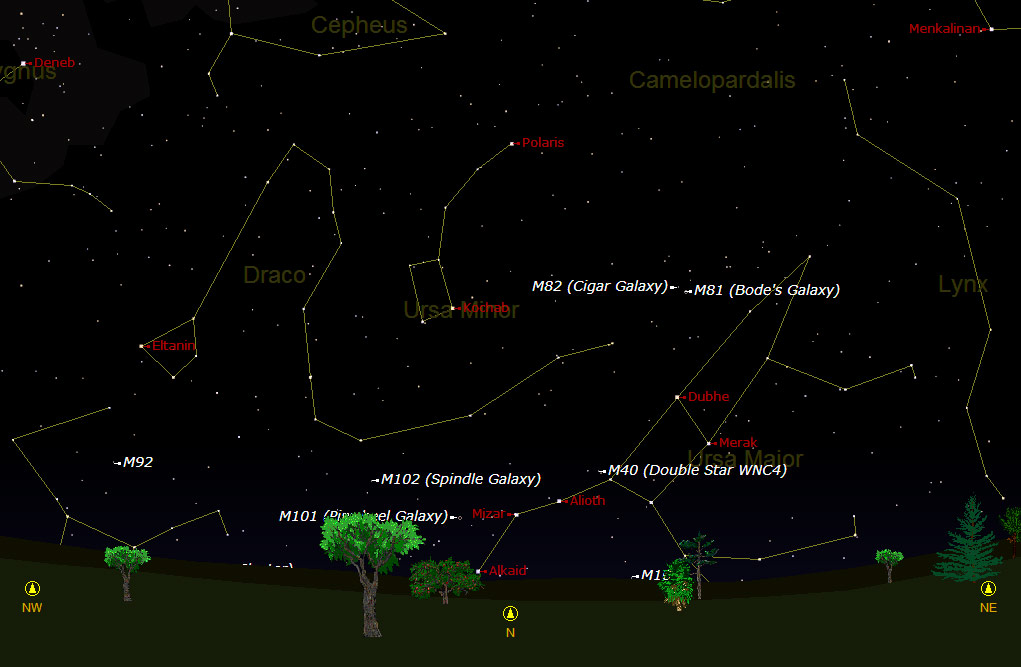
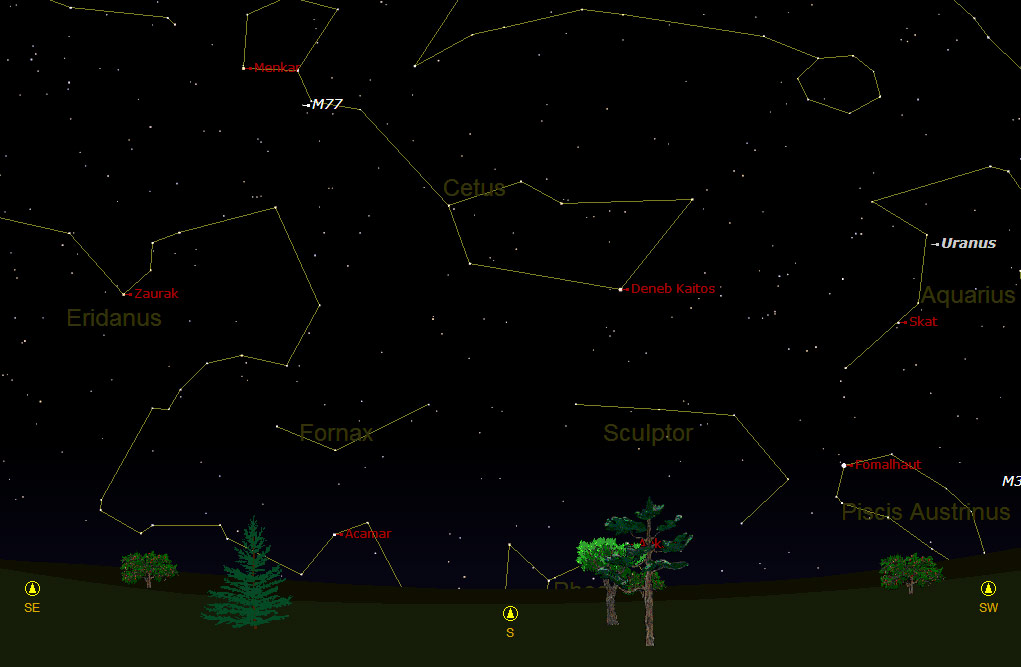
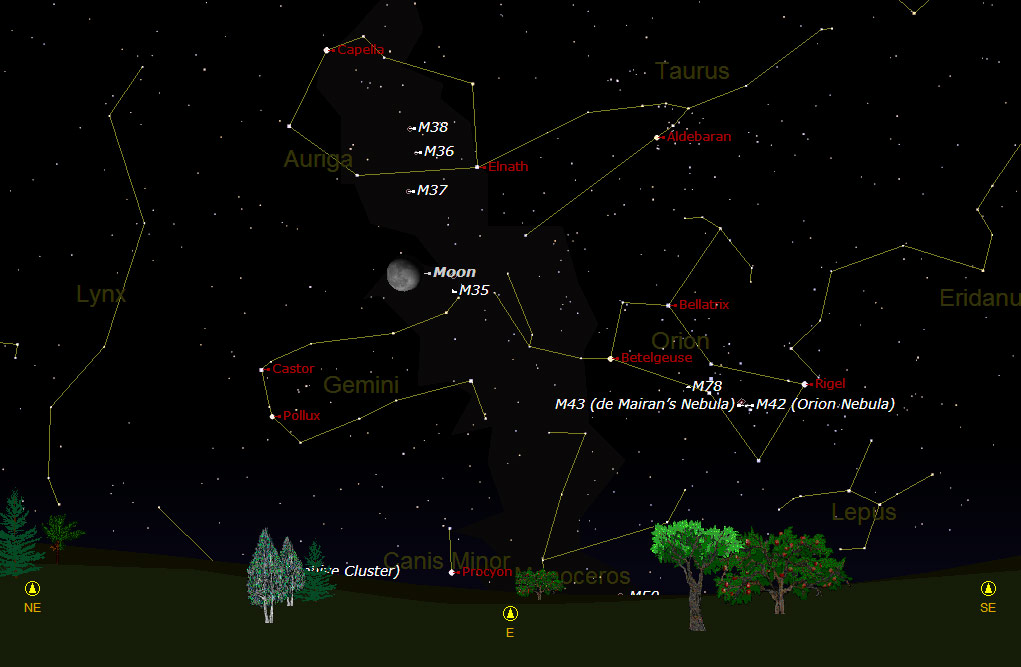


"Good afternoon," Ellie said cheerfully, as the music of Holst's "Uranus - the Magician" played softly. "Your midterm projects are due today. You were to conduct an interview with a student from a planet other than Earth, and I'd like you to present a few facts you learned." She peered around the class. "For those of you who I'm sure have forgotten this, I can be convinced to give you an extension.
"I'll keep the lecture short so we can hear your presentations. Today we're going to learn about Uranus. Stop snickering. Uranus is the seventh planet from the Sun. It is a gas giant, the third largest by diameter and fourth largest by mass. It is named after Uranus, the Greek god of the sky and progenitor of the other gods.
"NASA's Voyager 2 is the only spacecraft to have visited the planet and no other visits are currently planned. Launched in 1977, Voyager 2 made its closest approach to Uranus on January 24, 1986, before continuing its journey to Neptune.
"Uranus is the first planet discovered in modern times. Sir William Herschel formally discovered the planet on March 13, 1781; the other planets (from Mercury out to Saturn) have been known since ancient times, and Uranus' discovery expanded the boundaries of the solar system for the first time in modern human history. It was also the first planet discovered using technology (a telescope) rather than the naked eye.
"Uranus is composed primarily of gas and various ices. The atmosphere is about 83% hydrogen, 15% helium, 2% methane and traces of acetylene. The interior is richer in heavier elements, most likely compounds of oxygen, carbon, and nitrogen, as well as rocky materials. This is in contrast to Jupiter and Saturn which are mostly hydrogen and helium. Uranus (like Neptune) is very much similar to the cores of Jupiter and Saturn without the massive fluid metallic hydrogen envelope. Uranus' cyan color is due to the absorption of red light by atmospheric methane. Surface temperature on Uranus's cloud cover is approximately 55 K (-218 °C or -360 °F).
"One of the most distinctive features of Uranus is its axial tilt of ninety-eight degrees. Consequently, for part of its orbit one pole faces the Sun continually while the other pole faces away. At the other side of Uranus' orbit the orientation of the poles towards the Sun is reversed. Between these two extremes of its orbit the Sun rises and sets around the equator normally."
Ellie went on for a little while longer, then stopped. "Now, for those of you who are prepared, I'd like to hear a little bit about what you learned about life on other planets."
Sign In
Re: Sign In
Re: Sign In
Re: Sign In
Re: Sign In
on time for once!Re: Sign In
Re: Sign In
Re: Sign In
Re: Sign In
Re: Sign In
During the lecture
Re: During the lecture
He fidgets while he inwardly flails and is tapping his pen against the edge of his paper repeatedly.
Re: During the lecture
He wondered if he could try talking about Earth as an alien planet. It was technically true.
Re: During the lecture
She wondered if Zuko's world counted since she knew a lot about that now.
Re: During the lecture
Re: During the lecture
Presentation
Re: Presentation
Re: Presentation
Talk to Ellie
OOC