
http://takesaftermom.livejournal.com/ (![[identity profile]](https://www.dreamwidth.org/img/silk/identity/openid.png) takesaftermom.livejournal.com) wrote in
takesaftermom.livejournal.com) wrote in ![[community profile]](https://www.dreamwidth.org/img/silk/identity/community.png) fandomhigh2010-11-04 01:26 pm
fandomhigh2010-11-04 01:26 pm
takesaftermom.livejournal.com) wrote in fandomhigh2010-11-04 01:26 pm


Entry tags:
Famous Shipwrecks of the Deep [Thursday, Period One, 11/4]
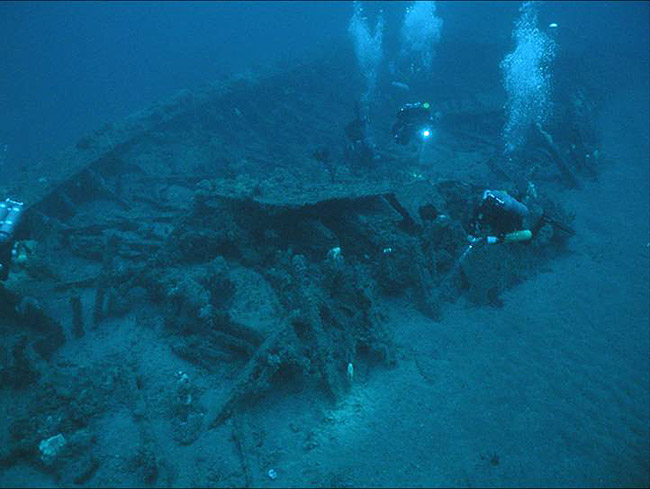
Upon entering, the students would find Summer positioned behind a projector at the back of the classroom and a picture displayed on the board in front. They'd also find leftover Halloween candy on their desks, and were welcome to take it or leave it. Summer had more than enough to go around.
She waited for for her students to get settled before she started the day's lecture.
"When John Ericsson conceived his 'impregnable battery', he had no idea that it would still be fighting battles a hundred years after his death. In the mid nineteenth century he struggled to have his concepts approved by distinguished industrialists mired in the past. But then came the War between the States, and with war always comes technological advancement and the adoption of previously unacceptable innovations," Summer began. "Word arrived in Washington that the South was building an ironclad ram that could destroy the Union fleet single-handedly. Unwittingly, the CSS Virginia (ex-USS Merrimack) provided the impetus to goad reluctant Northern politicians into funding the construction of an ironclad opponent. Thus the Monitor came into being."
Summer paused, switching to another picture before continuing with her lecture.
"Then came the battle that forever changed the way naval strategists viewed warship design and ship-to-ship engagement. The Monitor and the Virginia fought to a standstill, neither ship inflicting significant damage upon the other. Each was invulnerable to the other and to land-based batteries. Nevertheless, by the end of that year (1862) both ironclads were gone: the Virginia was blown up by her crew to prevent capture, the Monitor foundered in a gale off Cape Hatteras, North Carolina."
"She was highly unseaworthy in rough waters, hence her sinking during a gale. Sixteen of her sixty-two crewmen were lost. She was re-discovered in 1973 and her wreck site was designated as the first U.S. Marine sanctuary. There are a total of only thirteen to this day."
[Wait for the OCD Have at it!]
[Syllabus | Class Roster]
She waited for for her students to get settled before she started the day's lecture.
"When John Ericsson conceived his 'impregnable battery', he had no idea that it would still be fighting battles a hundred years after his death. In the mid nineteenth century he struggled to have his concepts approved by distinguished industrialists mired in the past. But then came the War between the States, and with war always comes technological advancement and the adoption of previously unacceptable innovations," Summer began. "Word arrived in Washington that the South was building an ironclad ram that could destroy the Union fleet single-handedly. Unwittingly, the CSS Virginia (ex-USS Merrimack) provided the impetus to goad reluctant Northern politicians into funding the construction of an ironclad opponent. Thus the Monitor came into being."
Summer paused, switching to another picture before continuing with her lecture.

"Then came the battle that forever changed the way naval strategists viewed warship design and ship-to-ship engagement. The Monitor and the Virginia fought to a standstill, neither ship inflicting significant damage upon the other. Each was invulnerable to the other and to land-based batteries. Nevertheless, by the end of that year (1862) both ironclads were gone: the Virginia was blown up by her crew to prevent capture, the Monitor foundered in a gale off Cape Hatteras, North Carolina."
"She was highly unseaworthy in rough waters, hence her sinking during a gale. Sixteen of her sixty-two crewmen were lost. She was re-discovered in 1973 and her wreck site was designated as the first U.S. Marine sanctuary. There are a total of only thirteen to this day."
[
[Syllabus | Class Roster]